How Much Does Radon Mitigation Cost in New Jersey? What New Homeowners Should Expect
If you’ve tested your new New Jersey home for radon and the results came back at or above 4 picocuries per liter — the EPA’s action level — your next question is almost certainly: what is this going to cost me? It’s a reasonable question, and the answer is more straightforward than most homeowners expect. Radon mitigation in New Jersey is not the open-ended, unpredictable expense that some home improvement projects turn into. It’s a well-defined process with a fairly consistent price range, and understanding what drives the cost up or down helps you evaluate quotes, ask the right questions, and make a confident decision.
This guide covers what radon mitigation typically costs in New Jersey, what factors affect the price, what’s included in a professional installation, what to watch out for when comparing contractors, and how to think about the cost relative to the value of what you’re getting.
The Baseline: What Most NJ Homeowners Pay for Radon Mitigation
For a standard single-family home in New Jersey with a basement or slab foundation, radon mitigation through sub-slab depressurization — the most common and most effective method — typically costs between $800 and $2,500. The majority of straightforward installations fall in the $1,000 to $1,800 range. More complex homes, homes requiring multiple suction points, or homes with unusual foundation configurations can push the cost higher, but for a typical NJ colonial, split-level, or ranch on a slab or poured concrete basement, the $1,000 to $1,800 window is a reasonable expectation.
These figures reflect professional installation by a certified radon mitigation contractor, including all labor, materials, the radon fan, PVC piping, exterior penetrations, electrical connection for the fan, and a post-mitigation test to verify the system is working. They do not include the initial radon test that identified the problem — that’s a separate cost typically ranging from $15 for a DIY charcoal canister kit to $150 or more for a professionally conducted test with a certified measurement specialist.
Compared to many home improvement projects, radon mitigation is relatively affordable for what it delivers. You’re not talking about a $10,000 HVAC replacement or a $20,000 roof. You’re talking about a permanent, low-maintenance system that protects the health of everyone in your household for the life of the home.
What Factors Affect the Cost
Within the $800 to $2,500 range, several variables push a specific project toward the lower or higher end. Understanding them helps you anticipate where your home might fall before you get your first quote.
Foundation Type
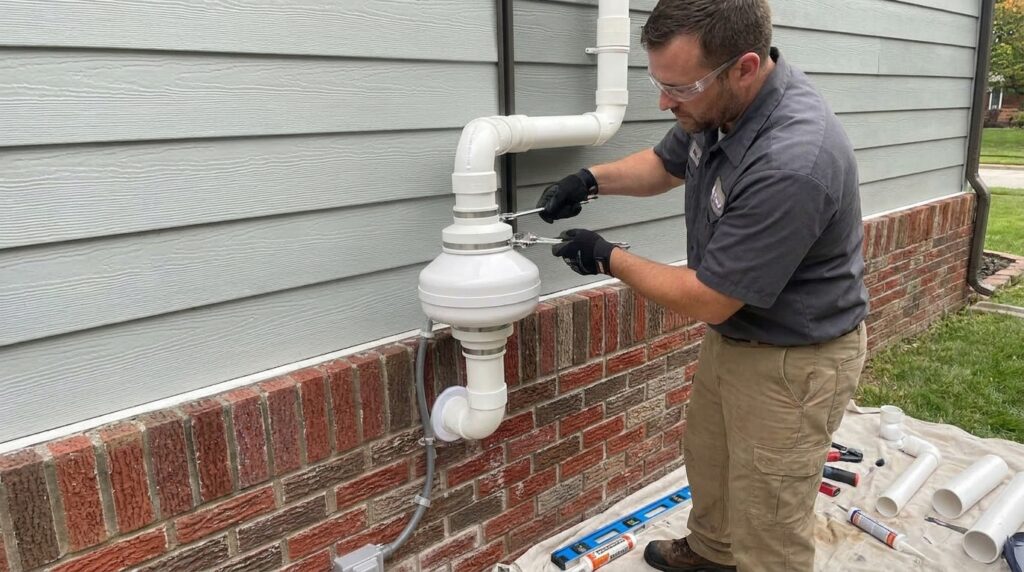
Foundation type is the single biggest driver of cost variation in NJ radon mitigation. Homes with a poured concrete basement slab are the most straightforward to mitigate — a single suction point drilled through the slab, a run of PVC pipe routed to the exterior, and a fan mounted outside or in the attic. These installations are efficient and typically fall toward the lower end of the cost range.
Homes with block foundation walls require additional consideration because block walls have hollow cores that can act as pathways for radon movement. Homes with crawl spaces require a different approach — typically a combination of ground cover membrane and sub-membrane depressurization — which adds complexity and cost. Homes with multiple foundation types, common in older NJ homes that have been expanded over decades, may require more than one suction point and a more involved design. A home in Flemington or Hackettstown with a partial basement, a partial crawl space, and a slab addition is a more complex mitigation project than a straightforward full-basement colonial in Parsippany or Somerville.
Number of Suction Points Required
Most homes can be mitigated effectively with a single suction point — one hole drilled through the slab, one pipe run, one fan. But some homes require two or more suction points to achieve adequate pressure field extension beneath the entire foundation. This is more common in homes with interior footings that divide the sub-slab space into isolated sections, homes with very dense or compacted sub-slab fill material that limits air movement, or larger homes where a single suction point can’t create sufficient negative pressure across the full footprint. Each additional suction point adds to the cost — typically $200 to $400 per additional point depending on the complexity of the pipe routing.
Pipe Routing and Fan Placement
The path the PVC pipe takes from the suction pit to the exterior affects both labor time and aesthetic outcome. A simple interior-to-exterior run through a rim joist in an unfinished basement is quick and straightforward. Routing pipe through a finished basement, up through a finished living space, or into an attic for an interior discharge adds time and complexity. Homes in Princeton, Lawrenceville, or Cherry Hill with finished basements and limited unfinished utility access areas can require more involved routing than homes with open unfinished basements.
Fan placement matters too. Fans should be installed outside the living envelope of the home — in the attic, on the exterior wall, or in the garage — so that any radon that might leak from a fan seal is vented outside rather than into the living space. Exterior mounting is the most common approach in NJ and is generally straightforward, but homes with limited exterior access or unusual siding conditions may require additional work.
Electrical Access
Radon fans require a continuous power supply. If a dedicated outlet is accessible near the fan installation location, the electrical connection is simple. If new wiring needs to be run from the electrical panel to reach the fan location, the electrician’s work adds to the project cost. Most certified radon mitigation contractors either have an electrician on staff or work with a regular electrician subcontractor. This is worth asking about when getting quotes — some contractors include electrical in their base price, others price it separately.
Post-Mitigation Testing
A responsible radon mitigation contractor will include post-mitigation testing in their installation package — a test conducted after the system is running to verify that radon levels have been reduced to below the action level. Some contractors conduct this test themselves using their own measurement equipment; others provide a separate test kit for the homeowner to run independently. Either approach is acceptable. What’s not acceptable is a contractor who installs a system without any post-mitigation verification. Always confirm that post-mitigation testing is included before signing a contract.
What a Complete Professional Installation Should Include
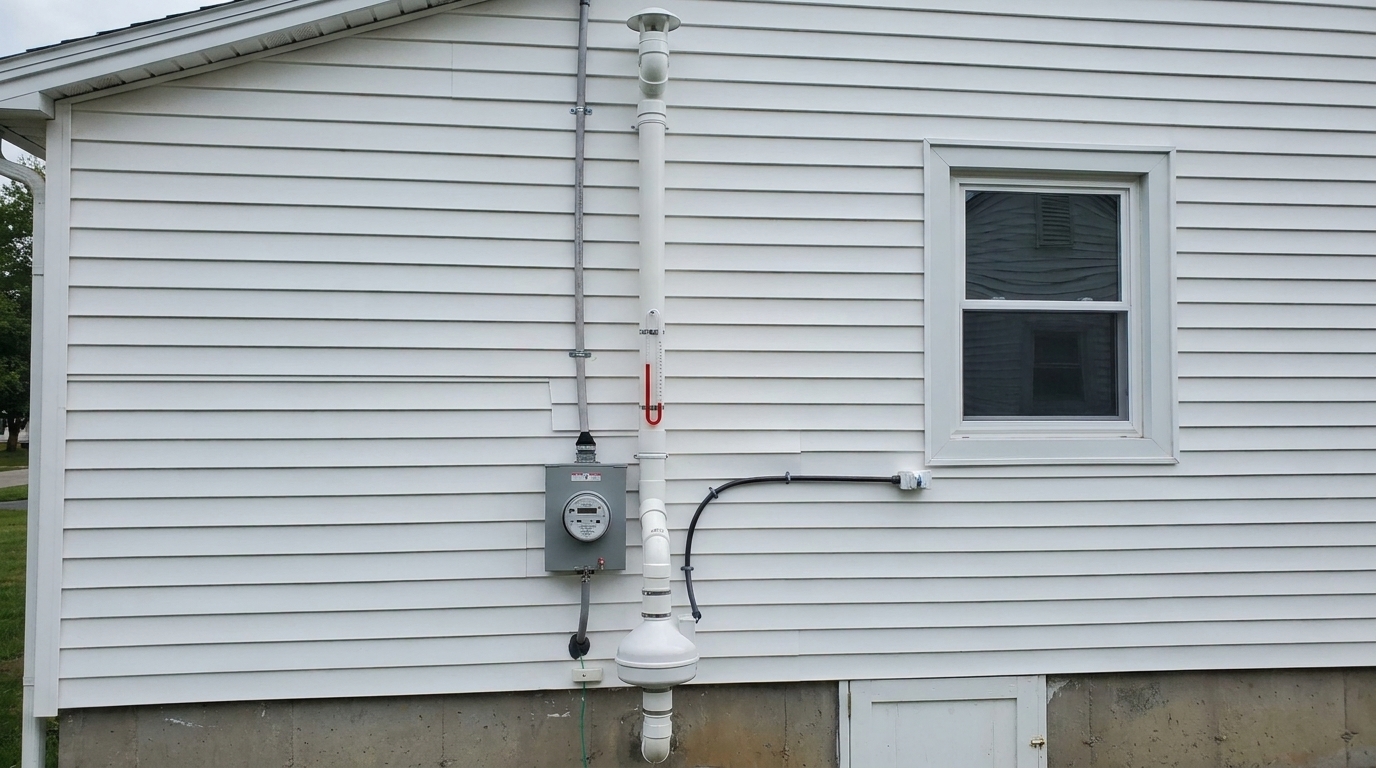
Understanding what’s included in a professional radon mitigation installation helps you evaluate quotes on an apples-to-apples basis. A complete installation from a certified NJ radon mitigation contractor should include a pre-installation diagnostic assessment to determine the appropriate suction point location and system design, drilling of the suction pit through the foundation slab, installation of the PVC vent pipe from the suction pit to the exterior, installation and electrical connection of the radon fan, sealing of any visible cracks or penetrations in the foundation slab that might serve as radon entry points, installation of a system performance indicator — typically a simple U-tube manometer that lets you see at a glance whether the fan is creating negative pressure — and a post-mitigation radon test to verify performance.
The system performance indicator deserves specific mention. A manometer mounted on the pipe — a small liquid-filled gauge that shows negative pressure in the system — lets you verify every day without a formal test that your mitigation system is running. If the fan fails, the fluid levels in the manometer equalize and you know immediately that something needs attention. It’s a simple, inexpensive component that provides ongoing peace of mind and should be standard on every installation. Ask about it specifically if a contractor’s quote doesn’t mention it.
Choosing a Contractor: What to Look For in New Jersey
Radon mitigation in New Jersey does not currently require a state contractor license specifically for radon work — which means the barrier to entry for someone calling themselves a radon mitigation contractor is lower than it should be. This makes contractor selection more important, not less. The key credential to look for is certification from the National Radon Proficiency Program (NRPP) or the National Radon Safety Board (NRSB), both of which require training, testing, and continuing education. The American Association of Radon Scientists and Technologists (AARST) sets the standards that both certification programs follow. Certified contractors are listed in searchable databases on the AARST website at aarst.org.
Beyond certification, ask whether the contractor carries liability insurance and whether they warranty their work. A reputable NJ radon mitigation contractor should offer a warranty on the system’s performance — typically a guarantee that post-mitigation radon levels will be below 4 pCi/L, or that they will return to adjust the system at no charge if they’re not. Get the warranty terms in writing before committing.
Be cautious of quotes that are significantly below the typical range — $400 or $500 for a full installation is a red flag that corners are being cut somewhere, whether in equipment quality, proper diagnostic assessment, or post-mitigation testing. Be equally cautious of quotes significantly above $2,500 for a standard single-family home without a clear explanation of what’s driving the higher cost.
Radon Mitigation vs. Radon Testing: Understanding the Full Cost Picture
New homeowners sometimes conflate the cost of testing with the cost of mitigation, or assume that a passing test result means no further expense is needed. To be clear about the complete cost picture: radon testing is an ongoing expense — the NJDEP recommends retesting every two years and after any significant renovation — while mitigation is a one-time installation cost with minimal ongoing operating expense.
Once a mitigation system is installed, the ongoing costs are modest. The radon fan consumes roughly the same electricity as a 20 to 40 watt light bulb running continuously — typically $30 to $75 per year in electricity depending on your utility rate. Fan replacement, when eventually needed, typically costs $150 to $300 for parts and labor and is needed every 10 to 15 years on average. Annual visual inspection of the system — checking the manometer reading, inspecting the pipe connections, making sure the exterior vent is clear — takes five minutes and costs nothing.
Post-installation radon retesting every two years is the other ongoing cost — typically $15 to $50 for a DIY long-term test kit, or $100 to $150 for a professionally conducted test. This is the confirmation that the system continues to perform as designed as the home ages and potentially settles or is modified.
The Cost of Not Mitigating: A Different Way to Look at the Math
Radon mitigation cost is sometimes discussed as if the relevant comparison is between spending the money and not spending the money. But that framing misses the real comparison, which is between spending $1,000 to $1,800 now and accepting elevated radon exposure for the years or decades you live in the home.
The EPA estimates that radon causes approximately 21,000 lung cancer deaths per year in the United States — more than drunk driving, more than home fires, more than carbon monoxide. The lifetime risk of developing lung cancer from radon exposure at 8 pCi/L — twice the action level, a level common in NJ homes in high-radon geology areas — is approximately 3 in 100 for non-smokers and significantly higher for smokers. These are not theoretical risks. They are documented, quantified public health statistics from a well-studied carcinogen.
A radon mitigation system at $1,500 installed cost, protecting a family of four for 20 or 30 years of residence, represents one of the most cost-effective health investments available to a homeowner. The math is not complicated. As we covered in our post on radon in water and air for NJ homeowners, radon exposure can come from multiple pathways — making the complete assessment and treatment of all relevant radon sources in your home the most protective approach.
Does Radon Mitigation Add Value to Your Home?
For new homeowners thinking about the long-term picture, radon mitigation is worth considering as a home value factor as well as a health protection measure. In the NJ real estate market — where radon testing is common in home purchases and elevated radon is a known negotiating point — a home with a professionally installed and verified mitigation system is in a better position than a home with a known radon problem and no system.
Buyers increasingly ask about radon, and a documented mitigation system with post-mitigation test results showing levels below the action level is a selling point, not a liability. The disclosure dynamics around radon in NJ real estate mean that an untreated elevated radon result can complicate a future sale, while a treated and verified result simplifies it. The $1,500 you spend on mitigation today may save you a more difficult negotiation — or a price reduction — when you eventually sell.
Getting an Accurate Quote for Your Specific Home
The cost ranges in this article are guidelines based on typical NJ residential installations. The only way to get an accurate price for your specific home is to have a certified contractor conduct an in-person assessment. A reputable contractor will want to see your foundation type, evaluate the sub-slab conditions, determine the most appropriate suction point location, assess pipe routing options, and review your test results before providing a firm quote. Be cautious of contractors who quote a price over the phone without seeing the home.
Getting two or three quotes from certified contractors is reasonable practice for a project of this size. When comparing quotes, make sure you’re comparing equivalent scopes — same number of suction points, same fan quality, post-mitigation testing included, performance warranty provided. The lowest quote is not always the best value if it’s missing components that a complete installation should include.
If you haven’t yet tested your home for radon and are in the process of establishing your first-winter baseline as a new NJ homeowner, our post on why winter is the most important time to test for radon covers the testing process in detail. And if you’re working through the broader well water and indoor air quality picture for your new NJ home, our 30-day water safety checklist for new NJ homeowners provides a structured framework for prioritizing all the tests that matter in your first month of ownership.
A Straightforward Investment in a Home You’ll Live In for Years
Radon mitigation in New Jersey is a well-understood, well-priced, and highly effective solution to a real and documented health risk. For most NJ homes, the cost falls in a range that is manageable for new homeowners, the installation is completed in a single day, and the system runs quietly and reliably for years with minimal maintenance. The question isn’t really whether you can afford to mitigate — it’s whether you can afford not to.
At Jersey Radon, we serve new homeowners across New Jersey — from Hackettstown and Flemington to Parsippany, Somerville, Toms River, and Princeton — providing certified radon mitigation installations, post-mitigation testing, and ongoing system support. If your test results have come back above the action level and you want a straightforward assessment of what mitigation will involve and cost for your specific home, reach out to our team for a free estimate. We’ll give you an honest evaluation and a clear price before any work begins.
