Can You Have Radon in Your Water AND Your Air? What NJ Homeowners Need to Know
Most New Jersey homeowners who think about radon think about it as an air quality problem. Radon gas seeps up from the soil, enters the home through foundation cracks and gaps, and accumulates in the lower levels of the house where it can be breathed in over time. That’s accurate — and it’s the radon exposure pathway that gets the most attention, the most public health messaging, and the most focus during real estate transactions.
But there’s a second radon exposure pathway that receives far less attention and is far less understood by homeowners — and for the significant portion of New Jersey households that rely on private wells for their water supply, it’s just as real and just as worth addressing. Radon dissolves into groundwater. It travels with that water into your home. And when you use well water that contains dissolved radon — showering, running the dishwasher, doing laundry, boiling water — that radon is released from the water into the air of your home, where it joins whatever radon is already entering through the foundation.
The result is that some NJ well water homeowners face a double radon exposure: radon from the soil entering through the foundation, and radon from the water being released into the indoor air every time water is used. Understanding both pathways, how they interact, and how each is tested and treated is essential for any new homeowner on a private well in New Jersey who wants a complete picture of their radon exposure.
How Radon Gets Into Groundwater
Radon forms from the radioactive decay of uranium and radium in soil and rock. In most parts of the country, radon that forms in the soil simply migrates upward and disperses into the outdoor air, where it’s quickly diluted to negligible concentrations. The problem arises when radon encounters pathways that concentrate it — the confined space beneath a home’s foundation, or the groundwater saturating the soil and rock formations that feed private wells.
Groundwater moving through uranium- and radium-bearing rock formations dissolves radon gas as it travels. The longer the water is in contact with radon-producing rock, the higher the dissolved radon concentration tends to be. Deep bedrock aquifers — the type tapped by many private wells in northern and central New Jersey, particularly in the granite and gneiss formations of Morris, Sussex, Warren, Passaic, and Somerset counties — tend to have higher radon concentrations than shallower aquifer systems, because the water spends more time in close contact with radon-producing bedrock before reaching the well.
Once radon-bearing groundwater is pumped into your home’s plumbing and pressure system, it remains dissolved in the water until something agitates or heats it — creating the conditions for the dissolved gas to escape into the air. Running a shower is particularly effective at releasing waterborne radon because the spray action creates enormous surface area and the warm water accelerates off-gassing. The steam and aerosolized water droplets carry radon into the bathroom air, and from there it disperses throughout the home.
How Much Does Waterborne Radon Contribute to Indoor Air Radon?
The EPA has studied the relationship between radon in well water and radon in indoor air, and the general finding is that for every 10,000 picocuries per liter (pCi/L) of radon in well water, indoor air radon levels increase by approximately 1 pCi/L on average. This is sometimes called the 10,000:1 transfer ratio, and while it varies based on home size, ventilation, water usage patterns, and other factors, it provides a useful framework for understanding the relative contribution of waterborne radon to total indoor exposure.
To put that in context: the EPA’s action level for radon in air is 4 pCi/L. If your well water contains 40,000 pCi/L of radon — a level that is not unusual in certain NJ bedrock aquifer zones — waterborne radon alone could be contributing approximately 4 pCi/L to your indoor air, potentially doubling the radon exposure from soil-based sources. At 20,000 pCi/L in water, the contribution is roughly 2 pCi/L — meaningful, particularly in a home that already has elevated air radon from the foundation pathway.
The EPA has established a drinking water guidance level of 300 pCi/L for radon in private well water based on this transfer relationship and the contribution to indoor air radon. Some states have set their own standards — New Jersey has not established a specific MCL for radon in private well water, but the EPA’s 300 pCi/L guidance level is the reference point used by most NJ water treatment professionals. At levels above 4,000 pCi/L in water, the EPA considers waterborne radon a significant contributor to indoor air exposure warranting treatment.
The Critical Point: Air Tests and Water Tests Are Completely Separate
This is where many New Jersey homeowners — including those who have done some radon testing — have a gap in their understanding. An air radon test tells you the concentration of radon gas in the air of your home. A water radon test tells you the concentration of dissolved radon in your well water. These are two entirely different measurements requiring two entirely different tests, and one does not tell you anything about the other.
A home that passes an air radon test with a reading of 2 pCi/L could still have 30,000 or 40,000 pCi/L of radon in its well water — contributing meaningfully to indoor air and posing a direct ingestion exposure through drinking. A home with a mitigation system that successfully reduces air radon to below 2 pCi/L may still have elevated waterborne radon being released into the air every time someone showers, partially offsetting the mitigation system’s effectiveness.
If a radon test was conducted as part of your home purchase in New Jersey, it was an air test. It was not a water test. The two are not interchangeable, and having one does not satisfy the information gap left by the absence of the other. For well water homeowners in NJ, both tests are necessary for a complete picture of radon exposure in the home.
Which NJ Homeowners Are at Greatest Risk for Waterborne Radon
The risk of elevated radon in well water correlates strongly with the geology of the aquifer system the well draws from. In New Jersey, the highest waterborne radon risk is associated with the crystalline bedrock formations of the Highlands region — the granite, gneiss, and other metamorphic and igneous rocks that underlie much of Morris, Sussex, Warren, Passaic, and northern Somerset counties. These rocks have naturally elevated uranium and radium content, and wells drilled into them frequently encounter groundwater with radon concentrations well above the EPA’s 300 pCi/L guidance level.
Homeowners in Hackettstown, Washington Township, Chester, Mendham, Bernardsville, Wharton, Rockaway, Dover, and communities throughout Morris and Sussex counties are in areas where bedrock well water radon testing is a standard recommendation rather than an afterthought. In Hunterdon County communities like Flemington, Lebanon Township, and Clinton, similar geology produces similar risk. Somerset County towns including Bernardsville, Far Hills, and Peapack-Gladstone sit on geology associated with elevated waterborne radon.
The coastal plain aquifer system of southern and central New Jersey — serving Ocean, Monmouth, Burlington, Atlantic, Camden, Gloucester, Salem, Cumberland, and Cape May counties — generally has lower waterborne radon risk than the bedrock regions of the north and center, because the sandy, sedimentary geology of the coastal plain produces less radon than crystalline bedrock. However, individual wells in the coastal plain can still have elevated waterborne radon, and testing remains the only definitive answer for any individual property regardless of regional generalizations.
Homes on municipal water — even in high-radon geology areas — do not face significant waterborne radon risk, because surface water treatment and the time water spends in distribution systems allows dissolved radon to off-gas before reaching consumers. Waterborne radon is specifically a private well concern.
Testing for Both: What Each Test Involves
Testing for air radon and water radon are both straightforward processes, but they require separate steps and separate laboratory analyses.
Air radon testing uses a passive detector — a charcoal canister for short-term tests of 48 hours to 7 days, or an alpha track detector for long-term tests of 90 days to one year — placed in the lowest livable level of the home. Short-term tests are the standard approach for initial screening; long-term tests provide a more accurate annual average. Test kits are available at hardware stores and online, or a certified radon measurement professional can conduct the test. The NJDEP maintains a list of certified radon measurement professionals at nj.gov. As we covered in our post on why winter is the most important time to test for radon in your NJ home, conducting the air test during cold weather under closed-house conditions gives the most useful and conservative result.
Water radon testing requires a water sample collected from a cold water tap — typically the kitchen tap or an outdoor spigot before any treatment equipment — using a specific protocol designed to minimize the loss of dissolved radon during collection. The lab will provide pre-filled collection vials and precise instructions. The sample must be collected carefully and shipped to the laboratory quickly, because radon in water begins to off-gas and decay once the sample is collected, making time-sensitive handling important for accurate results. Results are reported in picocuries per liter and compared to the EPA’s 300 pCi/L guidance level and the 4,000 pCi/L level at which waterborne radon is considered a significant indoor air contributor.
Our water testing service includes radon in water as part of comprehensive well water panels for NJ homeowners. If you’ve already established your air radon status but haven’t tested your water, adding a water radon test to your next comprehensive panel is the logical next step.
Treatment: Different Problems, Different Solutions
Because soil-based radon and waterborne radon enter the home through completely different pathways, they require completely different treatment approaches. A mitigation system designed for air radon does nothing for radon in water. A water treatment system that removes radon from water does nothing for radon entering through the foundation. In homes where both are elevated, both need to be addressed — and the order and design of treatment matters.
Treating Air Radon: Sub-Slab Depressurization
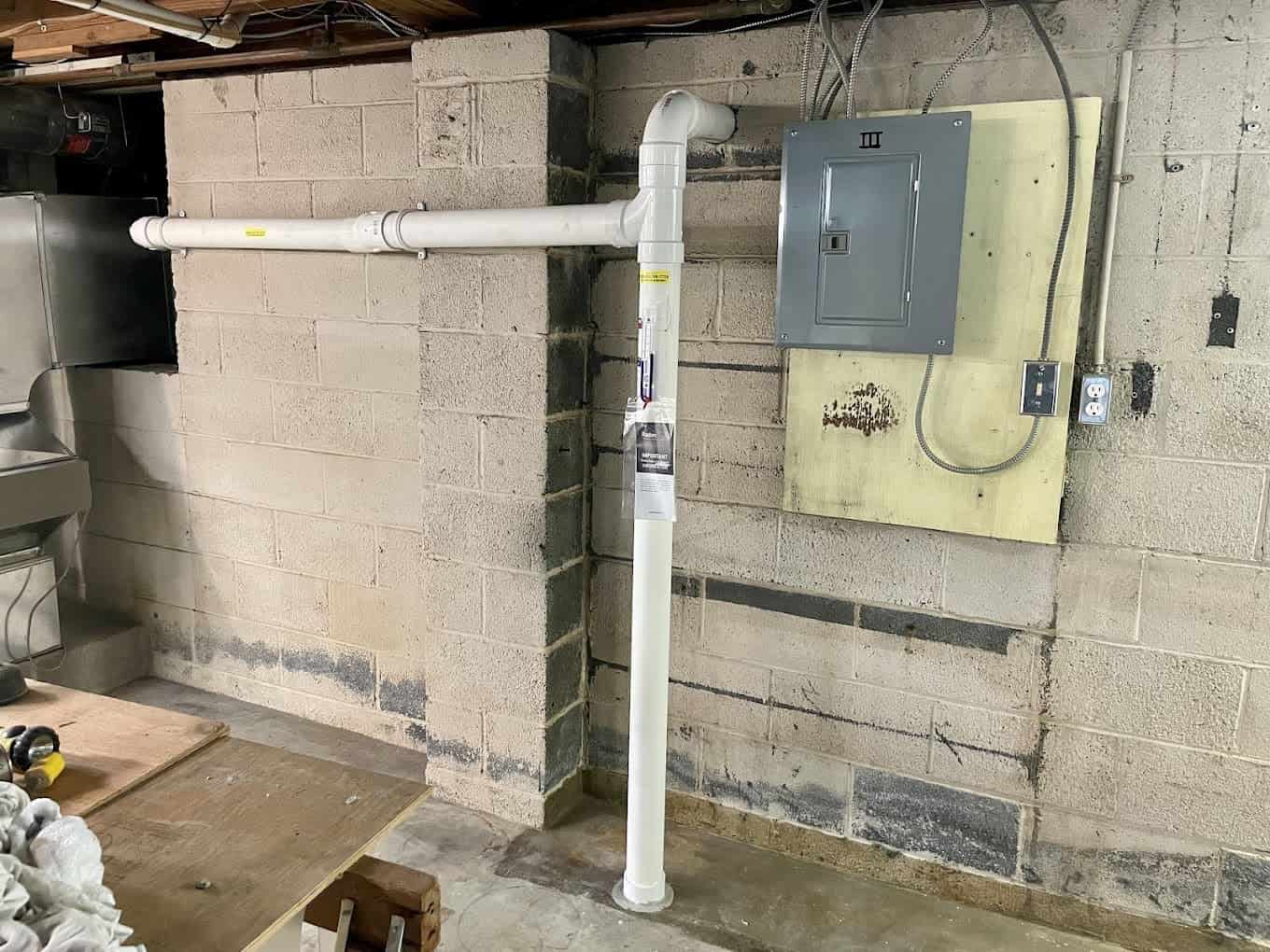
The standard and most effective treatment for soil-based radon in NJ homes is sub-slab depressurization — an active mitigation system that uses a continuously running fan and a PVC pipe inserted through the foundation slab to create negative pressure beneath the home, drawing radon out of the soil before it can enter the living space and venting it safely outside. A properly designed and installed sub-slab depressurization system can reduce indoor air radon by up to 99 percent and typically brings levels well below the EPA’s 4 pCi/L action level.
Installation is typically completed in a few hours without disruption to the household, and post-installation testing a few days after the system is running confirms its effectiveness. Learn more about residential radon mitigation in New Jersey including what the installation process involves and what to expect from a properly functioning system.
Treating Waterborne Radon: Aeration and GAC
Two technologies are used for removing radon from well water: aeration and granular activated carbon (GAC) filtration.
Aeration systems remove radon from water by exposing the water to air — either through a spray nozzle, a packed tower aerator, or a pressurized air injection system — before it enters the home’s plumbing. The dissolved radon off-gasses from the water during aeration and is vented to the outdoors, where it disperses harmlessly. Aeration systems are highly effective — capable of removing 95 to 99 percent of dissolved radon — and are the preferred approach for whole-house treatment when waterborne radon concentrations are high. The venting component is important: the off-gassed radon must be directed outdoors rather than into the home’s interior air, which would defeat the purpose of treatment.
Granular activated carbon (GAC) filters remove radon from water through adsorption — the radon adheres to the surface of the carbon media as water passes through. GAC systems are simpler and less expensive than aeration systems and are effective for moderate waterborne radon levels. The limitation is that the carbon media accumulates radon and its decay products over time, which can make the filter itself mildly radioactive and require careful handling during media replacement. GAC systems are generally more appropriate for point-of-use applications or for lower radon concentrations; aeration is preferred for whole-house treatment of higher concentrations.
Learn more about radon in well water treatment options available for NJ homeowners, including how aeration and GAC systems are sized and installed for residential applications.
When Both Are Elevated: Getting the Treatment Sequence Right
For NJ homes where both air radon and water radon are elevated, addressing both is necessary — and the interaction between the two treatment systems needs to be considered in the design. A sub-slab depressurization system for air radon and an aeration or GAC system for water radon operate independently and can be installed in either order. However, if waterborne radon is contributing significantly to indoor air levels, an air radon test conducted before the water radon is treated may underestimate what the air radon level will be after the water system is installed — because the water-based contribution to air radon will be removed.
The practical implication is that if you install an air mitigation system first and then add water radon treatment, you may find your post-mitigation air radon levels drop further than the initial post-installation test suggested. That’s a good outcome, not a problem. But it’s worth understanding the interaction so you’re not confused by changing air radon readings as different components of your treatment system are brought online.
For new homeowners in high-radon geology areas of Morris, Sussex, Warren, Hunterdon, and Somerset counties who are starting from scratch with no prior testing, the recommended sequence is: test both air and water simultaneously, review the results together with a professional, and design a treatment plan that addresses whichever pathways are elevated based on actual data rather than assumptions.
Radon in the Broader Context of NJ Well Water Safety
Radon — both in air and water — is one piece of the larger well water safety picture for new homeowners in New Jersey. It’s an important piece, but it exists alongside other contaminants that deserve attention: arsenic, PFAS, nitrates, iron, manganese, bacteria, VOCs, and others depending on location and local geology. Our post on what your NJ home inspection doesn’t tell you about water quality covers the full scope of what standard home purchase testing misses and why a comprehensive first-year water assessment matters.
Radon in water is frequently the last contaminant new NJ homeowners think to test for — partly because waterborne radon is less well known than air radon, and partly because it’s not included in any standard closing water test or lender requirement. But for well water homeowners in the bedrock geology regions of northern and central NJ, it’s one of the most important parameters to add to the testing list.
Two Pathways, One Complete Answer
Radon is not just an air problem. For New Jersey homeowners on private wells, it’s potentially an air problem and a water problem simultaneously — with each pathway contributing to total household exposure independently of the other. The only way to know which pathways are relevant to your home is to test both, separately, with appropriate methods for each.
The good news is that both air radon and waterborne radon are well understood, reliably testable, and effectively treatable. New Jersey homeowners in Hackettstown, Chester, Mendham, Flemington, Bernardsville, Rockaway, and throughout the high-radon geology regions of the state deal with these issues regularly, and proven solutions exist for every scenario.
At Jersey Radon, we help NJ homeowners understand and address radon exposure through both pathways — from air radon testing and sub-slab depressurization to waterborne radon testing and whole-house aeration or GAC treatment. If you want to know whether your new NJ home has a radon problem in your air, your water, or both, reach out to our team for a free consultation. We’ll help you test the right things, interpret what the results mean, and put the right treatment in place for your specific home and geology.
