Livingston Homeowners Spend a Lot Protecting Their Homes. Most Haven’t Tested Their Water Once.
Livingston is the kind of town where home maintenance gets done right. Security systems, HVAC servicing, roof inspections — Livingston homeowners invest in protecting their properties. And yet one of the most basic and impactful checks — a professional water quality test — gets skipped year after year. Not out of neglect, but because the water looks fine. It flows clear. It doesn’t smell obviously wrong. And the assumption is that a community like Livingston, with its resources and quality of life, must have good water.
That assumption is worth testing — literally. Essex County water, the aging housing stock in Livingston’s established neighborhoods, and the geology that underlies this part of North Jersey all create real water quality concerns that don’t show up in the annual consumer confidence reports utilities are required to publish. Those reports describe what the water looked like at the plant. A professional test tells you what’s coming out of your tap.
What Livingston’s Water System Looks Like — and Where Concerns Enter the Picture
Livingston receives its municipal water through the Essex County system, with treatment meeting New Jersey DEP and federal Safe Drinking Water Act standards. Distribution infrastructure serving Livingston’s established neighborhoods — many of which were developed in the 1950s through 1970s — includes service connections and internal plumbing from that era. Homes in areas like the Mount Pleasant section, Riker Hill, and the older sections near the high school are most likely to have lead solder at pipe joints, original brass fixtures with lead content, or galvanized steel lines that have been corroding quietly for decades.
Hard water is a consistent characteristic across Essex County and is particularly evident in Livingston. Calcium and magnesium at the levels typical of this region produce the scale that builds up inside water heaters, dishwashers, and coffee makers — reducing efficiency and shortening appliance life. Nearby West Orange, Short Hills, Millburn, and Roseland share the same regional water supply and report the same pattern.
Radon in water is worth noting for Livingston homeowners on private wells or in homes near the Watchung Ridgeline geology. Essex County’s geology places portions of the township in an elevated zone for naturally occurring radon in groundwater — a concern that’s separate from airborne radon and addresses a different exposure pathway.
What We Test for in Livingston Homes
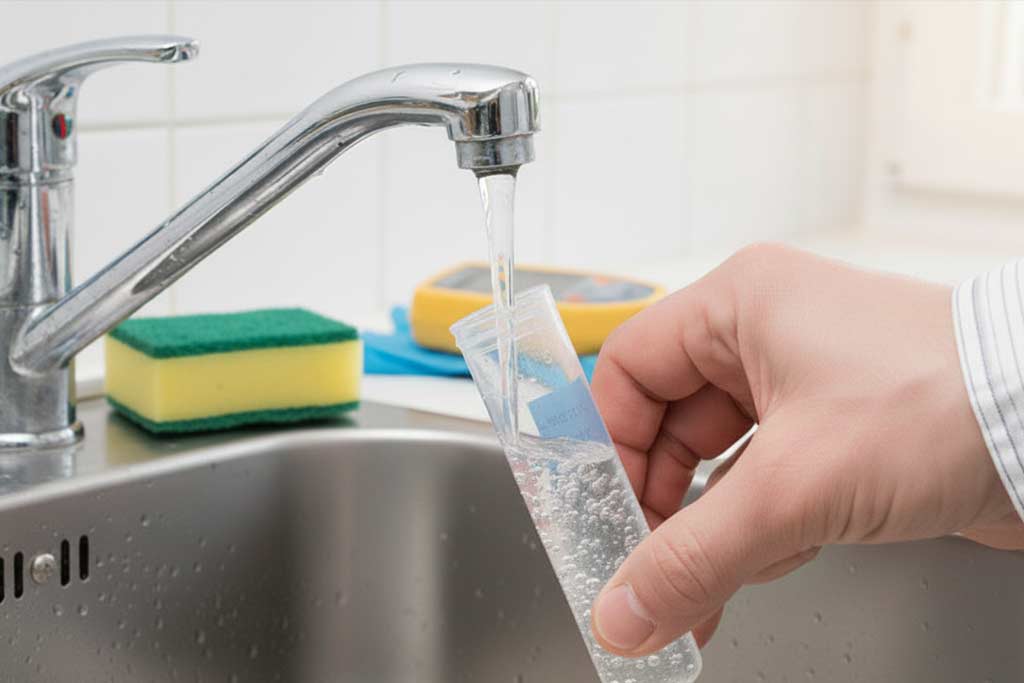
We sample at your tap and send to a certified New Jersey laboratory. For Livingston and Essex County homes, the most relevant contaminants to evaluate include:
- Lead and copper — first-draw sampling at the tap; essential in homes built before 1986
- Hardness — calcium and magnesium levels driving scale buildup and appliance wear across Essex County
- Bacteria and total coliform — relevant after any plumbing work or disruption to the main
- Radon in water — worth screening in homes on private wells or near geological risk zones
- Chloramine and disinfection byproducts — consistent concern for all Essex County municipal water customers
- Iron and manganese — can be present in aging distribution lines and produce taste and staining issues
- PFAS — documented in portions of the Essex County water system; worth including in a comprehensive panel
What Hard Water and Aging Plumbing Actually Look Like in a Livingston Home
The water quality problems most common in Livingston show up slowly enough that homeowners adapt to them rather than addressing them. The signs are there — they just get rationalized:
- A water heater that needed replacement years ahead of its expected lifespan
- Showerheads that lose pressure and require descaling every few months
- Dishes and glassware with a persistent haze even with premium dishwasher detergent
- A metallic or slightly flat taste to the water, especially the first glass in the morning
- Skin that feels tight after showering despite high-quality body wash and moisturizer
- A bleach or chemical smell that’s most noticeable when taking a hot shower
Common Water Issues in Livingston — Causes and Solutions
| What You’re Noticing | Likely Cause | Typical Solution |
|---|---|---|
| Scale on appliances and fixtures | Hard water — high calcium and magnesium | Water softener installation |
| Metallic taste, first morning draw | Lead or copper from older interior plumbing | Lead test + point-of-use reverse osmosis |
| Chemical smell in hot shower | Chloramine disinfection byproducts | Whole-home carbon block filtration |
| Orange staining in fixtures | Iron or manganese in distribution lines | Iron filtration system |
| Older home, no obvious issues | Invisible contaminants — lead, PFAS, bacteria | Comprehensive baseline test |
What Water Testing and Treatment Costs in Livingston
A standard residential water test in Livingston typically runs $150–$500 depending on the scope. A panel covering lead, hardness, bacteria, and disinfection byproducts covers the most common concerns for Essex County homeowners in established neighborhoods. A comprehensive panel adding PFAS provides a more thorough baseline for any home where a complete picture matters.
If treatment is warranted, a water softener installation for hard water runs $1,800–$5,500+. A whole-home filtration system for byproducts or iron concerns is $1,500–$4,500. Point-of-use reverse osmosis for lead or PFAS starts around $400–$800 installed. Results always come first.
Serving Livingston and Nearby Essex County Communities
We serve homeowners throughout Livingston and across North Jersey, including nearby West Orange, Short Hills, Millburn, and Roseland — communities that share Essex County’s water supply and the same regional water quality characteristics. Our full New Jersey service area covers the state, and our water testing service page details what each panel includes.
Frequently Asked Questions — Water Testing in Livingston, NJ
Should I test for radon in my Livingston water?
If your home is on a private well or near the Watchung Ridgeline area, radon in water is worth screening for. Essex County has geological zones with elevated naturally occurring radon in groundwater, and waterborne radon is a separate exposure pathway from airborne radon. If you’ve tested for airborne radon but not water, you have an incomplete picture of your home’s radon exposure.
My home was built in the 1960s in Livingston — what should I test for?
A home from that era should be tested for lead at minimum — lead solder at pipe joints was standard construction practice until 1986. Beyond lead, hardness, bacteria, and disinfection byproducts round out a solid baseline panel for a home of that age on municipal water. If you want a comprehensive picture, adding PFAS gives you full coverage of the most relevant concerns for Essex County homes.
How does hard water affect appliances over time?
Hard water deposits mineral scale inside water heaters, pipes, dishwashers, and washing machines — reducing efficiency and shortening their working life. It also forms visible deposits on fixtures and glassware and prevents soap and shampoo from lathering properly. In Livingston’s water, hardness is high enough that these effects accumulate meaningfully over the life of a home.
How quickly will I get results?
We typically schedule within a few days. The on-site visit takes under an hour, and lab results return within 3–7 business days. We follow up to walk through them with you directly.
Can I test just for lead without a full panel?
Yes. A lead-only first-draw test is available and is a reasonable starting point if lead is your primary concern. We can also discuss whether a broader panel makes sense based on your home’s age, plumbing history, and any symptoms you’ve noticed.
Schedule Your Livingston Water Test
If you’ve invested in your Livingston home and haven’t tested the water, this is the piece that’s been missing. We serve Livingston and all of Essex County. Call us at (732) 357-1988 or schedule online.