Short Hills Homes Are Among New Jersey’s Most Valuable. The Water Running Through Them Deserves the Same Attention.
Short Hills is one of the most affluent communities in New Jersey — a place where homes are meticulously maintained, renovations are done to the highest standard, and the details get attention. Water quality rarely makes that list. Not because Short Hills homeowners don’t care, but because the water looks fine, the neighborhood feels safe, and the assumption is that an address in the Millburn-Short Hills area means the basics are covered.
The basics are covered at the plant. What happens between the Essex County treatment facility and the faucet in a home that was built in 1955, renovated in 2010, but never had its original service line or basement plumbing replaced — that’s a different question. And it’s one that only a professional water quality test can answer definitively.
What Essex County Water Looks Like by the Time It Reaches a Short Hills Home
Short Hills receives its municipal water through the Essex County system, with treatment that meets New Jersey DEP and federal Safe Drinking Water Act standards. The distribution infrastructure serving Short Hills and the surrounding Millburn area spans multiple decades of construction — some sections modern, some significantly older, and the internal plumbing in Short Hills’ established housing stock reflecting whatever era each home was originally built.
Hard water is a defining characteristic of Essex County’s water supply. Short Hills homes consistently show the effects — scale inside water heaters, calcified showerheads, glassware that comes out of the dishwasher with a haze despite quality detergent. These are visible symptoms of a mineral content issue that a water softener addresses directly, but the right starting point is a test that confirms the actual hardness level rather than treating based on symptoms alone.
Lead is a concern in any Essex County home built before 1986. Short Hills has substantial housing stock from the mid-20th century — well-maintained and beautifully presented, but with plumbing that in many cases has never been fully updated. Even homes with renovated kitchens and bathrooms may have original service line connections, basement supply lines, or lead solder at pipe joints that weren’t part of the renovation scope. The water that leaves the plant lead-free can pick up lead at any of those points before it reaches the tap. Nearby Millburn, Livingston, Summit, and Maplewood share the same regional water supply and the same infrastructure characteristics.
What We Test for in Short Hills Homes
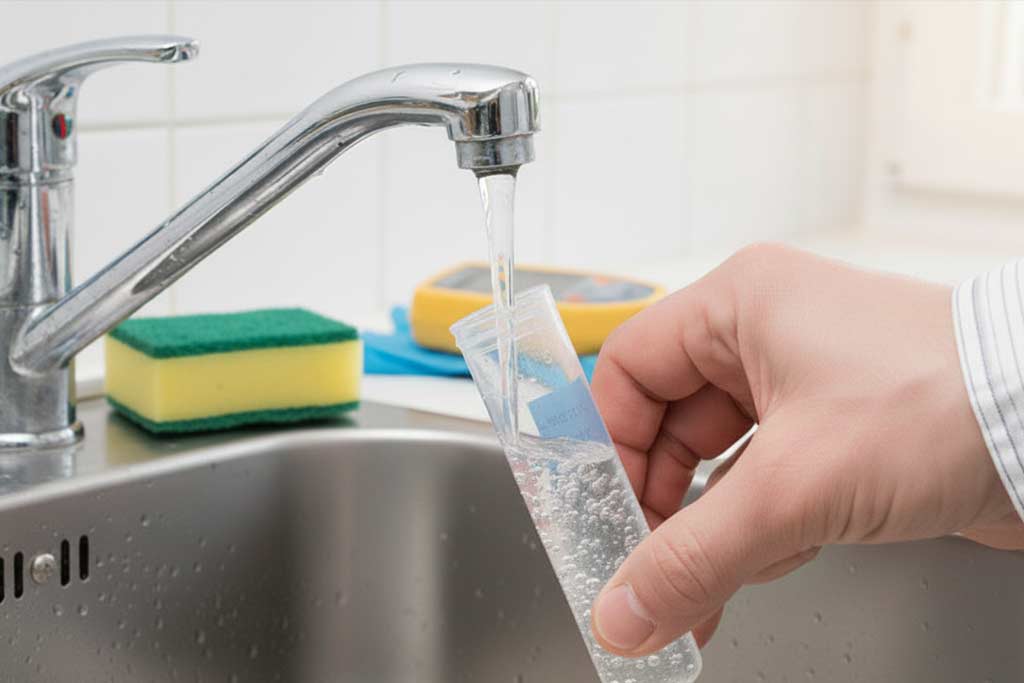
We collect samples at your tap and submit to a certified New Jersey laboratory. For Short Hills and Essex County homes, our standard panel covers the contaminants most relevant to this community’s specific water profile:
- Lead and copper — first-draw sampling at the faucet; essential in any pre-1986 home regardless of renovation history
- Hardness — the root cause of scale, appliance wear, and the skin and hair effects that Essex County homeowners consistently report
- Chloramine and disinfection byproducts — present throughout the Essex County distribution system and the source of the chemical smell in hot showers
- Bacteria and total coliform — relevant after plumbing work, main disturbances, or extended periods of low water use
- Iron and manganese — can be present in aging distribution lines and produce staining and taste issues
- PFAS — documented in portions of the Essex County water system; worth including in a comprehensive baseline
- pH and alkalinity — indicates how aggressively the water interacts with your pipes
The Water Quality Signals That Show Up in Short Hills Homes
In a community where home quality is a priority, it can be jarring to notice that something as fundamental as the water doesn’t quite perform the way it should. These are the signs most commonly reported by Essex County homeowners:
- Scale inside the coffee maker, kettle, and on showerhead faces — the most visible sign of hard water
- A metallic or slightly flat taste in the morning’s first glass — most pronounced after water has sat in pipes overnight
- A chlorine or chemical smell that intensifies in the shower and when boiling water
- Glassware and dishes with a persistent haze even with premium dishwasher products
- Skin that feels tight or dry after showering despite quality body wash and moisturizer
- A water heater or dishwasher that seems to need service or replacement before its expected lifespan
Common Water Issues in Short Hills — Causes and Solutions
| What You’re Noticing | Likely Cause | Typical Solution |
|---|---|---|
| Scale on fixtures and inside appliances | Hard water — elevated calcium and magnesium | Water softener installation |
| Metallic taste, morning draw | Lead or copper from older interior plumbing | Lead test + point-of-use reverse osmosis |
| Chemical smell in hot shower | Chloramine disinfection byproducts | Whole-home carbon block filtration |
| Hazy film on glassware | Hard water mineral deposits | Water softener installation |
| Renovated home, unknown plumbing history | Potential lead from unreplaced original components | First-draw lead test at kitchen tap |
What Water Testing and Treatment Costs in Short Hills
A standard residential water test in Short Hills typically runs $150–$500 depending on the panel. A comprehensive baseline covering lead, hardness, bacteria, disinfection byproducts, and PFAS is the most useful starting point for a community with this housing profile — it covers the most relevant concerns without leaving gaps that a basic panel would miss.
If treatment is indicated, a water softener installation for hard water typically runs $1,800–$5,500+. A whole-home filtration system for chloramine, byproducts, or iron concerns is $1,500–$4,500. Point-of-use reverse osmosis for lead or PFAS starts around $400–$800 installed. We present results and explain options — the decision is always yours.
Serving Short Hills and Nearby Essex County Communities
We serve homeowners throughout Short Hills and the surrounding Essex County area, including nearby Millburn, Livingston, Summit, and Maplewood — communities sharing the same regional water supply and infrastructure characteristics. Our full New Jersey service area covers communities across the state, and our water testing service page has more detail on what each panel includes.
Frequently Asked Questions — Water Testing in Short Hills, NJ
We renovated our Short Hills home extensively — do we still need to test for lead?
Almost certainly yes. Renovation work typically addresses visible plumbing — kitchen supply lines, bathroom fixtures, accessible pipes. It rarely addresses the service line from the street, basement supply mains, or the solder at joints throughout the system. Lead can still be present in any of those locations even after a comprehensive renovation. A first-draw test at your kitchen faucet tells you definitively whether lead is reaching the tap.
Is Essex County water hard?
Yes. The water serving Short Hills and the surrounding Millburn area tends toward moderate to significant hardness. The scale on your fixtures, the haze on your glassware, and the way your skin feels after showering are all consistent with this. A test gives you the specific number so you can make an informed decision about whether a softener makes sense and what size system your household needs.
What does PFAS testing involve?
PFAS testing requires a water sample sent to a laboratory that runs a specific panel for per- and polyfluoroalkyl substances. It’s not part of a standard basic test — it needs to be requested specifically. Given documented PFAS presence in portions of the Essex County water system, we include it as a recommendation for any Short Hills homeowner who wants a truly comprehensive baseline rather than just a spot check.
How quickly can I get tested?
We’re typically able to schedule within a few days. The on-site portion takes under an hour, and lab results come back within 3–7 business days. We follow up to walk through findings with you directly.
Is a water test worth it if we already use a pitcher filter?
Yes — and this is an important distinction. Pitcher filters reduce some contaminants at the point of use, but they don’t address the water in your shower, your ice maker, or the water your children drink from the bathroom tap. They also don’t remove all contaminants — lead reduction depends on the specific filter cartridge and its remaining capacity. A whole-home test gives you a complete picture of what’s actually in your supply, and a whole-home solution addresses it everywhere rather than just at one faucet.
Schedule Your Short Hills Water Test
If you own a home in Short Hills and haven’t tested your water — whether it’s an older home with unknown plumbing history or a recently renovated property where you’re not sure what was and wasn’t replaced — a professional water quality test is the most direct way to know what you’re working with. We serve Short Hills and all of Essex County. Call us at (732) 357-1988 or schedule online.