The Honest Breakdown: What a Water Softener Actually Costs in New Jersey
If you have been putting off addressing hard water because you are not sure what it will cost, you are not alone. Water softener pricing in New Jersey is not exactly transparent — quotes vary widely, salespeople lead with monthly payment figures, and it can be difficult to know whether you are looking at a fair number or getting taken advantage of.
This is a straight breakdown of what water softener installation actually costs in New Jersey, what drives the price up or down, and how to think about the investment relative to what untreated hard water is costing you right now. If you are ready to move past the research phase, our water softener installation page covers what the process looks like and how to get a free estimate.
The Baseline: What Most NJ Homeowners Pay
Water softener installation in New Jersey typically runs between $1,800 and $7,000 all in — equipment plus installation. The majority of residential jobs fall somewhere in the $2,500 to $4,500 range. That number covers the system itself, the installation labor, any basic plumbing modifications needed to connect the unit, and initial setup including programming and salt.
If you have seen lower numbers online — $400, $600, $900 — those are equipment-only prices for entry-level units purchased at a big box store, installed by the homeowner, and not sized to your actual water conditions. They are also not what most New Jersey homes need, particularly homes on private wells with high hardness levels or iron content.
What Drives the Price Up
Several factors push the total cost toward the higher end of the range.
Water hardness level. The harder your water, the larger the system capacity you need. A home with 20+ grains per gallon hardness needs a meaningfully larger resin tank than a home at 8 GPG. Larger systems cost more.
Household size and water usage. Softener capacity is calculated against daily water consumption. A household of five uses significantly more water than a household of two, and the system needs to regenerate efficiently without running out of softening capacity between cycles.
Iron content. Many New Jersey well water sources contain iron in addition to calcium and magnesium. Standard softeners handle low levels of clear-water iron, but elevated iron typically requires either a dedicated iron filter upstream of the softener or a specialized system designed to handle both. This adds to the total cost but is necessary for the softener to perform and last.
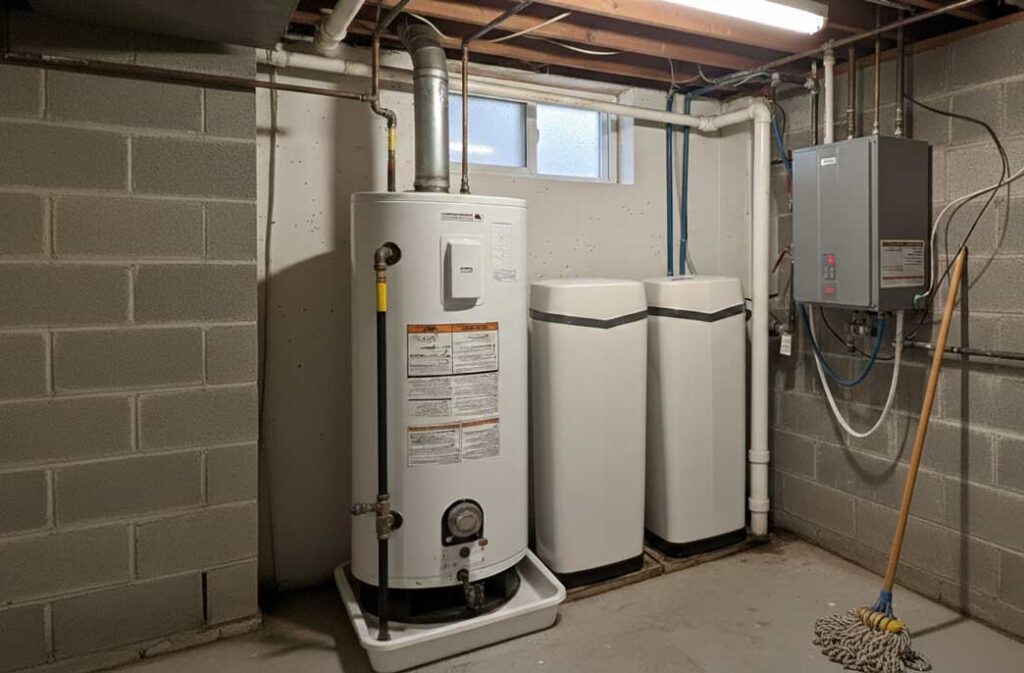
Plumbing access and modifications. Softeners need to be installed on the main supply line before the water heater. In some homes that location is straightforward. In others — finished basements, tight mechanical rooms, older homes with complicated plumbing layouts — additional work is needed to properly position and connect the unit. That labor adds to the total.
System brand and quality. There is a meaningful difference between entry-level equipment and professional-grade systems built for longevity and efficiency. Higher-end systems use demand-initiated regeneration, which means the unit regenerates based on actual water usage rather than a fixed schedule. This uses less salt, less water, and extends resin life.
What Drives the Price Down
Simpler installs with accessible plumbing, lower hardness levels, smaller households, and city water sources without iron content all push the total toward the lower end of the range. If your home is on municipal water in a region with moderate hardness — say, 8 to 12 GPG — and your mechanical room is straightforward, a quality installation can come in well under $3,000.
Repair vs. Replacement
If you already have a water softener that is underperforming, the cost picture is different. Many softener issues — a fouled resin bed, a failed injector, a cracked brine line, a stuck bypass valve — are repairable for a fraction of replacement cost. Control valve rebuilds, resin replacement, and brine tank cleaning are common repair scenarios that restore a system to full function.
The decision point is typically age and overall condition. A system under ten years old with a diagnosable mechanical issue is usually worth repairing. A system over fifteen years old that is producing hard water may be at the end of its useful life, particularly if the control head is no longer serviceable or parts are no longer available. A technician can assess which direction makes sense before you commit to either.
How to Think About the Cost
A water softener is not a luxury purchase. It is infrastructure — the same category as your water heater, your pressure tank, or your filtration system. The question is not really whether $2,500 to $4,500 is a lot of money. The question is what untreated hard water is costing you in comparison.
A water heater that fails early due to scale costs $800 to $2,500 to replace, plus labor. A dishwasher runs $600 to $1,500. A washing machine, similar. These are not hypothetical — they are the documented outcomes of running hard water through equipment that was not designed to handle sustained mineral exposure without treatment. Add elevated energy bills from an inefficient water heater, higher cleaning product costs, and more frequent plumbing service calls, and the cost of doing nothing adds up faster than most homeowners expect.
For the majority of New Jersey homes with moderate to high hardness, a properly sized water softener pays for itself over its lifespan. The math is not close.
Getting an Accurate Number for Your Home
The only way to get a number that actually applies to your situation is a water test and an in-home evaluation. Hardness level, iron content, household size, plumbing layout, and your current equipment all factor into the right system recommendation and the final price. A quote without a water test is a guess. Union County homeowners can find local pricing and service details on our water softener installation page for Westfield, NJ. For Middlesex County homeowners, see our water softener installation page for Edison, NJ for local service details.
Jersey Radon provides free estimates for water softener installation and repair throughout New Jersey. The evaluation includes water hardness testing and a clear explanation of what system is recommended and why — before any work begins. Contact our team to schedule your free estimate.
