Your Dishwasher Is Doing Its Job. Your Water Isn’t.
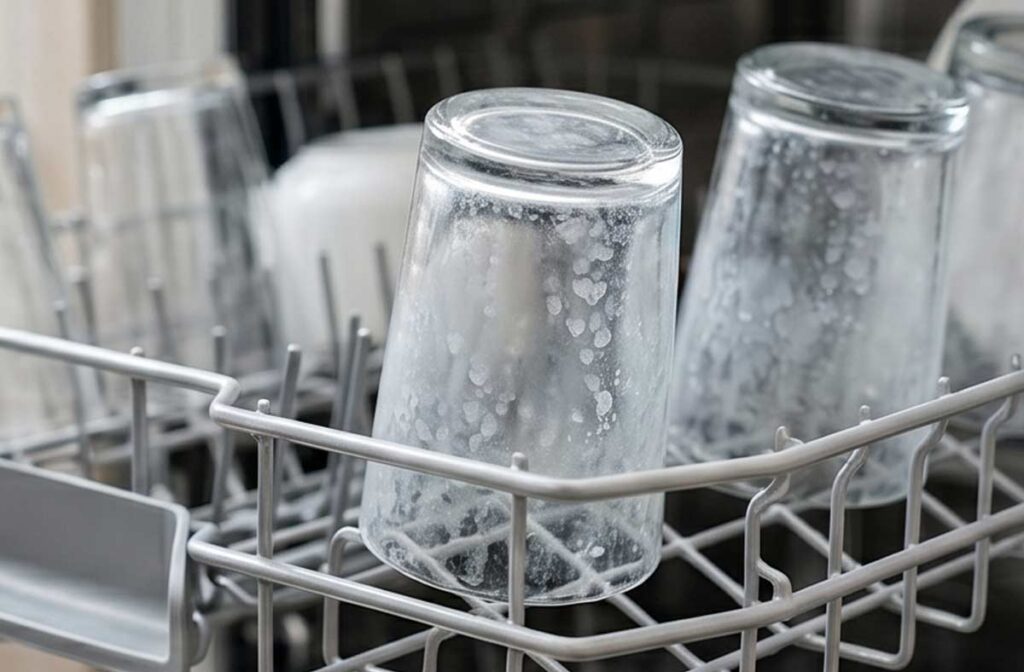
The dishes go in dirty. They come out with a white film, cloudy residue, or spots that were not there before the wash cycle. You have tried different detergent. You have run the rinse aid. You have checked the filter. The dishwasher checks out fine — and the residue is still there.
The dishwasher is not the problem. The water is. In most New Jersey homes where this is happening, hard water is the cause, and no amount of detergent switching or dishwasher maintenance will fix it. Water softener installation in New Jersey is what actually addresses it.
What the White Residue Is
The film or spots you are seeing on dishes, glassware, and silverware after a dishwasher cycle are mineral deposits — primarily calcium carbonate left behind when hard water evaporates during the drying cycle. The water itself disappears. The dissolved minerals do not. They stay on whatever surface the water was in contact with and dry into the chalky white or cloudy film you are pulling out of the machine.
This is the same process that creates limescale on your faucets and showerheads, just happening on your dishes every single wash cycle.
Why Rinse Aid Helps but Does Not Solve It
Rinse aid works by reducing the surface tension of water so it sheets off dishes rather than beading up and evaporating in place. This reduces spotting somewhat because less water is sitting on surfaces when drying begins. But rinse aid does not remove minerals from the water. If your water is hard enough, the mineral concentration is high enough that even sheeted water leaves visible deposits. Rinse aid manages the symptom at moderate hardness levels. At higher hardness — which is common in central and southern New Jersey — it stops keeping up.
What Hard Water Does to the Dishwasher Itself
The residue on your dishes is visible. What is happening inside the dishwasher is not, and it is more significant long-term. Scale accumulates on the spray arm nozzles that distribute water throughout the wash cycle. As nozzles narrow from mineral buildup, water distribution becomes uneven — some areas of the dishwasher get less water pressure, which is why residue often appears in patterns rather than uniformly. Dishes in certain rack positions consistently come out worse than others.
Scale also builds on the heating element at the bottom of the dishwasher, which is responsible for heating water to wash temperature and for the heated drying cycle. A scaling heating element works harder, uses more energy, and wears out faster. The interior tub itself accumulates a mineral film over time that traps food particles and becomes harder to clean.
Dishwashers in hard water homes have measurably shorter service lives than the same models operating on soft water. The spray arms clog, the heating element fails earlier, and the interior deteriorates faster.
Why Detergent Switching Does Not Work
Dishwasher detergents contain water-softening agents — typically citric acid or phosphate-based compounds — specifically because hard water is a known problem for dishwasher performance. Some formulations handle moderate hardness reasonably well. But detergent chemistry is calibrated for a range of water conditions, not for the higher end of what New Jersey well water can throw at it. Above a certain hardness threshold, no detergent formulation compensates fully, and the residue persists regardless of brand.
What Soft Water Does for Dishwasher Performance
When hard water minerals are removed at the point of entry into your home — before the water reaches the dishwasher — the mineral deposit problem stops. Dishes rinse clean because there are no calcium or magnesium ions left in the water to precipitate onto surfaces during drying. Glassware comes out clear. Silverware comes out without spots. The dishwasher interior stays cleaner, spray arms maintain consistent output, and the heating element operates without scale interference.
The improvement is immediate and consistent. It is one of the most concrete and testable outcomes of water softener installation — you will see the difference in the first full wash cycle after soft water reaches the appliance.
Confirming the Cause
If the residue description matches what you are seeing, a water hardness test will confirm the cause and the severity. Hardness level determines the right softener capacity for your household. New Jersey water hardness varies significantly by region and whether you are on well water or municipal supply — a test gives you the actual number rather than a regional estimate.
Jersey Radon provides water hardness testing and professional water softener installation throughout New Jersey. Free estimates are available, and every recommendation is based on your actual water conditions. Contact Our Team our team to schedule your assessment.
