Clifton Runs on Passaic River Water. Here’s What That Means for Your Home.
Clifton is one of the most densely populated cities in New Jersey, and its water tells that story. The Passaic Valley Water Commission draws from the Passaic River — a waterway with one of the most complicated contamination histories in the Northeast — and treats it to meet federal standards before distributing it throughout Passaic County. By the time that water reaches a home in Clifton’s Richfield neighborhood or in the Allwood section, it has traveled through a distribution network that includes mains of varying age, service connections that in older blocks may predate modern standards, and internal plumbing in homes that were built decades before lead-free requirements existed.
The water isn’t dangerous by default. But it has a profile worth understanding — and a professional water quality test is the only way to know what that profile looks like at your specific address.
What the Passaic River Source Means for Clifton’s Water Quality
The Passaic River has been subject to industrial discharge, combined sewer overflows, and decades of upstream contamination that the treatment process is designed to address. Treatment at the Passaic Valley Water Commission’s facilities is rigorous — but some contaminants, particularly PFAS compounds, have been documented in the Passaic River watershed from both industrial sources and firefighting foam use at sites throughout the region. Treatment removes many contaminants but not all PFAS compounds at all concentration levels, and monitoring requirements are still catching up with the science.
Clifton’s housing stock spans the range from dense multifamily buildings built in the 1920s and 1930s to postwar single-family homes and more recent development. The older the home, the more likely it is to have lead solder at pipe joints, galvanized interior lines, or original service connections that predate modern standards. Nearby Paterson, Passaic, Nutley, and Bloomfield share the same source water and many of the same infrastructure characteristics — the water quality concerns in Clifton don’t stop at the city line.
Chloramine is used throughout the Passaic Valley Water Commission distribution system, producing disinfection byproducts that homeowners across this part of North Jersey consistently report in the form of a chemical smell and taste — most noticeable in showers and when running hot water.
What We Test for in Clifton Homes
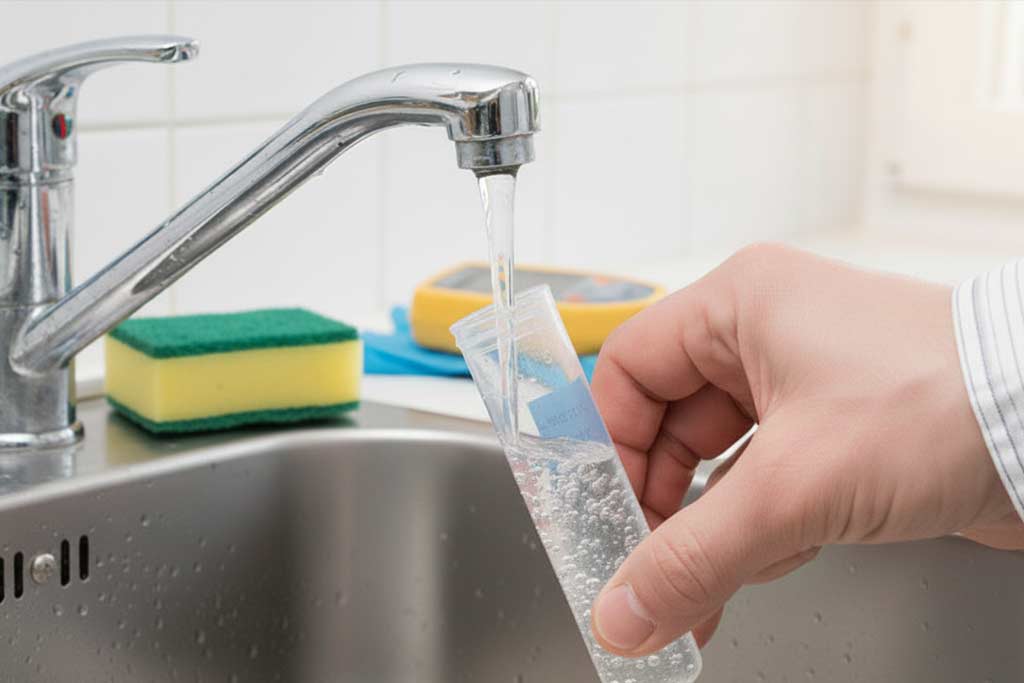
We sample at your tap and submit to a certified New Jersey laboratory. For Clifton and Passaic County homes, the most relevant contaminants include:
- Lead and copper — first-draw sampling at the faucet; critical in Clifton’s older housing stock
- PFAS — documented in the Passaic River watershed; increasingly important for any comprehensive baseline
- Chloramine and disinfection byproducts — trihalomethanes and haloacetic acids from Passaic Valley Water Commission supply
- Iron and manganese — present in portions of the distribution system and older supply lines
- Hardness — Passaic County water runs moderately hard, with real effects on appliances and fixtures
- Bacteria and total coliform — relevant in older buildings with complex internal plumbing
- pH and alkalinity — indicates how aggressively water interacts with your pipes
What Clifton Homeowners Notice — and What It Usually Means
In a dense urban environment, it’s easy to chalk water issues up to “just how things are here.” But these signals are worth paying attention to rather than accepting:
- A persistent chlorine or chemical smell that’s most noticeable in the shower or when boiling water
- A metallic or slightly bitter taste in the first glass drawn in the morning
- White scale accumulating on faucet aerators, showerheads, and inside the kettle
- Orange or brownish staining around sink drains, in toilet tanks, or on laundry
- Skin that feels dry or slightly irritated after bathing with no change in products
- Cloudy water when first turned on after several hours of non-use
Common Water Problems in Passaic County — Causes and Solutions
| What You’re Noticing | Likely Cause | Typical Solution |
|---|---|---|
| Chemical smell in shower | Chloramine disinfection byproducts | Whole-home carbon block filtration |
| Metallic taste, morning draw | Lead or copper from older plumbing | Lead test + point-of-use reverse osmosis |
| Orange staining in sink or toilet | Iron or manganese in distribution lines | Iron filtration system |
| Scale on fixtures and appliances | Hard water — elevated minerals | Water softener installation |
| Older home, no obvious symptoms | Invisible contaminants — PFAS, lead, bacteria | Comprehensive baseline test |
What Water Testing Costs in Clifton
A standard residential water test in Clifton typically runs $150–$500 depending on the panel. A basic panel covering lead, bacteria, hardness, and disinfection byproducts is the right starting point for most Passaic County homeowners. Adding PFAS screening provides a more thorough baseline given the watershed’s documented contamination profile.
If treatment is needed, a whole-home carbon filtration system runs $1,500–$4,500. A water softener for hard water is $1,800–$5,000+. Point-of-use reverse osmosis for lead or PFAS starts around $400–$800 installed. Results always come before recommendations.
Serving Clifton and the Surrounding Passaic County Area
We serve homeowners throughout Clifton and nearby Passaic County communities — including Paterson, Passaic, Nutley, and Bloomfield — which share the same Passaic River source water and distribution infrastructure. Our full New Jersey service area is available if you’re looking for coverage elsewhere in the state.
Frequently Asked Questions — Water Testing in Clifton, NJ
Is PFAS in Clifton’s water a real concern?
PFAS has been documented in the Passaic River watershed from industrial discharge and firefighting foam at sites throughout the region. The Passaic Valley Water Commission tests for PFAS and reports results publicly. However, plant-level results don’t tell you what’s arriving at your specific tap — particularly in older homes with complex plumbing. A direct test at your faucet is the only way to know your address-specific level.
How serious is lead risk in Clifton’s older homes?
Homes built before 1986 are the highest-risk category for lead from solder and fixtures. Clifton has substantial housing stock from the 1920s through 1960s, which means lead in internal plumbing is a real and common concern. A first-draw lead test at your kitchen tap is inexpensive and gives you a direct answer for your home rather than a general one about the city.
The water smells like chemicals when I shower — is that harmful?
The smell comes from chloramine volatilizing in warm water — it’s the disinfectant the Passaic Valley Water Commission uses throughout the distribution system. At the concentrations used for disinfection it’s not a direct health emergency, but the byproducts it forms over time are regulated for a reason. A whole-home carbon filter eliminates the smell and the byproducts effectively.
How do I schedule a test?
Call us or schedule online. We’re typically able to book within a few days, the on-site visit takes under an hour, and lab results come back within 3–7 business days. We follow up to walk through results with you when they’re ready.
Do you test apartments and rental units in Clifton?
Yes. We test any residential property. Tenants, landlords, and property managers all have reasons to know what’s in the water, and we work with all of them throughout Passaic County.
Get Your Clifton Water Tested
If you live in Clifton and have questions about your water — whether it’s a smell you’ve been ignoring, a taste you’ve accepted as normal, or just a baseline you’ve never established — a professional test is the most direct path to answers. Call us at (732) 357-1988 or schedule online.