What’s Actually in Your Jersey City Tap Water — and Why the Answer Might Surprise You
Jersey City sits on top of one of the most complex water systems in New Jersey. The city draws from multiple sources — the Hackensack and Passaic river watersheds, the Jersey City Reservoir system, and in some areas, supplemental supply from neighboring utilities. For homeowners across Hudson County, that complexity means water quality can vary significantly from one neighborhood to the next, and sometimes from one block to another. The brownstone in the Heights and the condo in Downtown Jersey City may be on the same municipal system but experience very different water at the tap.
There’s also the infrastructure factor. Much of Jersey City’s residential plumbing stock runs through buildings that are decades old — in some cases, over a century. Lead solder, galvanized steel, and older brass fixtures are common in the housing that makes up large portions of the city’s neighborhoods. The water that leaves the treatment plant clean can pick up contaminants on the way to your glass. A professional water quality test is the only way to know what’s actually arriving at your faucet.
The Jersey City Water Story Most Residents Don’t Know
Jersey City’s water has had documented quality issues over the years — including periods of elevated disinfection byproduct levels, turbidity events, and infrastructure-related concerns tied to its aging distribution network. The city’s water supply infrastructure includes mains that date back to the early 1900s, and while ongoing upgrades are underway, the pace of replacement hasn’t kept up with the age of the system.
Chloramine is used as the primary disinfectant in Jersey City’s municipal supply, which controls bacterial growth effectively but produces trihalomethanes and haloacetic acids as byproducts — compounds that have their own health implications at elevated concentrations. Homeowners in Greenville, Bergen-Lafayette, and the West Side frequently report a persistent chemical taste or smell that points directly to this disinfection chemistry. That smell is not a sign your water is unsafe, but it is a sign your water has a chemical profile worth understanding.
Hudson County’s urban density also means industrial history is never far away. PFAS contamination — from manufacturing, firefighting foam, and industrial discharge — has been documented in New Jersey groundwater and surface water at numerous sites. For homes near former industrial corridors along the waterfront or Hackensack River tributaries, extended PFAS testing is increasingly a reasonable precaution rather than an overreaction.
How We Test Water in Jersey City Homes
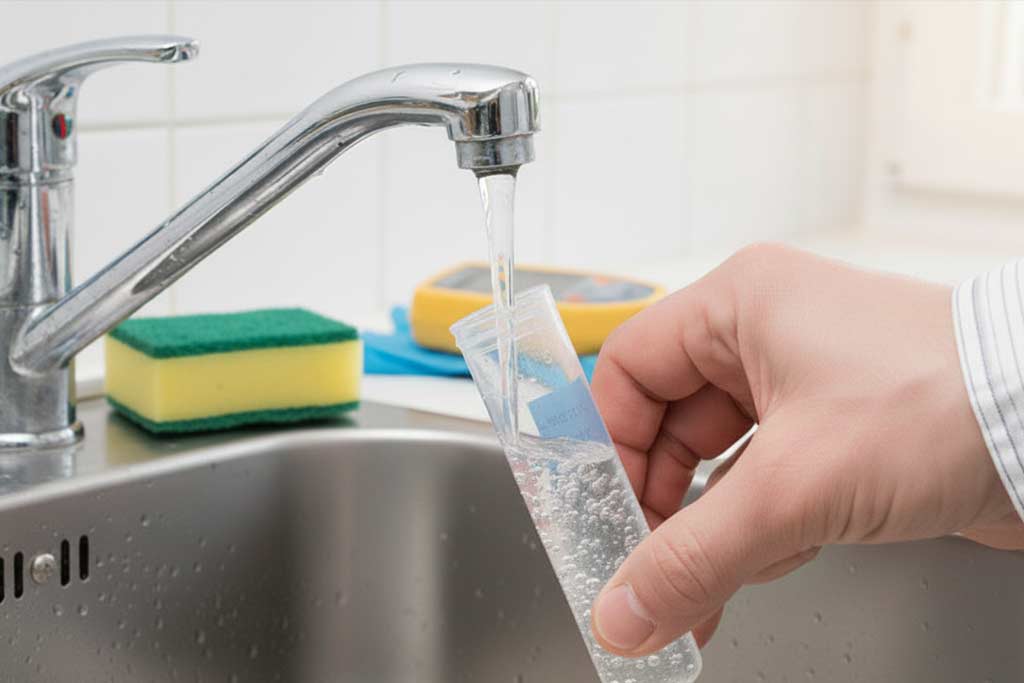
We come to your home, collect samples from your actual tap — not from a street-level test port or a neighbor’s property — and send them to a certified New Jersey laboratory for analysis. Every result gets explained to you in plain language. We don’t hand you a printout and leave. We tell you what each number means for your household specifically, what the acceptable ranges are, and whether anything warrants follow-up.
For Jersey City homes, our standard testing panel covers:
- Lead and copper — first-draw sampling at the tap, where exposure risk is highest
- Bacteria and total coliform — important in buildings with older internal plumbing or after any water main work nearby
- Chlorine, chloramine, and disinfection byproducts — relevant for all municipal water customers in Hudson County
- Hardness and mineral content — Jersey City water tends toward moderate hardness, which affects appliances, fixtures, and skin
- Nitrates — a concern near areas with historical industrial or agricultural land use
- pH and alkalinity — determines how corrosive your water is to the pipes it travels through
Extended panels covering PFAS, volatile organic compounds, and heavy metals beyond lead and copper are available for homeowners who want a more complete baseline — or who have specific concerns about the history of their building or neighborhood.
Warning Signs Jersey City Homeowners Tend to Dismiss
Water quality problems in urban homes are easy to rationalize away. You tell yourself it’s just the building, just old pipes, just how city water tastes. Sometimes that’s true. But sometimes it’s a signal that something in your water supply deserves a closer look. These are the signs worth paying attention to:
- A chemical, bleach, or swimming pool smell — most noticeable in the shower or when running hot water
- A metallic, flat, or slightly bitter taste that filtered pitchers don’t fully resolve
- White or gray scale accumulating on faucet aerators, showerheads, and around toilet bowl rims
- Orange or reddish staining in sinks, tubs, or around drains — often iron or manganese
- Skin that feels dry or tight after showering despite no changes in soap or routine
- Water that runs slightly cloudy or discolored when first turned on, especially after the building’s water hasn’t been used for several hours
Common Problems Found in Hudson County Homes — and What They Mean
| What You’re Noticing | Likely Cause | Typical Solution |
|---|---|---|
| Chemical or chlorine smell | Chloramine disinfection byproducts | Whole-home carbon block filtration |
| Metallic or bitter taste | Lead or copper from aging interior plumbing | Lead test + point-of-use reverse osmosis |
| Scale on fixtures and appliances | Hard water mineral content | Water softener installation |
| Rust or orange staining | Iron or manganese in supply | Iron filtration system |
| No symptoms but older building | Invisible contaminants — lead, PFAS, bacteria | Comprehensive baseline test |
What Water Testing Costs in Jersey City
A standard residential water test in the Jersey City area typically runs between $150 and $500 depending on the scope of analysis. A basic panel covering lead, bacteria, hardness, and key minerals covers the most common concerns for Hudson County homeowners. A comprehensive panel that adds PFAS, disinfection byproducts, and extended heavy metals will run higher — and for older buildings or homes near former industrial areas along the waterfront, that broader picture is often worth getting once as a baseline.
If results point toward treatment, costs depend on the technology needed. A whole-home filtration system for chloramine and byproduct reduction typically runs $1,500–$4,500 installed. A water softener for hard water is generally $1,800–$5,000+. Point-of-use reverse osmosis systems for lead or PFAS reduction start around $400–$800 installed. We present results first — there’s no package waiting for you at the end of the appointment.
Nearby Areas We Also Serve in Hudson County
We serve homeowners throughout Jersey City and the surrounding Hudson County area. Many of the water quality concerns that show up in Jersey City — aging infrastructure, disinfection byproducts, lead in older plumbing — are equally common in nearby Hoboken, Bayonne, Union City, and Secaucus. If you’re in any of those communities, we cover those areas as well. You can also browse our full New Jersey service area list to find coverage in your town.
Frequently Asked Questions — Water Testing in Jersey City, NJ
Is Jersey City tap water safe to drink?
Jersey City’s municipal water meets federal drinking water standards at the treatment level. But compliance at the plant doesn’t mean the water arriving at your tap is free of contaminants. Lead from internal plumbing, disinfection byproducts from chloramine treatment, and other issues can develop between the main and your faucet. Testing at your tap is the only way to get an address-specific answer.
I live in a newer building — do I still need to test?
Newer construction typically uses lead-free materials, which lowers one category of risk. But it doesn’t eliminate concerns about disinfection byproducts, hardness, or PFAS — all of which originate in the water supply itself, not in your building’s plumbing. Testing is still worthwhile, and a basic panel gives you a reliable baseline.
What’s the deal with the chlorine smell in Jersey City water?
Jersey City uses chloramine rather than straight chlorine for disinfection. Chloramine is more persistent in the distribution system, which is why the smell tends to linger rather than dissipate quickly. It’s not a health emergency, but it’s a real quality-of-life issue — and it’s one that a carbon-based whole-home filter handles effectively.
How quickly can I get tested?
We’re typically able to schedule within a few days. The on-site portion of the visit takes less than an hour. Lab results are usually back within 3–7 business days, and we follow up to walk through them with you directly.
Do you serve renters or just homeowners?
We work with anyone who wants to understand their water quality. Renters, condo owners, landlords, and homeowners all have legitimate reasons to test — and understanding what’s in your water is useful regardless of whether you own the building.
Get Your Jersey City Water Tested
If you’ve been living with a water taste or smell you can’t quite explain, or you’re moving into a home in Hudson County and want a clean baseline before you settle in — this is the straightforward next step. We come to you, test what’s actually in your water, and give you honest answers. Call us at (732) 357-1988 or schedule online and we’ll get you on the calendar.