The Hidden Water Quality Crisis Most Newark Homeowners Never See Coming
Newark made national news for a reason. The city’s aggressive lead pipe replacement program — one of the largest in the country — was a direct response to elevated lead levels detected in drinking water across dozens of neighborhoods. And while significant progress has been made, the story doesn’t end at the water main. Lead can still leach into your water between the city’s service line and the faucet in your kitchen, through internal plumbing, older fixtures, and brass components that most homeowners never think twice about. If your home in Essex County was built before 1986, there’s a real chance that the pipes inside your walls are part of the problem — and your water could be showing it in ways you’re not recognizing yet.
A professional water quality test is the only way to know what’s actually coming out of your tap. Not what the city reports. Not what your neighbor assumes. What’s in your specific water, at your specific address, today.
Newark’s Water Infrastructure Has a Long Memory
The water coming into Newark homes travels through a system that was built in layers over decades — some of it modern, some of it aging cast iron or galvanized steel, and some of it, in older sections of the city, still original lead service piping. Even homes that received new service lines under the city’s remediation program can still have lead solder, lead-containing fixtures, or old galvanized lines inside the structure itself. The water that tests clean at the meter doesn’t always test clean at the glass.
Beyond lead, Newark’s municipal supply is treated with chloramine — a combination of chlorine and ammonia — which is more stable than chlorine alone but produces different disinfection byproducts over time. Homeowners across the Ironbound district, Upper Vailsburg, and the North Ward frequently report a chemical taste or bleach-like smell that isn’t dangerous on its own, but is a signal worth paying attention to. In some cases, it’s an indicator that filtration would meaningfully improve the water coming into your home.
Sediment and turbidity are also common in Newark’s older distribution lines. After any kind of pressure change — a nearby main break, construction vibration, even a fire hydrant being flushed — that sediment gets stirred up and flows into homes. It usually clears within hours, but it’s a reminder that what you see isn’t always the full picture of what you’re drinking.
What We Test For — and Why It Matters in This Part of New Jersey
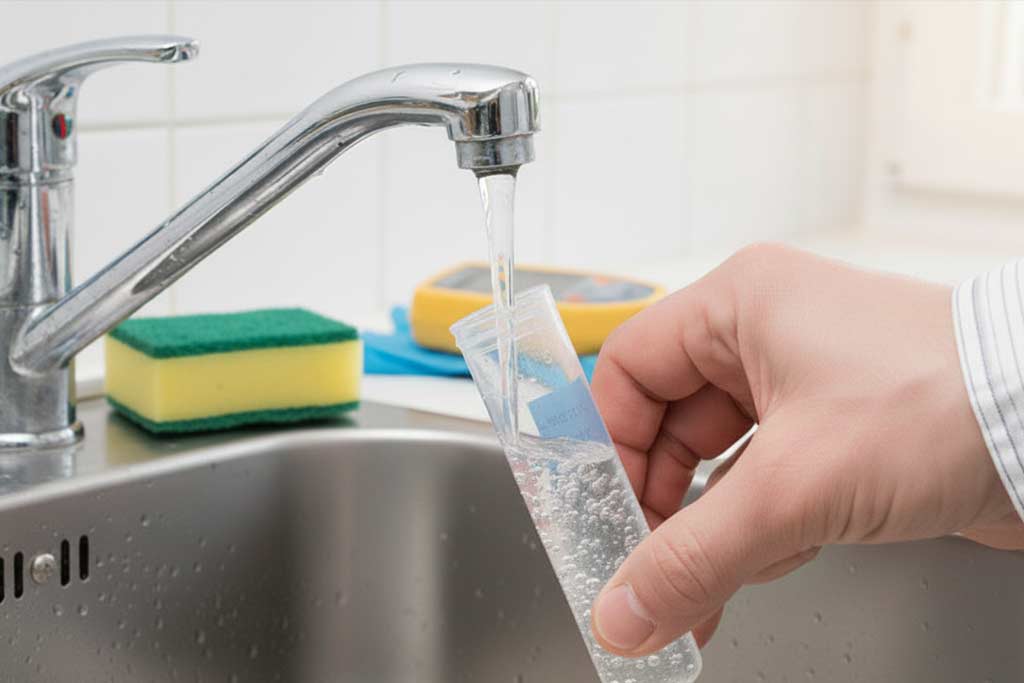
Our residential water testing process is designed to give you a complete picture, not just a pass/fail on one contaminant. We collect samples directly from your tap — not a street-level access point — and send them to a certified New Jersey laboratory for full analysis. Results typically come back within a few days, and we walk you through every number in plain language.
For Newark-area homes, our standard panel covers:
- Lead and copper — tested at the first draw, which is where risk is highest
- Bacteria and coliform — especially relevant if plumbing has been disturbed or a property sat vacant
- Hardness and mineral content — Essex County water tends to run moderately hard, which affects appliances and skin
- Chlorine and disinfection byproducts — relevant for municipal customers on chloramine treatment
- Nitrates and nitrites — a concern in areas with older infrastructure or nearby industrial history
- pH and alkalinity — affects corrosivity and how aggressively water interacts with your pipes
PFAS screening is available as an extended panel and is increasingly requested by homeowners who want a comprehensive baseline — particularly in communities with any history of industrial activity in the surrounding watershed. Newark and the surrounding Essex County corridor has that history.
Signs Your Water Is Telling You Something
Most water quality problems don’t announce themselves with dramatic symptoms. They build quietly — in the scale on your showerhead, in the way your skin feels after a shower, in a taste you’ve written off as “just how Newark water tastes.” Here are the signals that should prompt a test sooner rather than later:
- A metallic, bitter, or flat taste that persists even with filtered pitchers
- A chlorine or chemical smell, especially noticeable when running hot water or showering
- White or yellowish scale building up on faucets, inside the kettle, or around the toilet tank rim
- Reddish or brown staining in sinks or tubs — often iron or manganese
- Dry skin or dull hair that doesn’t improve with product changes
- Water that runs discolored for several minutes after a period of non-use
None of these symptoms confirm a specific problem on their own. But each one is a reasonable reason to stop guessing and get data.
What Water Problems Look Like — and What Fixes Them
| What You’re Noticing | Likely Cause | Typical Solution |
|---|---|---|
| Metallic or bitter taste | Lead or copper from older plumbing | Lead test + point-of-use reverse osmosis filter |
| Chlorine or bleach smell | Chloramine disinfection in municipal supply | Whole-home carbon block filtration |
| White crusty scale on fixtures | Hard water — elevated calcium and magnesium | Water softener installation |
| Rust-colored staining in sinks | Iron or manganese in water supply | Iron filtration system |
| No obvious symptoms | Invisible contaminants — lead, bacteria, PFAS | Comprehensive baseline test |
What It Costs to Test Your Water in Newark
A standard residential water quality test in the Newark area typically runs between $150 and $500 depending on which contaminants are included and whether laboratory analysis is required for specific panels. Basic testing covering lead, bacteria, hardness, and key minerals falls toward the lower end. A comprehensive panel that includes PFAS, disinfection byproducts, heavy metals, and extended chemistry will run higher — and for many homeowners in Essex County, that broader picture is worth having once, especially in an older home.
If testing reveals that treatment is needed, system costs vary by technology and scope. A point-of-use filter for lead removal can start around $300–$600 installed. A whole-home water filtration system typically runs $1,500–$4,500. A full water softener installation for hard water ranges from $1,800–$5,000+. We always present results before recommending anything, and there’s no obligation attached to the test itself.
Serving Newark and the Surrounding Essex County Communities
We work with homeowners across Newark and throughout Essex County — including East Orange, Irvington, Bloomfield, and Belleville, where many of the same infrastructure concerns and water quality patterns show up. If you’ve been comparing notes with a neighbor in Belleville or heard about water issues from someone in Bloomfield, those conversations are worth taking seriously. The same aging distribution network that serves Newark feeds much of this region, and the problems don’t stop at city limits.
Our team is familiar with the specific conditions in this part of North Jersey — the geology, the infrastructure age, the water treatment history — and that context shapes how we interpret test results and what we recommend. A number that’s borderline in one type of home might be a clear action item in another.
You can also view our full list of New Jersey service areas if you’re looking for coverage in another community.
Frequently Asked Questions — Water Testing in Newark, NJ
Is Newark tap water safe to drink right now?
Newark’s municipal water meets federal Safe Drinking Water Act standards at the treatment plant. The problem is what happens between the plant and your faucet. Older service lines, internal plumbing, and lead-containing fixtures can introduce contaminants that never show up in the city’s public reports. The only way to know what’s in your water at your address is to test it directly.
My home had its lead service line replaced. Do I still need to test?
Yes. Lead service line replacement addresses one source of contamination, but it doesn’t eliminate all of them. Lead solder used in older plumbing, brass fixtures, and galvanized interior lines can all continue to contribute lead to drinking water even after the street-side line has been replaced. Testing gives you a current, address-specific answer.
How long does it take to get results?
Most standard panels come back from the laboratory within 3–7 business days. We’ll contact you as soon as results are available and schedule time to walk through them with you — not just email you a spreadsheet of numbers.
Can water look perfectly clear and still be dangerous?
Absolutely. Lead, bacteria, nitrates, PFAS, and many other contaminants have no color, no smell, and no taste at the levels that matter for health. Clear water is not a safety guarantee — it’s just an absence of obvious visual indicators.
What if my test comes back showing a problem?
We explain what was found, what it means for your household specifically, and what the realistic options are for addressing it. Treatment recommendations are matched to what was actually detected — not a one-size-fits-all product pitch. You leave the conversation with a clear picture and complete control over the next steps.
Schedule Your Water Test in Newark
If you’re in Newark or anywhere in Essex County and you’ve had a question in the back of your mind about your water — this is how you get an answer. We come to you, we test what’s actually coming out of your tap, and we tell you the truth about what we find. No upselling. No pressure. Just data and a straight conversation about what it means.
Call us at (732) 357-1988 or schedule online — we’re typically able to book within a few days.