Paterson’s Aging Water System and the Contaminants Most Homeowners Never Think to Test For
Paterson is one of New Jersey’s oldest cities, and its water infrastructure reflects that history in ways that matter for the people living here today. The Passaic River — which supplies the region’s water — has one of the most documented contamination histories of any waterway in the Northeast. Industrial discharge, combined sewer overflows, and decades of upstream pollution have left the river in a state of ongoing remediation. Treatment facilities do their job, but between the Passaic River intake, the treatment plant, and the faucet in a home built in 1920, a lot can happen to water quality.
For Paterson homeowners, this isn’t abstract. It shows up in the taste of your tap water, the scale on your fixtures, and in some cases, in contaminants that have no taste or smell at all. A professional water quality test is the most direct way to move from concern to clarity.
What Paterson’s Water System Is Actually Up Against
The Passaic Valley Water Commission supplies water to Paterson and much of Passaic County, drawing primarily from the Passaic River and treating it to federal standards before distribution. The treatment process is rigorous — but it was designed to address the expected contamination profile of the source water, not necessarily emerging contaminants or the effects of aging distribution infrastructure downstream.
Paterson’s housing stock is among the oldest in New Jersey. Homes in the neighborhoods around the Great Falls, the Eastside, and Bunker Hill were built in eras when lead solder and lead service lines were standard. Even homes that appear to have modern plumbing may have lead-containing components at fixture connections or at points where newer pipes connect to older infrastructure. The water leaving the treatment plant is lead-free. By the time it reaches an older home’s first-floor faucet, that may no longer be true.
Chloramine is used for disinfection throughout this distribution system — the same chemistry used in much of North Jersey — which means disinfection byproducts are a consistent background concern for Paterson homeowners. Nearby Clifton, Wayne, Totowa, and Fair Lawn draw from the same source water system and share many of the same water quality characteristics.
What We Screen for in Paterson Area Homes
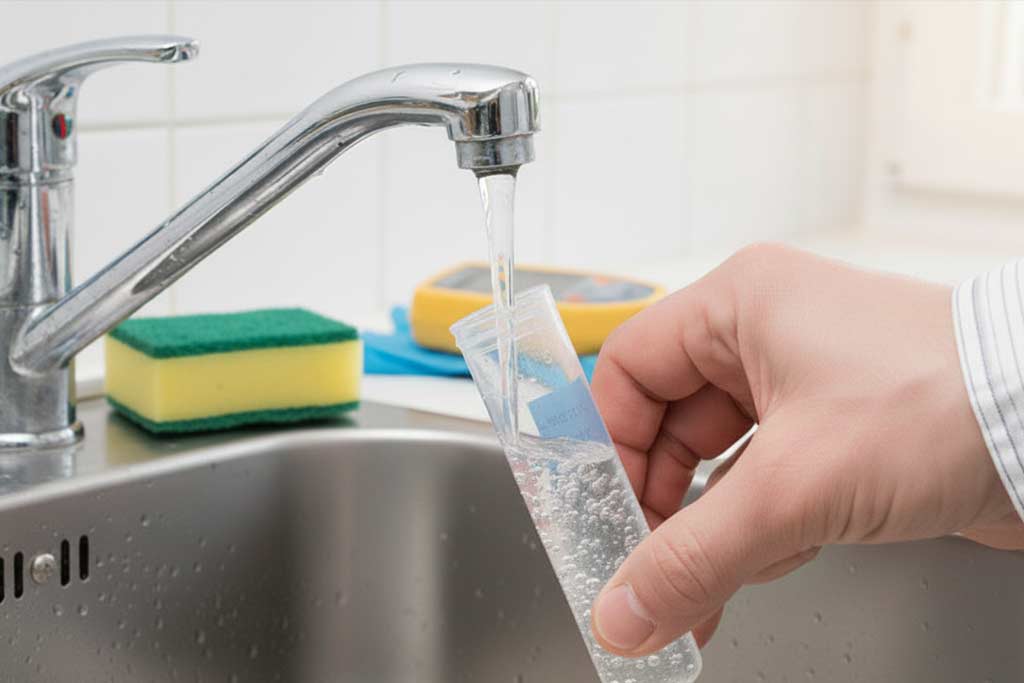
Our water testing process collects samples directly from your tap and submits them to a certified New Jersey lab. For homes in Paterson and across Passaic County, the most relevant contaminants to screen for include:
- Lead and copper — first-draw sampling at the faucet, critical in pre-1986 construction
- Chloramine and disinfection byproducts — trihalomethanes and haloacetic acids from Passaic Valley Water Commission supply
- Bacteria and total coliform — important in older buildings with complex internal plumbing
- Iron and manganese — present in portions of the Passaic watershed and aging distribution lines
- Nitrates — a concern given the river’s agricultural and industrial upstream inputs
- pH and alkalinity — indicates corrosivity and interaction with your home’s plumbing
- PFAS — documented in portions of the Passaic River watershed from industrial sources
The Symptoms Paterson Homeowners Accept as Normal — But Shouldn’t
In a city with older housing and a municipal water system that’s been around for generations, it’s easy to assume that the way your water tastes and smells is just how it is. It isn’t. These are signs worth taking seriously:
- A persistent chlorine or chemical smell — stronger in hot showers than at the kitchen tap
- A flat or slightly metallic taste, especially in the first glass drawn in the morning
- Brown or orange staining on porcelain fixtures, in toilet tanks, or on laundry
- Scale or white mineral buildup on faucet aerators and showerheads
- Dry, irritated skin after bathing that doesn’t resolve with product changes
- Water pressure fluctuations that suggest scale buildup inside pipes
Common Water Issues in Passaic County Homes
| What You’re Noticing | Likely Cause | Typical Solution |
|---|---|---|
| Chemical or chlorine smell | Chloramine disinfection byproducts | Whole-home carbon block filtration |
| Metallic taste, morning draw | Lead or copper from older plumbing | Lead test + point-of-use reverse osmosis |
| Brown or orange fixture staining | Iron or manganese in distribution lines | Iron filtration system |
| Scale on fixtures and appliances | Hard water mineral content | Water softener installation |
| No symptoms, pre-1986 home | Invisible lead from solder or service line | Lead-specific first-draw test |
Cost of Water Testing in Paterson, NJ
A standard residential water quality test in Paterson typically costs $150–$500 depending on which contaminants are included. A basic panel covering lead, bacteria, hardness, and chloramine byproducts addresses the most common concerns for Passaic County homeowners. An extended panel adding PFAS and organic compounds provides a more complete picture for older homes or those with specific concerns about the Passaic River watershed’s contamination history.
If treatment is needed, a whole-home carbon filtration system for chloramine and byproduct reduction runs $1,500–$4,500. A water softener for hard water is $1,800–$5,000+. Point-of-use reverse osmosis for lead or PFAS starts around $400–$800 installed. Results are always reviewed with you before any treatment discussion.
Serving Paterson and Nearby Passaic County Communities
We work with homeowners throughout Paterson and across Passaic County. The water quality patterns we see here — chloramine byproducts, lead in older plumbing, iron staining — are consistent in nearby Clifton, Wayne, Totowa, and Fair Lawn, which draw from the same source water system. We serve all of those communities. You can find our complete coverage area on our New Jersey service area page.
Frequently Asked Questions — Water Testing in Paterson, NJ
Is Paterson tap water safe to drink?
Paterson’s municipal water meets federal and state drinking water standards at the treatment plant. The more relevant question for homeowners is what happens between the plant and your faucet — particularly in older homes where lead solder, galvanized pipes, or aged brass fixtures may be introducing contaminants after treatment. Testing at your tap gives you an address-specific answer that the city’s annual water report cannot.
How serious is the lead risk in Paterson’s older homes?
It depends on the specific plumbing in your home. Homes built before 1986 are most likely to have lead solder at pipe joints; homes built before 1950 may have lead service lines. If you don’t know what your home’s plumbing looks like internally, a first-draw lead test is a reasonable and low-cost way to find out whether there’s an issue worth addressing.
The water smells like chlorine when I shower. Is that normal?
It’s common in municipal water systems that use chloramine, but common doesn’t mean ideal. Chloramine volatilizes in hot water, which is why the smell is most noticeable in showers. At the levels used for disinfection it’s not a direct health hazard, but the byproducts it produces over time are worth understanding — and a carbon-based filtration system removes them effectively.
How do I know if my water has PFAS?
You can’t detect PFAS by taste, smell, or appearance — it requires laboratory testing. Given the documented PFAS presence in portions of the Passaic River watershed, it’s a reasonable addition to a comprehensive water test, particularly for homeowners who want a thorough baseline rather than just a check on the most obvious concerns.
What happens after the test?
We walk through the results with you in plain language — what was found, what it means, and what (if anything) should be done about it. There’s no obligation to purchase treatment, and we don’t recommend solutions that don’t match what the test actually showed.
Get Your Paterson Home’s Water Tested
If you’re living in an older Paterson home and have never had your water tested — or if you’ve noticed taste, smell, or staining issues you’ve been putting off — a professional water quality test is the straightforward next step. We serve Paterson and all of Passaic County. Call us at (732) 357-1988 or schedule online.