Summit Is One of New Jersey’s Most Desirable Towns. Its Older Homes Carry Water Quality Risks Most Residents Don’t Know About.
Summit’s real estate market reflects its reputation — well-maintained homes, top-tier schools, a walkable downtown that draws buyers from across the state. What draws less attention is what’s inside the walls of Summit’s older housing stock. This is a town with a significant inventory of pre-war and early postwar homes, many of them beautifully renovated on the surface, with plumbing that hasn’t changed since they were built. Lead solder at pipe joints, galvanized steel supply lines, brass fixtures with lead content — these aren’t hypothetical concerns in Summit. They’re standard features of homes built in the 1920s, 1930s, and 1940s that make up a substantial portion of the town’s residential landscape.
Union County’s water supply delivers treated water that meets regulatory standards at the plant. The question for Summit homeowners — especially in the older neighborhoods around the center of town — is what that water picks up between the plant and the glass. A professional water quality test answers that question with data rather than assumptions.
Summit’s Water Supply and the Infrastructure That Carries It
Summit receives water from New Jersey American Water, drawing primarily from the Raritan River system and treating to meet New Jersey DEP and federal Safe Drinking Water Act standards. The Raritan Basin has documented PFAS contamination from historical industrial and agricultural sources, and disinfection byproduct levels in surface water systems tend to be higher than in groundwater-fed supplies — both of which are relevant considerations for Summit homeowners who want a complete picture of their water quality.
Hard water is a consistent characteristic across Union County, including Summit. Calcium and magnesium at the levels typical of this region produce scale on fixtures, accelerated appliance wear, and the skin and hair effects that many homeowners have attributed to everything except the water itself. Nearby New Providence, Chatham, Berkeley Heights, and Millburn share the same regional supply and the same water quality profile.
For Summit’s older homes specifically, corrosivity and lead risk are the water quality concerns most worth prioritizing. Hard, slightly acidic water traveling through older plumbing picks up lead and copper at pipe joints and fittings — producing the metallic taste that’s most noticeable first thing in the morning and that no pitcher filter fully eliminates.
What We Test for in Summit Homes
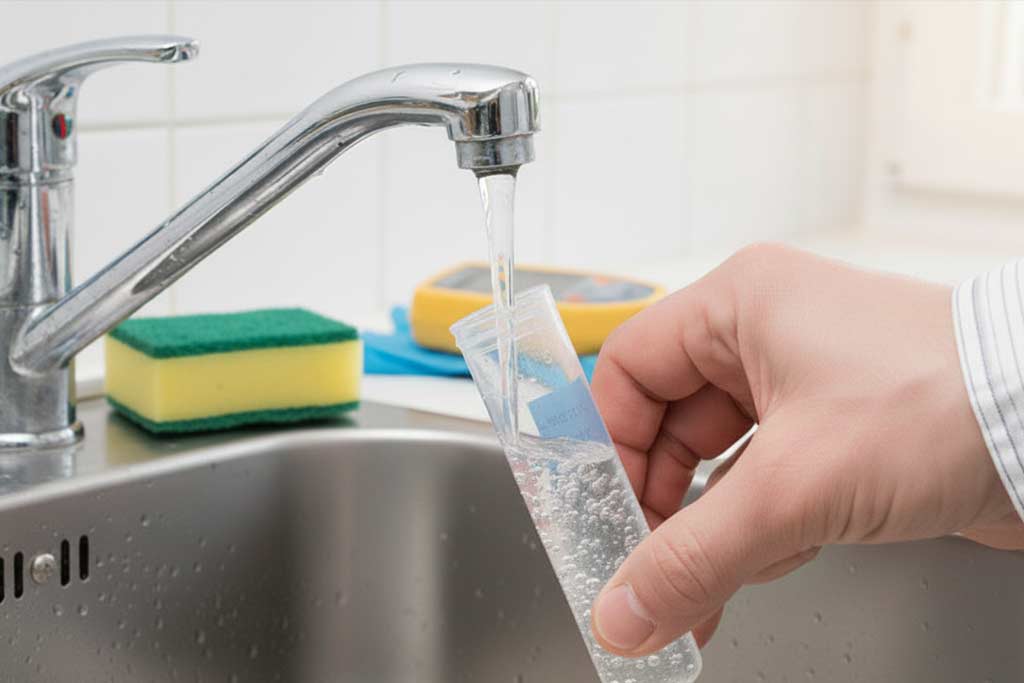
We collect samples at your tap and send to a certified New Jersey laboratory. For Summit and Union County homes, the most relevant contaminants to evaluate include:
- Lead and copper — first-draw sampling at the faucet; the single most important test for Summit’s pre-war housing stock
- Hardness — calcium and magnesium levels driving scale and appliance wear across Union County
- PFAS — documented in the Raritan watershed; a reasonable addition to any comprehensive panel
- Chlorine and disinfection byproducts — consistent concern for New Jersey American Water customers in the area
- Bacteria and total coliform — relevant after plumbing work or in homes that have had supply disruptions
- Iron and manganese — can be present in aging distribution lines serving older sections of Summit
- pH and alkalinity — determines corrosivity and interaction with older plumbing materials
What Summit Homeowners Notice — and What It’s Actually Telling Them
Summit homeowners tend to be analytically minded — they notice things. Here are the water quality signals that are worth investigating rather than accommodating:
- A faint metallic taste in the first glass of water drawn in the morning — especially pronounced after the water has sat in pipes overnight
- Scale inside the coffee maker, on showerhead faces, and around faucet bases that builds back quickly after cleaning
- A chlorine or chemical smell that’s notably stronger in hot showers than at the kitchen tap
- Skin and hair that feel different after showering at home versus elsewhere — often a hard water signal
- Glassware and dishes with a hazy film despite quality dishwasher detergent
- Appliances — water heaters and dishwashers in particular — requiring maintenance or replacement ahead of schedule
Water Quality Issues Common in Summit — Causes and Solutions
| What You’re Noticing | Likely Cause | Typical Solution |
|---|---|---|
| Metallic taste, morning draw | Lead or copper from older interior plumbing | Lead test + point-of-use reverse osmosis |
| Scale on fixtures and appliances | Hard water — elevated calcium and magnesium | Water softener installation |
| Chemical smell in hot shower | Chloramine disinfection byproducts | Whole-home carbon block filtration |
| Hazy film on glassware | Hard water mineral deposits | Water softener installation |
| Pre-war home, no obvious symptoms | Invisible lead or PFAS contamination | Comprehensive baseline test |
What Water Testing and Treatment Costs in Summit
A standard residential water test in Summit typically runs $150–$500 depending on scope. A panel covering lead, hardness, bacteria, and disinfection byproducts is the right starting point for most Union County homeowners in older housing. Adding PFAS provides a complete picture for homes near historically affected portions of the Raritan watershed.
If treatment is warranted, a water softener installation for hard water typically runs $1,800–$5,500+. A whole-home filtration system for byproducts or chemical concerns is $1,500–$4,500. Point-of-use reverse osmosis for lead or PFAS starts around $400–$800 installed. We always review results with you before any treatment discussion.
Serving Summit and Nearby Union County Communities
We serve homeowners throughout Summit and across Union County, including New Providence, Chatham, Berkeley Heights, and Millburn — all drawing from the same regional water supply with the same underlying water quality characteristics. Our full New Jersey service area covers communities statewide, and our water testing service page details what each panel includes.
Frequently Asked Questions — Water Testing in Summit, NJ
My Summit home is from the 1930s — is lead testing really necessary?
Yes, and it’s among the most important things you can do. Homes from that era were built with lead solder as standard, and many have original service connections that predate modern lead-free requirements. The metallic taste you may notice first thing in the morning is a common indicator — but lead can be present at concerning levels even without a noticeable taste. A first-draw test at your kitchen faucet is the only reliable way to know.
Does Summit have hard water?
Yes. Union County water, including the supply serving Summit, tends toward moderate to significant hardness. The scale on your fixtures, the haze on your glassware, and the dry skin after showering are all consistent with hard water at the levels typical in this area. A test gives you the specific number so you can make an informed decision about whether a softener makes sense for your household.
Is PFAS in Summit’s water worth testing for?
It’s a reasonable addition to any comprehensive panel given the Raritan watershed’s documented PFAS profile. New Jersey American Water tests for PFAS at the plant level, but those results don’t reflect what’s arriving at your specific faucet — particularly in a home where aging plumbing may be introducing additional variables along the way.
How quickly can I get scheduled?
Typically within a few days. The on-site visit takes under an hour, and lab results are back within 3–7 business days. We follow up to walk through them with you directly when they’re ready.
We just renovated our Summit home — do we still need to test?
It depends on the scope of the renovation. If kitchens and bathrooms were updated with new supply lines and fixtures, lead risk at those specific points is reduced. But if the main service line, basement plumbing, or older lateral connections weren’t replaced, lead can still be present upstream of your new fixtures. A post-renovation test is a smart way to confirm the work actually solved the problem rather than just moved it.
Schedule Your Summit Water Test
If you own an older home in Summit and have questions about your water — or if you’ve noticed any of the symptoms described above and haven’t connected them to the water supply — a professional test is the most direct way to get real answers. We serve Summit and all of Union County. Call us at (732) 357-1988 or schedule online.