Why Toms River Homeowners Are Taking a Much Closer Look at Their Drinking Water
Toms River has a water quality history that most residents know about in general terms but fewer have acted on personally. Ocean County sits atop a complex aquifer system that has been impacted by decades of industrial activity, landfill contamination, and the legacy of one of New Jersey’s most significant environmental cases. The Ciba-Geigy chemical plant contamination, the Reich Farm Superfund site, and the broader groundwater plume issues that affected parts of the township for years have left a generation of Toms River homeowners with lingering questions about what’s in their water — questions that a professional test can actually answer.
Whether your home is on Ocean County municipal water or a private well, the case for knowing exactly what’s in your supply is stronger here than in most parts of New Jersey. The good news is that testing is straightforward, results are specific to your address, and the answers are almost always more useful than the anxiety of not knowing.
Ocean County’s Water Quality Landscape — What the History Means for Your Home Today
The contamination events that affected Toms River in the 1980s and 1990s are largely remediated, but the groundwater in this part of Ocean County continues to be monitored for residual contamination. For homeowners on private wells — which are common in the more rural and semi-rural sections of the township — that monitoring doesn’t extend to your property. You are responsible for your own well water, and regular testing is the only way to know whether anything has changed.
For homes on municipal water, Toms River’s public supply draws primarily from the Cohansey and Kirkwood-Cohansey aquifers, which are among the most productive in the state but also among the most susceptible to surface contamination. The Jersey Shore’s proximity means seasonal population swings that can affect treatment demand, and the aging infrastructure in older sections of the township introduces the same lead and corrosion concerns found throughout New Jersey’s residential housing stock.
Nearby Brick, Lakewood, and Manchester Township share many of the same geological and infrastructure characteristics. Homeowners across this part of Ocean County frequently encounter iron and manganese from groundwater sources, occasional bacterial concerns in well systems, and the hard water that’s typical of the region’s aquifer chemistry.
What Our Testing Panel Covers for Toms River Homes
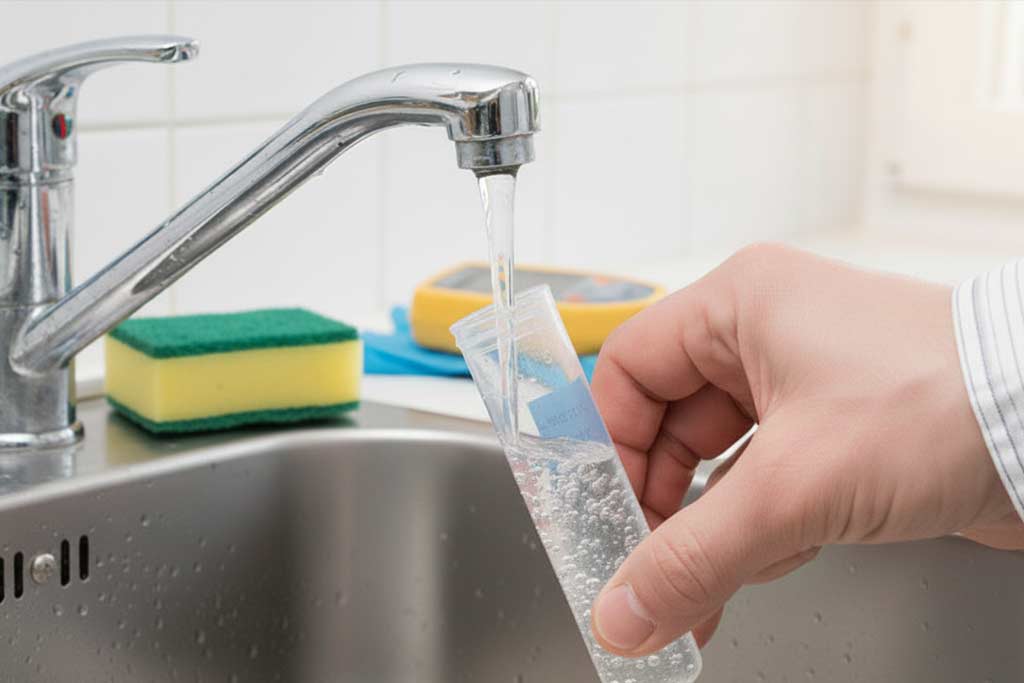
We collect samples from your tap and send them to a certified New Jersey laboratory for analysis. For Ocean County homes, the contaminants most worth screening for include:
- Volatile organic compounds (VOCs) — historically relevant given the area’s contamination legacy
- Bacteria and total coliform — essential for any home on a private well
- Iron and manganese — extremely common in Ocean County groundwater and aquifer-fed municipal supplies
- Lead and copper — relevant in any home with older plumbing, particularly pre-1986 construction
- Nitrates — a concern near agricultural areas and in regions with historical fertilizer or septic influence on groundwater
- Hardness — Ocean County water varies but tends toward moderate to high mineral content
- pH and alkalinity — affects how corrosive your water is to your plumbing system
PFAS testing is increasingly requested by Toms River homeowners given the area’s proximity to documented contamination sites and the state’s ongoing PFAS monitoring programs. It’s available as an extended panel and is worth considering for any home on a private well or near historically affected areas.
Signs That Something in Your Toms River Water Deserves Attention
Some of the most common water quality problems in Ocean County homes show up gradually — easy to adapt to, hard to connect to a specific cause. These are the signs worth not ignoring:
- Orange, brown, or rust-colored staining in sinks, toilet tanks, or on laundry — classic iron or manganese
- A sulfur or rotten egg smell, particularly noticeable in well water or when running hot water
- Water that tastes flat, metallic, or slightly earthy despite looking clear
- Scale buildup on fixtures, inside appliances, or around shower drains
- Cloudy or slightly discolored water after the supply hasn’t been used for several hours
- Skin irritation or dryness after bathing that doesn’t respond to product changes
Common Water Problems in Ocean County — Causes and Solutions
| What You’re Noticing | Likely Cause | Typical Solution |
|---|---|---|
| Orange or rust staining | Iron or manganese from aquifer sources | Iron filtration system |
| Sulfur or egg smell | Hydrogen sulfide in well or groundwater | Aeration or oxidizing filter |
| Metallic or flat taste | Lead, copper, or mineral imbalance | Full panel test + targeted filtration |
| Scale on appliances | Hard water — calcium and magnesium | Water softener installation |
| Well water with no obvious symptoms | Invisible contaminants — bacteria, VOCs, nitrates | Comprehensive well water test |
What Water Testing Costs in Toms River
A standard residential water test in the Toms River area runs $150–$500 for most panels. For homes on private wells, a well-specific panel that includes bacteria, nitrates, iron, manganese, and VOCs is worth prioritizing and typically falls in the $250–$600 range depending on scope. Extended testing for PFAS and additional organic compounds adds to that cost but provides a more thorough picture for homeowners with specific concerns about the area’s contamination history.
If treatment is needed, an iron filtration system typically runs $1,200–$3,500 installed. A water softener for hardness is generally $1,800–$5,000+. A whole-home filtration system for VOC or chemical concerns ranges from $1,500–$6,000+ depending on the technology required. We walk through results with you before any treatment conversation begins.
Serving Toms River and Surrounding Ocean County Communities
We serve homeowners throughout Toms River and across Ocean County, including nearby Brick, Lakewood, Manchester Township, and Berkeley Township — areas that share the same aquifer system and many of the same water quality characteristics. If you’re in any of those communities, we cover that territory. Our full New Jersey service area is available if you’re looking for coverage elsewhere in the state, and our water testing service page has more detail on what different testing panels include.
Frequently Asked Questions — Water Testing in Toms River, NJ
Is Toms River water safe given the area’s contamination history?
The major contamination events that affected Toms River in prior decades have been largely remediated and continue to be monitored. Municipal water in the township meets current federal and state standards. That said, private wells are not covered by municipal monitoring, and the aquifer system in Ocean County has documented vulnerability to surface contamination. Testing gives you a current, property-specific answer rather than a general one.
I’m on a private well — how often should I test?
New Jersey recommends annual testing for private wells at minimum, covering bacteria and nitrates. In Ocean County, given the groundwater history, we typically recommend a more comprehensive panel every two to three years — including VOCs, iron, manganese, and pH — with bacteria tested annually. If you’ve never tested your well, start with a full baseline panel.
My water smells like sulfur. Is that dangerous?
A sulfur or rotten egg smell is almost always hydrogen sulfide gas, which occurs naturally in some groundwater sources and is common in parts of Ocean County. At low levels it’s more of a nuisance than a health hazard, but at higher concentrations it warrants treatment. Testing confirms the level and guides the appropriate solution — typically aeration or an oxidizing filter system.
Does testing take a long time?
The on-site visit takes under an hour. Lab results return within 3–7 business days for standard panels, slightly longer for extended screens like PFAS. We follow up to walk through results with you once they’re back.
Can you test for the specific chemicals associated with the old Toms River contamination sites?
Yes. Volatile organic compounds — including the specific compounds historically associated with industrial contamination in the area — can be included in an extended testing panel. If that’s a specific concern, let us know when scheduling and we’ll make sure the right panel is ordered.
Schedule Your Water Test in Toms River
If you’re a Toms River homeowner with questions about your water — whether you’re on a private well, recently moved in, or just want a current baseline — a professional test is the most straightforward way to get real answers. We serve Ocean County and the surrounding Jersey Shore region. Call us at (732) 357-1988 or schedule online.