Nitrates in NJ Well Water: What New Homeowners Near Farms and Septic Systems Need to Know
Of all the contaminants that can show up in New Jersey well water, nitrates are among the most deceptive. There’s no color, no smell, no taste. The water looks and feels completely normal. You could drink nitrate-contaminated water for years without any sensory indication that anything is wrong. And yet nitrates at elevated levels pose a genuine health risk — particularly for infants, pregnant women, and people with certain health conditions — that makes testing and, if necessary, treatment an urgent priority for new well water homeowners in New Jersey.
If your new home is in a rural or semi-rural part of New Jersey — near farmland in Salem, Cumberland, Burlington, or Gloucester counties, or in a neighborhood with older or high-density septic systems in Monmouth, Ocean, or Hunterdon counties — nitrate contamination of your well is a real and documented risk. This guide explains what nitrates are, where they come from, what they do to human health, how to test for them, and what your options are if your results come back above the action level.
What Are Nitrates and Where Do They Come From?
Nitrates are nitrogen-containing compounds that occur naturally in soil and water at low levels, but reach problematic concentrations primarily through human activity. Nitrogen is an essential plant nutrient, and the same properties that make nitrogen compounds valuable as fertilizer also make them highly mobile in the environment — particularly in groundwater.
When nitrogen-based fertilizers are applied to agricultural fields, lawns, or gardens in amounts that exceed what plants can absorb, the excess nitrate leaches through the soil and into the groundwater below. In New Jersey, this pathway is most significant in the agricultural regions of Salem, Gloucester, Cumberland, and Burlington counties, where intensive vegetable, grain, and nursery crop production has historically resulted in elevated nitrate levels in shallow aquifers. Homeowners in Vineland, Bridgeton, Woodbury, and surrounding communities in South Jersey well water zones are in areas where agricultural nitrate loading has been a documented groundwater quality concern for decades.
Septic systems are the second major source. A properly functioning septic system treats wastewater before it reaches the groundwater, but no septic system removes nitrates entirely — they pass through the treatment process and enter the groundwater as a normal byproduct of septic operation. In areas with high septic density — older suburban neighborhoods in Monmouth, Ocean, and Hunterdon counties where lot sizes are small and septic systems are closely spaced — the cumulative nitrate loading from many systems in proximity can elevate groundwater nitrate levels significantly above what any single system would contribute.
Animal waste from livestock operations — poultry farms, horse properties, dairy operations — is another significant source, particularly in Warren, Hunterdon, and Morris counties where agricultural land use includes significant livestock activity. Manure applied to fields or stored near wells can leach nitrates into the groundwater at elevated concentrations, and the proximity of a farm operation to a residential well is a meaningful risk factor worth accounting for.
Finally, failing or improperly installed septic systems — systems with cracked tanks, damaged drain fields, or inadequate setback distances from wells — can contribute nitrates at higher concentrations than properly functioning systems. If your new home has a septic system and you don’t know its condition or maintenance history, having it inspected alongside your water test is good practice.
The Health Risk: Why Nitrates Matter Most for Infants
The health concern associated with nitrate in drinking water centers on a condition called methemoglobinemia — sometimes called blue baby syndrome. In infants under six months of age, nitrates in drinking water or formula mixed with nitrate-contaminated water are converted in the digestive tract to nitrites, which interfere with the blood’s ability to carry oxygen. The result is a condition where the blood cannot deliver adequate oxygen to the body’s tissues, causing skin to take on a bluish tint — hence the name — and potentially leading to serious illness or death in severe cases.
Infants are uniquely vulnerable for two reasons. First, the bacteria responsible for converting nitrate to nitrite thrive in the less acidic digestive environment of young infants. Second, fetal hemoglobin — the form of hemoglobin present in infants in their first months of life — is more susceptible to oxidation by nitrite than adult hemoglobin. Older children and adults have digestive chemistry and hemoglobin that make them substantially more resistant to the same effect, though some research suggests long-term nitrate exposure at elevated levels may have health implications for adults as well, including associations with certain cancers and thyroid function.
The EPA’s maximum contaminant level for nitrate in drinking water is 10 milligrams per liter (mg/L), expressed as nitrogen. This standard was set specifically to protect infants from methemoglobinemia. If you have an infant in your household, are pregnant, or are planning to become pregnant, and your home is on a private well in New Jersey, nitrate testing is not optional. It is essential, and it should be done immediately — not as part of a future comprehensive test, but now.
Nitrites — a related compound and an intermediate in the nitrogen cycle — have their own MCL of 1 mg/L. Both should be included in your test panel.
Nitrate Risk Across New Jersey: Where to Pay Closest Attention
The NJDEP has mapped nitrate vulnerability across the state’s aquifer systems, and the pattern reflects the agricultural and land use history of each region. The coastal plain aquifers of southern New Jersey — particularly the unconfined Kirkwood-Cohansey aquifer that supplies many private wells in Burlington, Ocean, Atlantic, Cumberland, Salem, and Cape May counties — are classified as highly vulnerable to nitrate contamination due to their sandy, permeable soils and shallow water table that allows rapid movement of surface-applied nitrogen into the groundwater.
In central New Jersey, the Raritan aquifer system serving parts of Monmouth, Middlesex, and Somerset counties shows elevated nitrate in areas with high residential septic density and historical agricultural activity. Homeowners in Freehold, Howell, Manalapan, and Millstone Township sit in areas where nitrate testing is a routine recommendation for private well owners. Further north, in Hunterdon County communities like Flemington, Lebanon Township, and Clinton, the combination of agricultural land use and residential septic systems in a region with significant private well reliance makes nitrate a priority parameter.
Warren County — encompassing Hackettstown, Washington Township, and the surrounding rural communities — has both agricultural activity and limestone geology that can concentrate nitrate in certain aquifer zones. Morris County communities like Chester, Mendham, and Long Valley, where horse farms and agricultural properties are common, face similar dynamics.
It’s important to note that proximity to farmland or septic systems is a risk factor, not a guarantee. Your specific well’s depth, the aquifer it draws from, and local groundwater flow patterns all influence whether agricultural or septic nitrate sources are reaching your water. Testing is the only way to know.
Testing: What to Order and How to Do It Right
Nitrate testing for private wells in New Jersey is straightforward and inexpensive. Any laboratory certified by the NJDEP for drinking water analysis can run a nitrate and nitrite panel. The NJDEP maintains a list of certified labs at nj.gov, and most will mail you a sample collection kit with pre-cleaned containers and detailed instructions.
Nitrate sampling doesn’t require the same careful first-draw protocol that lead testing does — a standard tap sample after a brief flush is typically appropriate, and the lab instructions will specify exactly what’s required. Results are typically returned within five to ten business days and will report nitrate and nitrite concentrations in mg/L alongside the applicable MCL for easy comparison.
If your purchase included a lender-required water test, there’s a reasonable chance nitrates were included — they’re one of the two parameters most commonly required by NJ mortgage lenders alongside bacteria. But if that test was done more than a year ago, or if conditions near your well have changed — new agricultural activity, a nearby septic failure, or significant rainfall events that can temporarily spike nitrate levels — a fresh test is warranted. Annual nitrate testing is the NJDEP’s recommendation for private wells, and it’s one of the lowest-cost, highest-value things a well water homeowner can do.
Our water testing service includes nitrate and nitrite as part of comprehensive well water panels designed for NJ homeowners. If you’re establishing your baseline water quality picture as a new homeowner — as we outlined in our guide on the 30-day water safety checklist for new NJ well water homeowners — nitrates should be on the list from day one.
What to Do If Your Nitrate Level Is Above the MCL
If your test results show nitrate above 10 mg/L, you should stop using the well water for infant formula preparation, drinking, and cooking immediately until the issue is addressed. Boiling water does not remove nitrates — it actually concentrates them as water evaporates. Bottled water is the safe interim solution for drinking and formula preparation while you arrange treatment.
For the longer term, there are two proven treatment technologies for nitrate removal from private well water: reverse osmosis and ion exchange with anion resin.
Reverse Osmosis
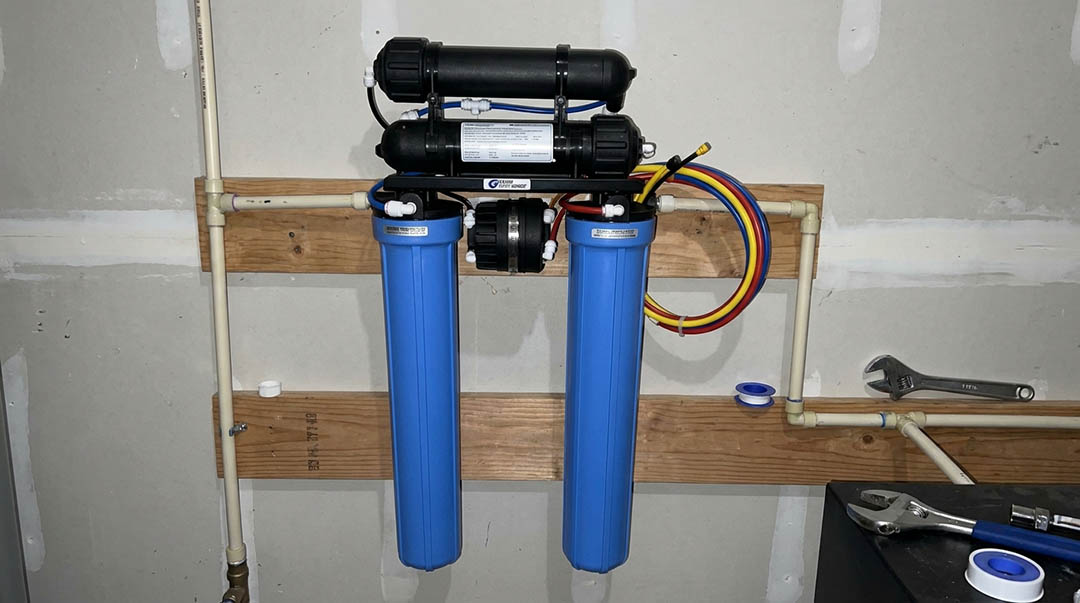
Reverse osmosis (RO) systems are highly effective at removing nitrates — typically achieving 85 to 95 percent removal — along with a wide range of other contaminants including PFAS, arsenic, lead, and many VOCs. Point-of-use RO systems installed under the kitchen sink treat the water at the tap used for drinking and cooking, which is the most cost-effective approach for nitrate reduction when whole-house treatment isn’t required. RO systems require periodic membrane replacement — typically every two to three years — and pre-filters that protect the membrane need regular attention as well.
For households with infants where nitrate is the primary concern, a point-of-use RO system at the kitchen tap is typically the recommended first step. It’s relatively affordable to install, highly effective, and provides treated water for the uses that matter most — drinking and formula preparation. Our water purification systems include reverse osmosis options sized for NJ residential applications.
Ion Exchange with Anion Resin
For whole-house nitrate treatment — situations where nitrate levels are very high, where the household’s water usage makes point-of-use treatment impractical, or where whole-house protection is preferred — ion exchange with a nitrate-selective anion resin is the standard approach. These systems work similarly to water softeners but use a resin specifically designed to capture nitrate ions rather than calcium and magnesium. They require periodic regeneration with a salt brine solution and produce a nitrate-rich backwash that must be disposed of properly.
It’s worth noting that standard water softeners do not remove nitrates. The cation exchange resin in a softener targets positively charged ions like calcium and magnesium. Nitrate is a negatively charged anion and passes through a standard softener unaffected. If someone suggests that your water softener is addressing your nitrate problem, that’s incorrect — a separate anion exchange system or RO unit is required.
Our water filtration page covers the full range of whole-house treatment options available for NJ homeowners dealing with nitrates alongside other water quality concerns.
Nitrates and Other Contaminants: Understanding the Connection
Nitrate contamination rarely exists in isolation. The same agricultural and septic sources that introduce nitrates into groundwater often contribute other contaminants as well. Agricultural areas with heavy pesticide or herbicide use may also have elevated VOCs or other organic compounds in the groundwater. Septic systems contribute not only nitrates but also bacteria, pharmaceuticals, and personal care products to groundwater in high-density areas.
In areas where PFAS contamination from agricultural biosolids application is a concern — parts of Burlington, Salem, and Gloucester counties where sewage sludge has historically been applied to farmland — nitrate and PFAS testing should go hand in hand. The same fields that contribute agricultural nitrate loading to the groundwater may also be sources of PFAS from biosolids application. Our post on PFAS in New Jersey well water covers that risk in detail for homeowners in affected areas.
The broader point is that a single-parameter approach to well water testing leaves gaps. A comprehensive water test that includes nitrates alongside bacteria, heavy metals, VOCs, hardness, and — where relevant — PFAS and radon gives you the complete picture of what your well water actually contains and what treatment, if any, is needed to address it.
Seasonal Variation: Why Timing Your Test Matters
Nitrate levels in well water are not perfectly static — they can vary seasonally based on precipitation patterns, agricultural activity, and groundwater recharge dynamics. Heavy rainfall events in spring and fall can temporarily spike nitrate levels as surface-applied nitrogen is flushed rapidly into the groundwater. Irrigation-heavy summer months can concentrate nitrate in a declining water table. Spring testing — shortly after winter snowmelt and early spring rains — often captures higher nitrate levels than summer or fall testing.
This seasonal variability is one reason the NJDEP recommends annual nitrate testing rather than testing once and assuming the result is permanent. A result of 7 mg/L in August — below the MCL — might look different if tested in April after a wet winter. For households with infants or pregnant women, the conservative approach is to test in spring when levels are likely to be at their seasonal peak, giving you the most protective picture of your well’s nitrate exposure.
Protecting Your Family Starts With Knowing What’s in Your Water
Nitrates are one of the few well water contaminants that carry a specific, well-documented acute health risk for a defined vulnerable population — infants under six months — making them a priority parameter regardless of where you live in New Jersey. For new homeowners near agricultural land, in high-density septic areas, or in regions the NJDEP has identified as having elevated nitrate vulnerability, the case for prompt testing is even stronger.
The reassuring part is that nitrate is well understood, reliably testable, and effectively treatable. You don’t have to accept elevated nitrate levels as a feature of rural NJ well ownership. You just need to know what you have and apply the right solution for your household’s situation.
At Jersey Radon, we help new homeowners across New Jersey — from Flemington and Hackettstown to Freehold, Vineland, Bridgeton, and throughout the agricultural and septic-dense communities of South and Central Jersey — test their well water for nitrates and install the right treatment systems when levels are elevated. If you’ve recently moved into a home with a private well and you want to establish a complete water quality baseline that includes nitrates, reach out to our team for a free consultation. We’ll help you understand your risk, get the right tests ordered, and put the right solution in place for your home and your family.
