Do NJ City Water Homes Need a Water Softener?
Water softeners are almost universally associated with well water in New Jersey — and with good reason. Private wells in NJ aquifers frequently produce water with hardness levels that cause immediate, visible problems: scale on fixtures, soap that won’t lather, appliances that wear out ahead of schedule. Municipal water customers tend to assume that if the city is treating their water, hardness is being handled along with everything else. It is not. Water softening is not part of the municipal treatment process for most New Jersey utilities. The water entering your home from the city main is treated for safety — bacteria, regulated contaminants, disinfection — but not for hardness. If the source water serving your municipality is hard, which it is for a significant portion of New Jersey, it arrives at your tap hard, and every consequence of hard water that well water homeowners experience applies equally to city water homeowners. The difference is that well water homeowners usually find out about it immediately because their problems are more dramatic. City water customers often adapt to hard water over time without recognizing it as a treatable condition.
This page is part of our complete guide to NJ city water treatment. If you want to confirm your municipal water hardness or evaluate softener options for your home, our water softener installation and repair team serves homeowners throughout New Jersey.
How Hard Is NJ Municipal Water?
Water hardness is measured in grains per gallon (GPG) or milligrams per liter (mg/L), with water above 7 GPG generally considered hard and above 10.5 GPG considered very hard. New Jersey draws municipal water from a mix of surface water reservoirs and groundwater sources, and hardness varies significantly by utility and region. Northern NJ utilities drawing from the Passaic River watershed and reservoir systems in Morris, Passaic, and Bergen counties generally serve moderately hard water in the 7 to 12 GPG range. Central and southern NJ utilities drawing from the Raritan River basin or the Potomac-Raritan-Magothy aquifer system frequently serve water in the 10 to 18 GPG range. Some South Jersey utilities sourcing from the Kirkwood-Cohansey aquifer serve softer water below 5 GPG.
Your utility’s annual Consumer Confidence Report lists water hardness — typically expressed as calcium carbonate in mg/L, which you can convert to grains per gallon by dividing by 17.1. A result of 170 mg/L as CaCO3 equals approximately 10 GPG, which is in the hard range where scale accumulation in water heaters, appliances, and pipes is well-documented. If your CCR lists hardness at 200 mg/L or above — roughly 12 GPG — the case for a water softener on city water is as strong as it would be for a well water home with the same hardness level. The source of the water does not change what hardness does to your plumbing. Our guide to reading your NJ water quality report covers how to find and interpret hardness data in your CCR.
What Hard Municipal Water Does to NJ Homes Over Time
The effects of hard water on a city water home accumulate gradually and are easy to attribute to other causes. Scale deposits inside water heaters reduce efficiency measurably — a water heater operating in hard water conditions can consume 20 to 30 percent more energy than the same unit operating with softened water, and scale accumulation shortens the heater’s service life by years. Dishwashers accumulate scale on the heating element and spray arms, reducing cleaning effectiveness and eventually causing premature failure. Washing machines develop scale deposits in the drum and water inlet valve. The soap inefficiency caused by hard water — hard water requires significantly more detergent, shampoo, and soap to produce adequate lather — is a direct ongoing cost that most city water households absorb without connecting it to water quality.
Scale on faucet aerators and showerheads is the most visible manifestation of hard water in a city water home. The white or yellow crusty buildup that requires periodic removal with vinegar is calcium carbonate — the same mineral that is scaling the inside of pipes and appliances where you cannot see it. Hard water also interacts with the chlorine and chloramine used in municipal disinfection to produce a combined effect on skin and hair that is more drying and irritating than either factor alone. Many NJ city water customers who notice dry skin, dull hair, or scalp irritation after bathing are responding to the combination of disinfectant and hardness rather than to either one independently.
How a Water Softener for City Water Differs from a Well Water Installation
The ion exchange process that removes hardness minerals works identically regardless of whether the water source is a well or a municipal main. What differs is the pre-treatment context and the water chemistry the softener is working with. Well water softeners frequently need to manage iron alongside hardness, which affects resin selection, regeneration chemistry, and maintenance requirements. Municipal water softeners in NJ are almost never dealing with iron — the city’s treatment process removes iron before the water enters distribution. This means a city water softener installation is typically simpler in its design requirements than a well water installation and has a longer resin service life under normal conditions.
Municipal water does present one variable that well water typically does not: chloramine. As discussed in our page on chloramine in NJ water, many NJ utilities now use chloramine as the distribution disinfectant rather than free chlorine. Chloramine degrades softener resin over time — not rapidly, but measurably over years of continuous exposure. High-quality softener resin is more resistant to chloramine degradation, and some manufacturers specifically offer chloramine-resistant resin grades for municipal water applications. If your NJ utility uses chloramine, specifying chloramine-resistant resin at installation extends the softener’s effective service life and is worth the modest additional cost. Our water softener installation team can confirm your utility’s disinfectant type and specify the appropriate resin for your water conditions.
Sizing a Water Softener for NJ City Water
Softener sizing for a city water home follows the same calculation as for a well water home: daily water use in gallons multiplied by hardness in grains per gallon gives the daily grain removal requirement, and the softener capacity in grains divided by the daily grain requirement gives the days between regeneration cycles. The target for most residential installations is a regeneration frequency of every three to seven days — frequent enough to keep the resin performing but not so frequent that salt consumption becomes excessive. For a family of four in an NJ city water home with 12 GPG hardness and average daily use of around 75 gallons per person, a 48,000-grain softener regenerating approximately every four days is a reasonable starting point. The right size for your specific home depends on actual household water use and current water hardness from a confirmed test, not generic estimates.
Water Softener Placement and City Water Considerations
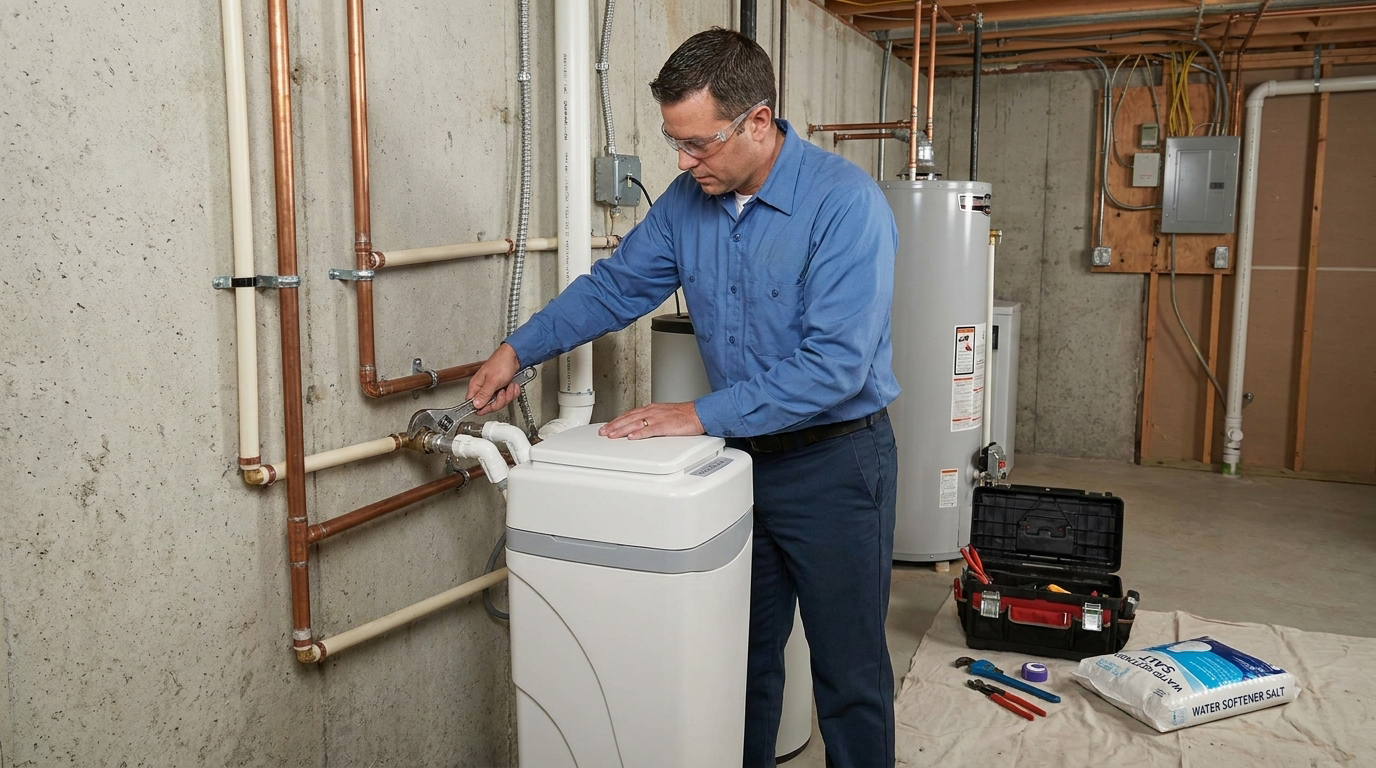
In a well water home, the treatment system has a defined sequence — iron filter, softener, UV — with the softener positioned after iron removal to protect the resin. In a city water home, the softener installation is simpler. Municipal water arrives without significant iron, sediment, or biological contamination requiring pre-treatment ahead of the softener. The softener is typically installed at the point of entry, treating all water entering the home before it reaches the water heater, fixtures, and appliances. A bypass valve is standard equipment on any properly installed softener, allowing the system to be bypassed for outdoor irrigation — softened water used for irrigation wastes salt and provides no benefit to plants — and for service access.
One consideration specific to city water homes is water pressure. Municipal supply pressure in NJ homes is typically in the 60 to 80 PSI range — higher than the 40 to 60 PSI common in well water homes with pressure tanks. Softener control valves are rated for specific maximum operating pressures, and the higher end of municipal supply pressure can accelerate valve wear in systems not rated for it. Confirming the supply pressure and specifying equipment rated appropriately for it is part of a proper city water softener installation.
The Water Softener and Filtration Combination for NJ City Water Homes
Hardness is not the only water quality concern for NJ city water customers, and a softener addresses only the hardness component of what is often a multi-factor picture. Many NJ city water homeowners benefit from combining a softener with a whole-house carbon filtration system — the softener handling hardness and the carbon filter handling chloramine, disinfection byproducts, taste, and odor. These two systems can be installed in sequence at the point of entry, with the carbon filter typically positioned ahead of the softener to protect the resin from chloramine degradation while also treating the water for chemical contaminants before softening.
For homeowners also concerned about lead — particularly relevant in older NJ homes with pre-1986 plumbing — a point-of-use reverse osmosis system at the kitchen sink provides targeted lead reduction at the drinking and cooking tap without affecting the whole-house softener or filtration installation. Our page on lead in NJ city water covers the lead exposure pathway and filtration options in detail. For the complete picture of how these treatment systems work together for NJ city water homeowners, see our guide to NJ city water treatment. And for guidance on what whole-house carbon filtration specifically addresses in city water, see our page on whole house carbon filtration for NJ city water homes.
If you want to confirm your municipal water hardness or discuss softener options for your NJ home, our team can help with both the testing and the installation. Request a free estimate online or call (732) 357-1988 — we serve homeowners throughout New Jersey.