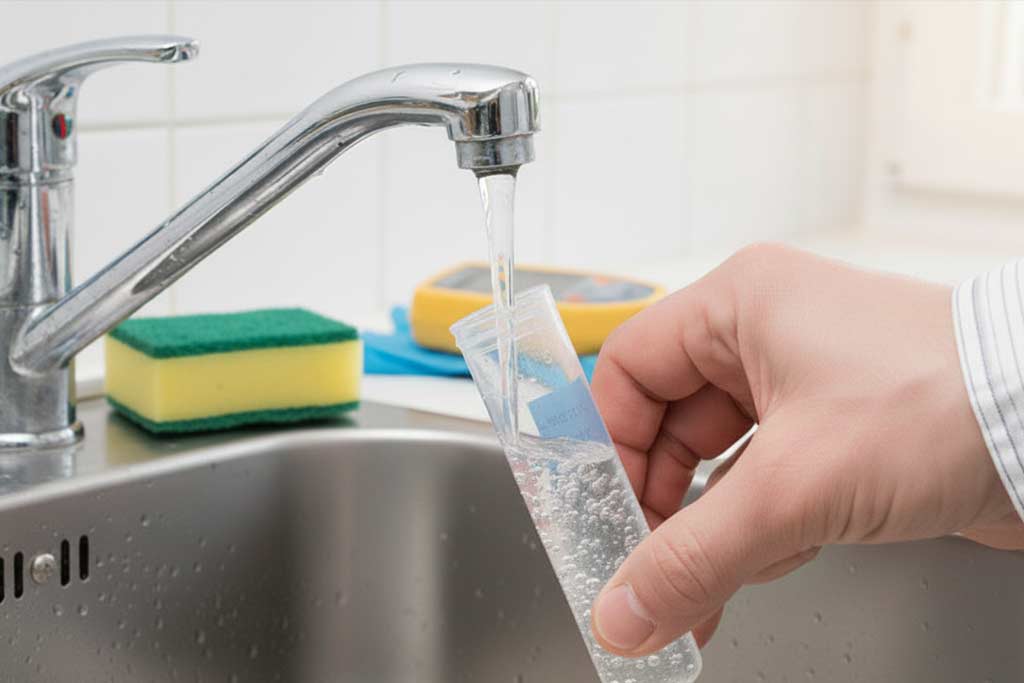
If your home runs on a private well, you’re likely responsible for the safety of your own drinking water. Unlike municipal water systems — which are tested regularly and required to meet federal and state standards — private wells in New Jersey receive no routine government oversight. What comes out of your tap is entirely up to you to monitor. The problem is that most well water contaminants are invisible. They have no color, no smell, no taste. Your water can look perfectly clear and still contain bacteria, heavy metals, PFAS, radon, or nitrates at levels that pose real health risks.
A water test is the only way to know what’s actually in your well water. But many homeowners aren’t sure what a test covers, which tests they actually need, or what to do with the results when they get them. This guide breaks it all down — what well water testing in New Jersey looks for, which contaminants matter most, how the testing process works, and when to retest.
Why NJ Well Water Homeowners Face Unique Risks
New Jersey’s geology, industrial history, and agricultural activity create a water quality landscape that’s unlike most other states. The state sits on rock formations that naturally leach radon, arsenic, and manganese into groundwater. Its industrial legacy — chemical plants, refineries, military installations, manufacturing facilities — has left behind a dense network of contamination plumes that continue to migrate through the aquifers many private wells draw from. Agricultural activity in South Jersey introduces nitrates and pesticides. And the state’s high population density means septic systems are often in close proximity to well heads, raising the risk of bacterial contamination.
The New Jersey Department of Environmental Protection has identified more contaminated sites per square mile than almost any other state. For private well owners, that’s not abstract — it means the groundwater feeding your well has likely traveled through or near compromised soil or rock at some point in its journey. Testing isn’t paranoia. It’s basic due diligence. Morris County homeowners can find area-specific service information on our water testing page for Morristown, NJ.
What Does a Well Water Test Actually Measure?
This is where most homeowners get confused — because there’s no single universal “well water test.” What a test measures depends entirely on which panel you order. A basic coliform bacteria test tells you nothing about arsenic. A heavy metals panel won’t detect PFAS. Understanding the categories of contaminants helps you choose the right tests for your situation.
Bacteria and Coliform
Total coliform and E. coli testing is the most fundamental well water test and should be done by every well owner at least annually. Coliform bacteria are indicators of fecal contamination — their presence signals that your well casing, cap, or surrounding soil may have been compromised by surface water intrusion, a nearby septic system, or animal waste. E. coli specifically indicates fecal matter from warm-blooded animals and is a direct health hazard. Bacterial contamination can cause gastrointestinal illness, and it’s especially dangerous for young children, elderly adults, and anyone with a compromised immune system.
Nitrates and Nitrites
Nitrates enter groundwater primarily from fertilizer runoff, septic system effluent, and animal waste. They’re a particular concern in rural and agricultural areas of New Jersey, including parts of Burlington, Salem, and Cumberland counties. Nitrate contamination is most dangerous for infants under six months old, where it can cause a condition called methemoglobinemia — sometimes called blue baby syndrome — which interferes with the blood’s ability to carry oxygen. The EPA’s maximum contaminant level for nitrates in drinking water is 10 milligrams per liter.
Heavy Metals
New Jersey’s geology naturally contains elevated levels of several heavy metals that can leach into groundwater without any industrial source. Arsenic is found at elevated levels throughout the state, particularly in the Piedmont and Highlands regions. Long-term arsenic exposure is linked to bladder, lung, and skin cancers. Manganese, uranium, and lead are also found in NJ well water in certain areas. Lead is more commonly introduced through older plumbing and fixtures than from the well itself, but it can still appear in well water samples drawn from homes with older infrastructure. A heavy metals panel typically screens for arsenic, barium, cadmium, chromium, lead, mercury, selenium, and uranium.
Volatile Organic Compounds (VOCs)
VOCs are carbon-based chemicals that evaporate easily at room temperature. In well water, they typically originate from industrial contamination, underground storage tank leaks, or solvent use. Common VOCs found in NJ well water include trichloroethylene (TCE), tetrachloroethylene (PCE), benzene, and methyl tert-butyl ether (MTBE). Many VOCs are known or suspected carcinogens. If you live near a former industrial facility, a gas station, or a dry cleaner, VOC testing is particularly important.
PFAS (Per- and Polyfluoroalkyl Substances)
PFAS — the forever chemicals discussed at length in our PFAS in NJ Well Water guide — require a dedicated laboratory test using EPA Method 533 or 537.1. Standard water quality panels do not include PFAS. New Jersey has established maximum contaminant levels for PFOA, PFOS, and PFNA, and the state has documented PFAS contamination in groundwater throughout many counties. If your well is within a few miles of a military base, airport, industrial site, or landfill, PFAS testing should be considered non-optional.
Radon in Water
Most people know radon as an air quality issue, but radon dissolves into groundwater and can be present in well water at significant concentrations. When you use well water contaminated with radon — showering, running the dishwasher, boiling water — radon is released into the indoor air. The EPA estimates that waterborne radon contributes meaningfully to indoor radon air levels in homes on private wells. If you’ve already tested your home’s air for radon, that test does not tell you whether radon is also present in your water. A separate water radon test is required. New Jersey well water homeowners in areas with known elevated radon geology should test both. You can learn more about radon in well water and treatment options on our water services page.
pH, Hardness, and Mineral Content
Beyond health-based contaminants, a general water chemistry panel measures pH, hardness, iron, manganese, and total dissolved solids (TDS). These parameters don’t typically pose direct health risks at moderate levels, but they affect water taste, appearance, and the longevity of your plumbing and appliances. High iron causes orange staining on fixtures and laundry. High hardness causes scale buildup in pipes and water heaters and leaves cloudy spots on glasses and dishes. Very low pH (acidic water) can corrode copper pipes and leach lead into drinking water over time. Understanding your water chemistry helps determine whether a water softener, iron filter, or pH neutralizer would benefit your home.
Which Tests Do You Actually Need?
The answer depends on where you live, the age of your well and home, nearby land use, and whether anyone in your household is in a higher-risk group such as infants, pregnant women, or immunocompromised individuals. As a baseline, every NJ private well owner should test annually for bacteria and nitrates, and every two to three years for a broader panel including heavy metals, VOCs, and general water chemistry.
Beyond the baseline, certain situations call for targeted testing. If you live near a military installation, airport, or former chemical plant, add PFAS. If you’re in a high-radon area — and much of northern and central New Jersey qualifies — test for radon in water. If your water has a rotten egg odor, test for hydrogen sulfide and sulfur bacteria. If you’ve recently had flooding, a sewage backup, or any work done near your well, retest for bacteria immediately regardless of your regular schedule.
If you’re buying a home on a private well in New Jersey, a comprehensive pre-purchase water test is essential. The NJDEP recommends testing for bacteria, nitrates, pH, hardness, iron, manganese, lead, arsenic, and VOCs at minimum before closing — with PFAS and radon added depending on the property’s location. Middlesex County homeowners can find local testing details on our water testing page for Edison, NJ.
How the Testing Process Works
Getting your well water tested in New Jersey is straightforward. You’ll want to use a laboratory certified by the NJDEP for drinking water analysis — using a certified lab ensures the results are legally defensible and methodologically sound. The NJDEP maintains a searchable list of certified labs on its website.
Most labs will mail you a sample collection kit with pre-cleaned containers, detailed instructions, and a chain-of-custody form. For bacteria testing, you’ll need to sanitize the tap, run the water for a set period, and collect the sample using precise technique to avoid surface contamination. For most other tests, collection is simpler — a first-draw or flushed sample depending on what’s being tested. The lab instructions will specify exactly what’s required for each parameter in your panel.
Once you mail or deliver your samples, results typically come back within five to ten business days, depending on the lab and the panel. Results are reported with the detected concentration for each parameter alongside the applicable standard — either the EPA maximum contaminant level (MCL) or the NJ state MCL, whichever is more stringent. For parameters with no established MCL, labs often include a health advisory level or note that no standard exists.
Understanding Your Results
A result below the MCL doesn’t automatically mean your water is risk-free — it means it’s within the regulatory threshold. Some contaminants have health effects below the MCL, particularly for vulnerable populations. And a result above the MCL means you should stop drinking the water until the issue is addressed and the well retested after treatment.
If your results show elevated bacteria, the first step is shock chlorination of the well followed by retesting. If bacteria persist after treatment, the well itself may have a structural issue — a cracked casing, a poorly sealed cap, or improper grouting — that needs to be assessed by a licensed well driller.
For chemical contaminants like arsenic, nitrates, PFAS, or VOCs above action levels, the solution is typically a certified treatment system installed at the point of entry (whole-house) or point of use (under the sink). The right treatment technology depends on which contaminants are present and at what levels — which is why testing before selecting a treatment system matters. Installing a water softener when you need an arsenic filter, or a carbon filter when PFAS requires reverse osmosis, wastes money and leaves the problem unaddressed.
How Often Should You Test Your NJ Well Water?
The NJDEP recommends testing private wells at minimum once a year for bacteria and nitrates. A broader panel covering heavy metals, VOCs, and general chemistry should be done every two to three years, or any time there’s a change in your water’s taste, odor, or appearance, after any flooding or nearby construction, after repairs to the well or plumbing, or when a new family member — particularly an infant — joins the household.
Think of well water testing the way you think of a home’s annual maintenance checklist. You change the furnace filter, you service the HVAC, you inspect the roof. Testing your well water is the same category of responsible ownership — routine, inexpensive relative to the cost of problems it can prevent, and something that lets you sleep at night knowing your family’s water is safe. Camden County homeowners can find local service details on our water testing page for Cherry Hill, NJ.
Start with a Test, Then Make the Right Call
The most common mistake NJ well water homeowners make is assuming their water is fine because it looks, smells, and tastes fine. The second most common mistake is installing a treatment system without testing first — and ending up with the wrong solution for the actual problem. A water test is the foundation. Everything else follows from it.
At Jersey Radon, we work with New Jersey homeowners to identify what’s in their water and install the right treatment systems to address it — from whole-house filtration and purification systems to water softeners and radon treatment. If you’ve recently received water test results and aren’t sure what they mean, or if you’re ready to schedule testing and want guidance on which panel makes sense for your area, reach out to our team for a free consultation.
