Your Soap Isn’t the Problem. Your Water Is.
You have switched shampoos. You have tried different body wash. You have gone through four or five bottles looking for one that actually lathers the way it is supposed to. Nothing works quite right — the soap sits on your skin, does not foam up, and leaves you feeling like you never fully rinsed. Your hair feels coated no matter what conditioner you use.
The soap is fine. The water is the issue. And if you are in New Jersey on well water or even municipal supply, there is a very good chance hard water is the reason. Water softener installation in New Jersey is the fix — not a different brand of shampoo.
Why Hard Water and Soap Do Not Get Along
Soap is designed to work in soft water. The cleaning chemistry relies on surfactant molecules that lift oils and dirt from skin or hair, emulsify them in water, and rinse away cleanly. That process depends on water that does not interfere with the surfactant chemistry.
Hard water interferes with it directly. Calcium and magnesium ions in hard water react with the fatty acid salts in soap and form insoluble compounds — what is commonly called soap scum. Instead of lathering, the soap binds to the minerals in the water and precipitates out as a sticky, filmy residue. You get less foam, less cleaning action, and a film left on skin and hair that does not rinse off because it is no longer water-soluble.
This is not a concentration problem. Using more soap in hard water does not help — it just produces more soap scum. The same reaction happens regardless of how much product you use.
What It Feels Like
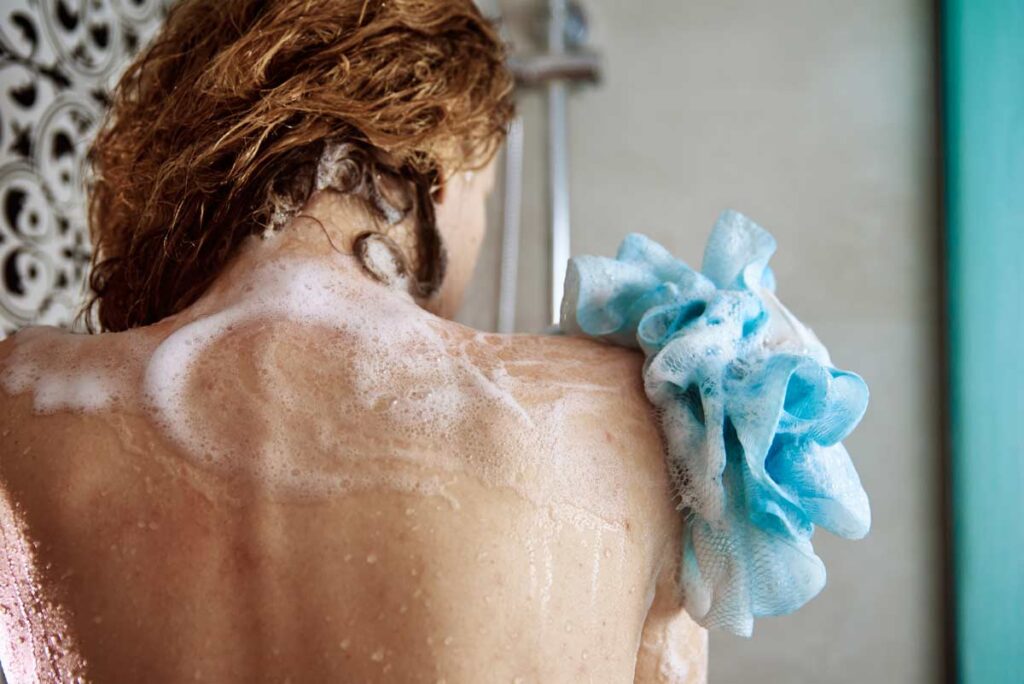
The experience is specific enough that most people can recognize it once they know what they are looking for. Skin feels tight, dry, or slightly sticky after showering even though you just washed. There is a sensation of residue that you cannot quite rinse away no matter how long you stay under the water. Hair feels heavier than normal, looks dull, and may feel slightly waxy or coated after washing. It does not respond well to styling products because the mineral-and-soap residue on the hair shaft interferes with how those products absorb.
Some people experience increased skin irritation or dryness, particularly in households with young children or anyone with eczema or sensitive skin. The mineral film that stays on skin after washing acts as a barrier that traps irritants against the skin and inhibits natural moisture.
Why Switching Products Does Not Work
Every soap, shampoo, and body wash on the market is formulated assuming a baseline water quality. When hard water is the variable, no product adjustment compensates for it fully. Some products marketed as suitable for hard water or containing chelating agents that partially bind minerals perform somewhat better, but none of them eliminate the underlying problem. The minerals are still in the water. The reaction still happens. The residue still forms.
The only solution that actually addresses the cause is removing the calcium and magnesium from the water before it reaches the shower.
What Changes With Soft Water
Homeowners who install a water softener consistently report the same thing: the shower experience changes immediately. Soap lathers the way it is supposed to. Shampoo rinses clean. Skin feels noticeably different — not tight or filmy, just clean. Hair is easier to manage, looks less dull, and responds normally to conditioner.
The difference is not subtle. It is one of the most immediate and noticeable changes that follows water softener installation, and it is one of the reasons homeowners who make the switch rarely go back.
Beyond the shower, soft water also means less soap and shampoo used per wash — because the product is actually working — and less product residue accumulating in drains, on shower walls, and on fixtures.
Confirming Hard Water Is the Cause
If the description above matches your experience, a water hardness test will confirm it. Hardness is measured in grains per gallon or parts per million, and the result tells you both whether you have a hard water problem and how significant it is. New Jersey water hardness varies by region and source — Northern NJ typically runs 85 to 171 PPM, Central NJ 120 to 205 PPM, and Southern NJ up to 256 PPM or higher on private wells.
A test takes minutes. The result drives the equipment recommendation — specifically what size softener your household water usage and hardness level require.
Getting It Sorted
Jersey Radon provides water hardness testing and professional water softener installation throughout New Jersey, with free estimates and an evaluation process that starts with your actual water conditions. If your soap has never lathered right in your current home, the water is almost certainly why. Contact Our Team to schedule a free estimate.
