Arsenic in NJ Well Water: What New Homeowners in the Highlands and Piedmont Need to Know
Of all the contaminants that can be present in New Jersey well water, arsenic is one of the most important to test for — and one of the most commonly missed during the home purchase process. It has no color, no smell, no taste. There is no sensory signal that it’s present. A glass of water with arsenic at five times the federal limit looks and tastes identical to a glass of water with none. And yet long-term arsenic exposure at elevated levels is linked to some of the most serious health outcomes associated with drinking water contamination anywhere in the country.
For new homeowners in the Highlands and Piedmont regions of New Jersey — Morris, Sussex, Warren, Hunterdon, Somerset, and Passaic counties, and parts of Bergen and Essex — arsenic in well water is not a remote possibility. It’s a geologically predictable reality for a significant percentage of private wells. Understanding why arsenic is present in NJ groundwater, what the health risks are, how to test for it, and what treatment options are available is essential groundwork for any new homeowner on a private well in these regions.
Why New Jersey Has an Arsenic Problem in Well Water
Arsenic in New Jersey groundwater is primarily a geological issue rather than an industrial contamination issue, though industrial sources exist in some areas. The bedrock formations underlying much of northern and central New Jersey — particularly the metamorphic and igneous rocks of the Highlands and the sedimentary formations of the Piedmont — contain naturally elevated concentrations of arsenic-bearing minerals. As groundwater moves through these formations over time, arsenic leaches from the rock into the water.
The Highlands physiographic province, which stretches across parts of Warren, Sussex, Morris, Passaic, and Bergen counties, is underlain largely by Precambrian crystalline bedrock — granite, gneiss, and related metamorphic rocks — that have some of the highest natural arsenic concentrations of any geological formation in the northeastern United States. Private wells drilled into this bedrock in communities like Hackettstown, Washington Township, Chester, Mendham, Long Valley, Wharton, and Rockaway encounter groundwater that has been in extended contact with arsenic-bearing minerals, and elevated arsenic concentrations are a predictable consequence.
The Piedmont region — encompassing parts of Somerset, Hunterdon, Middlesex, Morris, and Passaic counties — has a different but equally arsenic-relevant geology. The Brunswick shale and other Triassic sedimentary formations of the Piedmont contain arsenic in concentrations that, while typically lower than the crystalline Highlands bedrock, are still sufficient to produce well water arsenic levels above the federal MCL in many locations. Homeowners in Flemington, Raritan, Somerville, Bernardsville, Peapack-Gladstone, and Bedminster are in the Piedmont zone where arsenic testing is a standard recommendation.
Beyond natural geological sources, certain areas of New Jersey have elevated groundwater arsenic from legacy industrial activity — past use of arsenic-based pesticides in agricultural areas, mining operations, and industrial discharge in some urban and peri-urban settings. These anthropogenic sources tend to be more localized than the broad geological patterns of the Highlands and Piedmont, but they’re worth noting for homeowners in areas with known industrial history.
The Health Risk: What Long-Term Arsenic Exposure Actually Does
Arsenic is a Group 1 human carcinogen — meaning the evidence that it causes cancer in humans is definitive, not merely suggestive. The cancers most strongly associated with long-term arsenic exposure through drinking water are bladder cancer, lung cancer, and skin cancer. The relationship between arsenic exposure and these cancers is dose-dependent and cumulative — the higher the concentration and the longer the duration of exposure, the greater the risk. Decades of drinking water with arsenic at two or three times the MCL represents meaningfully elevated cancer risk compared to a population drinking water at or below the standard.
Beyond cancer, long-term arsenic exposure has been associated with cardiovascular disease, diabetes, peripheral neuropathy, and adverse reproductive and developmental outcomes. Skin effects — hyperpigmentation, hyperkeratosis, characteristic skin lesions — are among the earliest observable signs of chronic arsenic exposure at high doses, though these are more typically seen at concentrations higher than those encountered in most NJ well water situations.
The EPA’s maximum contaminant level for arsenic in drinking water is 10 micrograms per liter (µg/L), equivalent to 10 parts per billion (ppb). This standard applies to public water systems. For private wells, there is no federal enforcement mechanism — the responsibility for testing and addressing arsenic contamination falls entirely on the well owner. New Jersey has adopted the federal 10 ppb standard as its state guideline for private well water. Some health researchers and advocates argue that the 10 ppb standard is insufficiently protective and that meaningful cancer risk exists at concentrations below that level, but 10 ppb is the regulatory threshold used in practice.
Children and pregnant women are considered particularly vulnerable to arsenic exposure. Arsenic crosses the placental barrier and has been associated with adverse birth outcomes and developmental effects at concentrations relevant to drinking water. For new homeowners with young children or who are pregnant, arsenic testing is not a precaution to get around to eventually — it’s something to do immediately.
What the Home Purchase Process Almost Certainly Missed
Arsenic is not included in the standard water test required by NJ mortgage lenders. The lender-required test typically covers bacteria and nitrates — a two-parameter screen designed to satisfy lending guidelines, not to provide a comprehensive picture of water quality. Arsenic, despite being a well-documented groundwater concern across large swaths of New Jersey, is not part of that standard screen.
This means that a home in Chester, Mendham, or Hackettstown with arsenic at 25 ppb — two and a half times the federal MCL — can change hands with a clean lender water test and no indication to the buyer that anything is wrong with the water. The home inspector didn’t test for it. The lender didn’t require it. The previous owners may not have known it was there. And the new homeowner moves in and starts drinking the water without any awareness of what it contains.
This is one of the most significant gaps in the NJ home purchase water quality process, and it’s precisely why a comprehensive post-purchase water test — as we outlined in our guide on what your NJ home inspection doesn’t tell you about water quality — is so important for well water homeowners in arsenic-risk geology areas.
How to Test for Arsenic in Your NJ Well Water
Arsenic testing for private wells in New Jersey requires a laboratory certified by the NJDEP for drinking water analysis. Standard home test kits from hardware stores are not appropriate for arsenic — they’re not sensitive enough and not certified for regulatory purposes. You need a proper laboratory analysis using ICP-MS or hydride generation atomic absorption spectrometry, which is what NJDEP-certified labs use.
The NJDEP maintains a searchable list of certified labs at nj.gov. Most certified labs will mail you a sample collection kit with pre-cleaned containers and detailed instructions. Arsenic sampling typically uses a first-draw sample — water collected from the tap without running it first, to capture water that has been in contact with the plumbing — or a flushed sample depending on the specific protocol the lab specifies. Follow the lab’s instructions precisely, as sampling technique affects result accuracy.
Results for arsenic are typically returned within five to ten business days and reported in micrograms per liter (µg/L) or parts per billion (ppb) alongside the 10 ppb MCL for comparison. Results should also include a method detection limit — the lowest concentration the test can reliably detect — which for properly conducted ICP-MS analysis should be well below 1 ppb.
Arsenic should be tested as part of a comprehensive well water panel that also covers bacteria, nitrates, other heavy metals, pH, hardness, iron, manganese, and — depending on your location — PFAS, VOCs, and radon in water. Testing for arsenic in isolation misses the broader picture of your well water quality, and treatment system design for arsenic needs to account for the other parameters in your water. Our water testing service provides comprehensive panels designed for NJ well water homeowners that include arsenic alongside all relevant parameters for your region.
Arsenic levels in well water can vary over time — seasonal changes in groundwater levels, drought conditions, and changes in local land use can all influence arsenic concentrations. Testing once and assuming the result is permanent is not the right approach. Retesting every two to three years, or after any significant change in well conditions, is prudent practice.
Understanding Your Arsenic Test Results
If your arsenic result comes back below 5 ppb, your water is well within the regulatory guideline and arsenic is unlikely to be a significant health concern. Retest on your regular two to three year schedule and continue monitoring.
If your result is between 5 and 10 ppb, you are below the MCL but in a range where some health researchers recommend considering treatment, particularly for households with pregnant women, infants, or young children. A discussion with a water treatment professional about your household’s specific situation is worthwhile.
If your result is above 10 ppb, you are above the federal MCL and action is recommended. Stop using the well water for drinking and cooking — use bottled water in the interim — and consult with a water treatment professional about the appropriate treatment system for your arsenic concentration and overall water chemistry. Results significantly above the MCL — 25, 50, or 100 ppb, all of which occur in NJ well water in high-risk geology areas — warrant prompt action rather than a deliberate timeline.
Treatment Options for Arsenic in NJ Well Water
Arsenic removal from well water is a well-understood treatment challenge, and multiple proven technologies are available. The right choice for your home depends on your arsenic concentration, the form of arsenic present in your water, your overall water chemistry, and whether you need whole-house treatment or point-of-use treatment at the kitchen tap.
One important chemistry note before discussing treatment options: arsenic in groundwater exists in two primary forms — arsenite (As III, trivalent arsenic) and arsenate (As V, pentavalent arsenic). Most treatment technologies for arsenic are significantly more effective against arsenate than arsenite. If your water’s pH and oxidation-reduction conditions favor arsenite, pre-oxidation — typically with chlorine injection or aeration — to convert arsenite to arsenate before the primary arsenic treatment step dramatically improves removal efficiency. A water test that includes arsenic speciation, or a professional assessment of your water chemistry, informs whether pre-oxidation is needed for your specific water.
Adsorptive Media Filtration
Adsorptive media filters — using iron oxide, iron hydroxide, or titanium dioxide-based media — are the most widely used whole-house arsenic treatment technology for NJ residential applications. These systems pass water through a tank of specialized media that has a strong affinity for arsenate ions, capturing them on the media surface as water flows through. The media has a finite capacity and requires periodic replacement when it’s exhausted — typically every one to three years depending on arsenic concentration, water flow, and media type.
Adsorptive media systems are chemical-free, require minimal maintenance between media replacements, and are effective for a wide range of arsenic concentrations when properly sized. They are the go-to whole-house arsenic treatment for homes in Chester, Mendham, Hackettstown, Flemington, and other high-arsenic geology communities in Morris, Warren, Sussex, and Hunterdon counties.
Reverse Osmosis
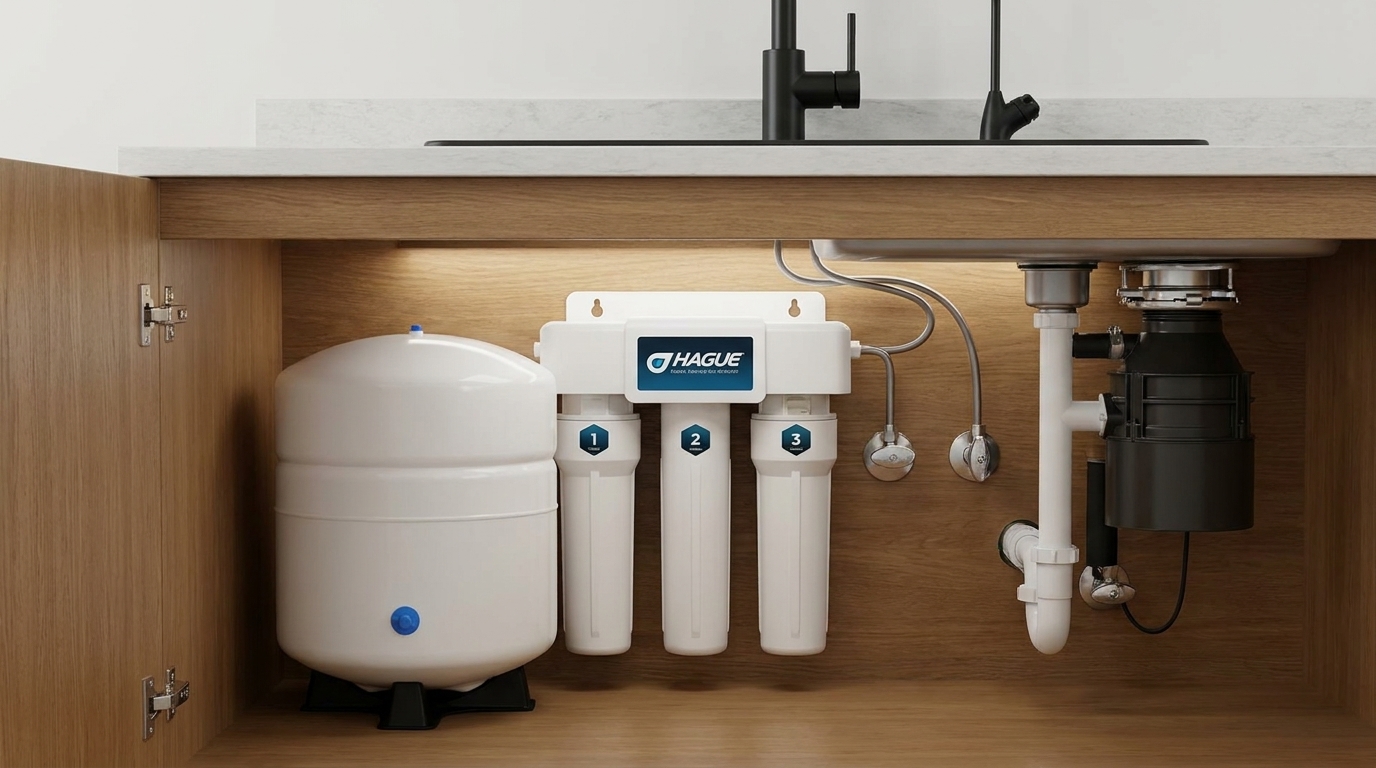
Reverse osmosis systems at the point of use — typically under the kitchen sink — are highly effective at removing arsenate, typically achieving 90 to 95 percent or better removal. For households where the primary concern is arsenic in drinking and cooking water rather than whole-house treatment, a point-of-use RO system is a cost-effective solution that also removes PFAS, nitrates, lead, and many other contaminants simultaneously.
The limitation of point-of-use RO is that it only treats water at the specific tap where it’s installed. Bathing, showering, and other water uses throughout the home are not treated. For arsenic, the primary exposure pathway is ingestion — drinking and cooking — so point-of-use RO at the kitchen tap addresses the most significant route. Dermal absorption of arsenic during bathing is generally considered a minor exposure pathway at typical residential concentrations, though some health professionals recommend whole-house treatment for higher arsenic levels.
Our water purification systems include reverse osmosis options appropriate for NJ residential well water applications, sized and configured for your specific water chemistry.
Anion Exchange
Strong base anion exchange resins with selectivity for arsenate can be used for both whole-house and point-of-use arsenic treatment. These systems work similarly to water softeners but target negatively charged arsenate ions rather than calcium and magnesium. They require periodic regeneration with a brine solution and produce an arsenic-rich regenerant waste stream that must be disposed of properly — which can be a practical complication for residential applications. Anion exchange is more commonly used in commercial and municipal water treatment than in residential settings, but it’s available as a residential option for specific water chemistry situations where adsorptive media is less suitable.
What Doesn’t Work for Arsenic
Standard carbon block filters, sediment filters, water softeners, and UV disinfection systems do not remove arsenic from drinking water. If you have confirmed arsenic above the MCL in your well water and someone is suggesting that your existing water softener or carbon filter is addressing it, that’s incorrect. These technologies have no meaningful effect on dissolved arsenic. A certified treatment system specifically designed for arsenic removal — adsorptive media, RO, or anion exchange — is required.
Boiling water also does not remove arsenic. Like nitrates, arsenic is not affected by boiling — and boiling actually concentrates arsenic as water volume is reduced through evaporation. Bottled water is the appropriate interim solution while a treatment system is being selected and installed.
Arsenic and Other Well Water Contaminants: The NJ Context
In the Highlands and Piedmont regions of New Jersey, arsenic rarely exists in isolation as the only well water concern. The same geology that produces arsenic also produces elevated radon — both in groundwater and in soil gas — as well as uranium, manganese, and in some areas elevated iron. Homes in high-arsenic geology areas are also in high-radon geography, and a comprehensive well water assessment in these regions should include both.
PFAS contamination from industrial and military sources adds another layer of complexity in parts of Morris, Somerset, and Passaic counties where industrial activity and military installations overlap with private well use. The complete picture for a new homeowner in Hackettstown, Chester, or Mendham includes arsenic, radon in water, radon in air, and potentially PFAS — along with the standard bacteria, nitrates, iron, manganese, hardness, and pH parameters that matter for any NJ well water assessment. Our post on radon mitigation costs in New Jersey covers the radon side of this equation for homeowners dealing with multiple well water and indoor air quality concerns simultaneously.
Treatment system design for homes with multiple contaminants requires careful sequencing. An adsorptive media arsenic filter, a radon aeration system, a water softener for hardness, and an iron filter for elevated iron each have specific placement requirements in the treatment train — getting the order wrong reduces the effectiveness of all of them. This is why a comprehensive water test before any treatment decisions are made, followed by a treatment system design that addresses all confirmed contaminants in the correct sequence, is the right approach rather than addressing contaminants one at a time with independent systems. Our whole-house water filtration page covers how integrated multi-contaminant treatment systems are designed for NJ residential applications.
Test First, Then Act — But Don’t Wait
Arsenic in NJ well water is a known, mapped, geologically predictable risk across large areas of the state. For new homeowners in Morris, Sussex, Warren, Hunterdon, Somerset, and Passaic counties — and in parts of Bergen, Essex, and Passaic where Highlands geology extends — testing for arsenic is not a precautionary measure for the cautious. It’s basic due diligence for anyone drinking water from a private well in these regions.
The reassuring part is that arsenic is reliably detectable with proper laboratory testing, well understood in terms of its health implications, and effectively treatable with proven technologies. You don’t have to accept arsenic-contaminated water as an unavoidable feature of rural NJ well ownership. You just need to know what you have and apply the right solution.
At Jersey Radon, we help new homeowners across New Jersey — from Hackettstown and Washington Township to Chester, Mendham, Flemington, Bernardsville, and throughout the Highlands and Piedmont communities where arsenic is a documented well water concern — test their water comprehensively and install treatment systems that address arsenic and the other contaminants commonly found alongside it. If you’ve just moved into a home with a private well in an arsenic-risk area and you want to know what’s actually in your water, reach out to our team for a free consultation. We’ll help you get the right tests ordered, understand what the results mean, and put the right treatment in place for your home and your family.
