Hard Water vs. Soft Water in New Jersey: How to Tell the Difference
Cloudy dishes fresh out of the dishwasher. Chalky white buildup around your faucets. Skin that feels tight and dry no matter how much lotion you use. If any of that sounds familiar, your New Jersey home is probably dealing with hard water.
Hard water shows up most often in homes on private wells, but municipal customers aren’t immune either. It won’t make you sick, but left untreated it quietly works against you — scaling up plumbing, wearing down appliances, and turning routine cleaning into a bigger chore than it should be.
This guide breaks down what separates hard water from soft, how to spot the warning signs in your own home, and when it’s time to consider water softener installation, water softener repair, or a professional water test.
Hard Water vs. Soft Water
The difference comes down to mineral content. Hard water carries higher concentrations of dissolved calcium and magnesium. Soft water has much less of both — either because it started out that way naturally, or because a softener has already stripped those minerals out.
| Characteristic | Hard Water | Soft Water |
|---|---|---|
| Mineral content | Higher levels of calcium and magnesium | Low levels of calcium and magnesium |
| Soap and shampoo | Produces less lather and may leave residue | Lathers more easily and rinses more cleanly |
| Dishes and glassware | May leave spots, cloudiness, or mineral film | Typically produces cleaner, clearer results |
| Faucets and showerheads | Can develop white or gray scale deposits | Produces substantially less mineral buildup |
| Skin and hair | May feel dry, dull, or coated | May feel smoother or slightly slippery |
| Plumbing and appliances | Can contribute to scale accumulation | Helps reduce hardness-related scale |
What Is Hard Water?
Water picks up hardness the same way it picks up flavor — by passing through the ground. As it filters through soil and rock, it absorbs naturally occurring calcium and magnesium, and the more it absorbs, the harder it gets.
Hardness is typically measured in grains per gallon (GPG) or milligrams per liter:
- Soft: Less than 1 GPG
- Slightly hard: 1 to 3.5 GPG
- Moderately hard: 3.5 to 7 GPG
- Hard: 7 to 10.5 GPG
- Very hard: More than 10.5 GPG
Levels vary widely across New Jersey depending on local geology, your water source, and how much treatment your municipal supplier already performs. Private wells sitting on calcium-rich rock formations tend to produce the hardest water of all.
What Is Soft Water?
Soft water is simply water with little to no calcium or magnesium in it. A small amount of groundwater is naturally soft, but for most homeowners, “soft water” means water that’s already passed through an ion-exchange softener.
The results are hard to miss: soap lathers more easily, glassware comes out spot-free, and fixtures and appliances stay cleaner for longer.
One thing that catches people off guard — softened water can feel slightly slippery. That’s not soap residue; it’s just what soap feels like when it’s rinsing off skin without hardness minerals reacting against it.
How to Tell If Your New Jersey Home Has Hard Water
You can spot the symptoms, but a professional water test is the only way to get an actual number — one that tells you whether treatment is worth it and how to size a softener correctly.
Signs worth paying attention to:
- White or gray buildup around faucets and showerheads
- Cloudy glassware or spots on dishes
- Soap scum on tubs, shower doors, and tile
- Soap or shampoo that won’t lather well
- Dry skin or dull hair after bathing
- Mineral deposits inside kettles, coffee makers, or humidifiers
- Water flow that’s gradually weakening at scaled fixtures
- Recurring scale buildup inside water heaters
Our Team’s water testing services pinpoint your exact hardness level and flag related issues like iron, manganese, and pH imbalance at the same time.
What Hard Water Can Do to Your Home
It’s easy to write hard water off as a cosmetic annoyance, since the first signs show up somewhere visible — a sink, a shower door, a stack of spotty dishes. The real damage happens where you can’t see it.
Scale tends to build up inside:
- Water heaters
- Dishwashers
- Washing machines
- Faucet cartridges
- Showerheads
- Supply lines
- Plumbing fixtures
- Whole-house treatment equipment
Once scale sets in, everything downstream gets harder — more frequent cleaning, more maintenance calls, shorter equipment lifespans. It can even undercut other water treatment systems if hardness wasn’t factored into the original design.
Is Hard Water Safe to Drink?
Yes — hard water isn’t considered dangerous to drink. Calcium and magnesium occur naturally, and hardness is generally treated as a maintenance issue rather than a health concern.
That said, some people with sensitive skin do find the soap residue hard water leaves behind irritating. And hardness tells you nothing about the rest of your water’s safety — private well owners should still test separately for bacteria, arsenic, nitrates, PFAS, and lead.
How a Water Softener Works
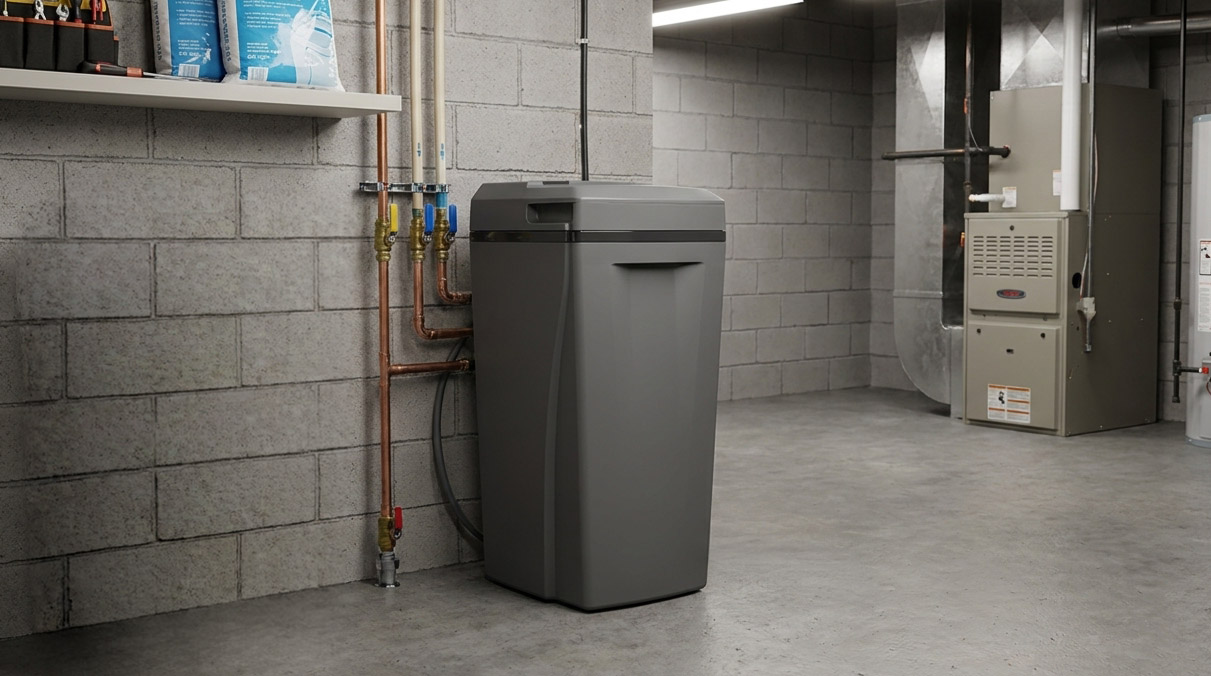
Traditional softeners rely on ion exchange. Water flows through a tank filled with resin beads that grab onto calcium and magnesium as it passes, releasing softened water on the other side while the hardness minerals stay behind on the resin.
That resin can’t do this forever — it needs to regenerate periodically. During regeneration, a brine solution from the salt tank flushes the accumulated minerals off the resin so it’s ready to go again.
Sizing a softener correctly means factoring in:
- The hardness level of your untreated water
- Daily household water consumption
- The number of occupants in the home
- Iron or manganese concentrations
- Available water pressure and flow rate
- Existing plumbing and treatment equipment
Our team of experts bases every water softener installation in New Jersey on actual test results and real household demand — not guesswork.
Do You Need Water Softener Installation or Repair?
Which service makes sense depends on whether you already have a softener, and whether it’s actually doing its job.
You May Need a New Water Softener If:
- Your home doesn’t currently have a softener
- Testing confirms moderate, hard, or very hard water
- You’re regularly scrubbing scale off fixtures and appliances
- Your current system is outdated or undersized
- Your existing equipment doesn’t match your water chemistry
A professional water softener installation delivers treated water throughout the house and cuts down on future scale buildup.
You May Need Water Softener Repair If:
- Hard water symptoms have come back
- The salt level never seems to change
- There’s a hardened salt bridge in the brine tank
- The system regenerates too often
- The system isn’t regenerating at all
- You notice leaks near the valve or tank
- The control panel is throwing an error
- Water still comes out hard right after regeneration
Sometimes it’s a simple fix — recalibration, cleaning, a valve repair, a new brine line, fresh resin. Our team of water treatment experts handle water softener repair throughout New Jersey for systems that have stopped delivering consistent results.
What to Check When Buying a Home With an Existing Softener
Just because a softener is hooked up and stocked with salt doesn’t mean it’s actually working. Before you trust it, check:
- The system’s age and service history
- The current salt level
- The programmed hardness setting
- The regeneration schedule
- Whether the bypass valve is open or closed
- Hardness levels before and after treatment
- Whether iron or sediment has fouled the system
If water is still hard coming out of the tap, get a professional softener inspection and repair before assuming you need a full replacement.
Salt-Based Softeners vs. Salt-Free Conditioners
Salt-free conditioners get marketed as a softener alternative, but they don’t actually do the same job.
A traditional ion-exchange softener removes calcium and magnesium from your water entirely. A salt-free conditioner changes how those minerals behave so they’re less likely to form scale — but they never leave the water.
| System Type | Removes Hardness Minerals? | Reduces Scale? | Requires Salt? |
|---|---|---|---|
| Ion-exchange water softener | Yes | Yes | Usually |
| Salt-free water conditioner | No | May reduce scale formation | No |
A salt-free system can make sense if scale reduction is your only goal. Just don’t expect the lathering, spot-free glassware, or water feel that comes with genuinely softened water — that only happens when the minerals are actually removed.
Why Water Testing Should Come Before Treatment
Hardness is just one piece of your water chemistry. New Jersey well water can also carry iron, manganese, sediment, low pH, sulfur, or contaminants that affect health.
Those factors shape which equipment you actually need, and the order it needs to go in. High iron, for example, can foul standard softener resin before it ever gets the chance to work. Acidic water often needs neutralizing before anything else gets installed.
A full water test tells you whether a softener alone will solve the problem, or whether you need a more complete water filtration system.
Get the Right Hard Water Treatment for Your New Jersey Home
Once you know your actual hardness level and understand the rest of your water chemistry, hard water becomes a lot less mysterious — and a lot easier to fix. Testing takes the guesswork out of it, whether you end up needing a new system, an adjustment to what you already have, or a repair.
Don’t have treatment yet? Start with water softener installation in New Jersey.
Already have a system, but the hard water symptoms are back? Look into water softener repair services.
Contact Jersey Radon to schedule water testing or talk through the right treatment approach for your home.
