Radon in Water in Edison, NJ — Is Your Well or Municipal Supply Carrying It Into Your Home?
Edison homeowners have a well-documented hard water problem and an emerging PFAS concern. Radon in water sits in a different category — less visible in the public conversation but genuinely relevant for any home in Middlesex County drawing from groundwater. Most Edison homes are on municipal supply, which significantly reduces radon through treatment. But the township is large, private wells exist in portions of it, and the Raritan aquifer system that underlies much of Central Jersey passes through geological formations that produce naturally occurring radon in groundwater. A water assessment that specifically includes radon is the only way to know whether it’s a concern at your address.
How Radon Gets Into Water — and Why It Matters
Radon is a naturally occurring radioactive gas that forms as uranium decays in bedrock and soil. It’s familiar to most homeowners as an airborne concern — but radon also dissolves into groundwater as it moves through uranium-bearing rock, and water carries it into the home through the plumbing. When that water is used — in the shower, the dishwasher, or at a running faucet — radon releases from the water into the indoor air, adding to whatever radon is entering from the soil and foundation.
Research has estimated that 10,000 pCi/L of radon in water raises indoor air radon by approximately 1 pCi/L. For a home on a private well in a moderate-radon geological zone like Middlesex County, that contribution to indoor air exposure can be meaningful — particularly when combined with the soil-gas pathway. For municipal water customers, aeration during treatment significantly reduces this risk. But it doesn’t eliminate it entirely, and homeowners who want a definitive answer rather than a probability still have reason to test.
Edison’s Water Sources and What They Mean for Radon Risk
The majority of Edison homes draw from Middlesex County utility sources — treated water that undergoes processing before distribution. Aeration and other treatment steps reduce radon significantly for municipal customers, making elevated waterborne radon arriving at a typical Edison tap relatively unlikely. The concern is more specific for homes in portions of the township where private wells are in use — drawing directly from the Raritan aquifer or local groundwater without any intervening treatment.
Middlesex County’s geology is less uranium-rich than the crystalline bedrock counties of northern New Jersey, meaning the baseline radon-in-groundwater risk is somewhat lower here than in Morris, Somerset, or Hunterdon counties. That context matters — but it doesn’t mean the question is irrelevant for Edison well owners. Any private well in Central Jersey deserves a radon screen as part of a comprehensive baseline panel. Nearby Metuchen, Woodbridge, Piscataway, and East Brunswick share the same regional aquifer characteristics.
When Testing Makes Sense for an Edison Home
- Your Edison home is on a private well drawing from local groundwater
- You’ve tested indoor air radon and found elevated levels without a clear soil-gas explanation
- You’re purchasing a home with a private well and want a complete water quality baseline
- You want to rule out waterborne radon as a contributing factor to indoor air concerns
- You’re on municipal water but want certainty rather than a statistical assumption
Radon in Water Risk by Scenario — Edison Area Homeowners
| Scenario | Risk Level | Recommended Action |
|---|---|---|
| Private well in Middlesex County | Moderate — groundwater exposure without treatment | Test as part of any comprehensive well panel |
| Edison municipal water customer | Lower — treatment reduces radon significantly | Test if indoor air radon is elevated or if concerned |
| Elevated indoor air radon, source unclear | Water may be contributing — unknown without testing | Test water radon as part of full radon assessment |
| Home purchase with private well | Unknown — baseline needed | Test before or immediately after closing |
What Happens After Testing
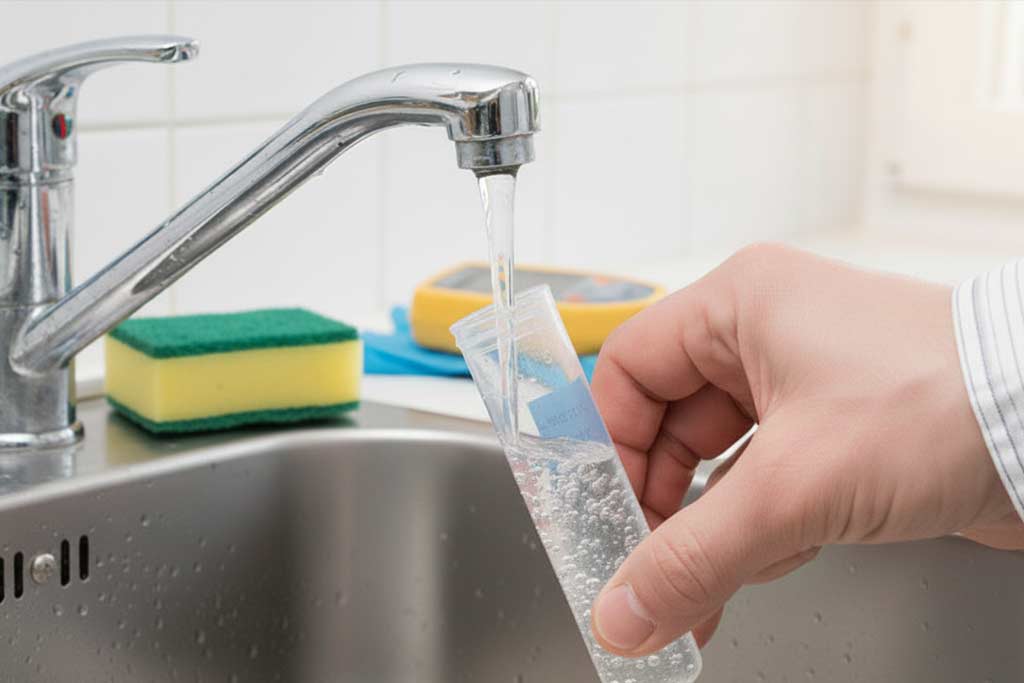
A radon-in-water test returns a specific picocuries-per-liter concentration. Below 4,000 pCi/L — the EPA’s suggested action level — no treatment is required. Above it, aeration systems and granular activated carbon filtration are the established treatment approaches. Our radon in water removal page covers the full treatment picture. For homeowners also thinking about PFAS, iron, and chloramine byproducts in Edison’s water, our water filtration page covers those concerns alongside radon. Our full New Jersey service area covers communities statewide.
Frequently Asked Questions — Radon in Water Testing in Edison, NJ
Is radon in water a significant concern for Edison municipal customers?
For most Edison municipal water customers, the risk is low — treatment significantly reduces radon before water reaches homes. It becomes more relevant for homeowners with elevated indoor air radon that hasn’t been fully explained, or for any property in the township on a private well. Testing gives you a direct answer rather than a regional probability.
Does Middlesex County have elevated radon in groundwater?
Middlesex County has a moderate radon profile relative to the higher-risk crystalline bedrock counties of northern New Jersey. That said, radon in groundwater is present throughout New Jersey to varying degrees, and any private well in Middlesex County deserves to be tested as part of a comprehensive baseline panel.
Is radon testing included in a standard water quality test?
No. Radon in water requires a specific laboratory analysis that must be ordered separately. A standard panel covering hardness, PFAS, lead, and bacteria does not include radon unless it’s explicitly requested. If you’ve had your water tested and radon wasn’t on the panel, that question remains unanswered.
How long does testing take?
Sample collection at your home takes under an hour. Laboratory results for radon-specific analysis typically return within one to two weeks.
What level of radon in water requires action?
The EPA’s suggested action level for private well water is 4,000 pCi/L. We walk through your specific results in context when they come back — what the number means for your household’s total radon exposure, not just how it compares to a regulatory threshold.
Find Out What’s in Your Edison Home’s Water
If you’re on a private well in Edison or anywhere in Middlesex County and haven’t specifically tested for radon — or if indoor air radon has been a concern you haven’t fully resolved — a radon-in-water test is a straightforward and worthwhile addition to your water quality picture. We serve Edison and all of Middlesex County. Call us at (732) 357-1988 or reach out online.