Do You Need Radon in Water Testing in Montclair, NJ? Here’s How to Know.
Montclair homeowners tend to be thorough about the things that matter — the age of the roof, the condition of the boiler, the lead in the pipes. Radon in water is the concern that frequently gets missed, even by homeowners who’ve already tested their indoor air. Essex County sits within New Jersey’s elevated-radon geological zone, and while Montclair is predominantly a municipal water community, that doesn’t eliminate the question entirely — and for any home in the area connected to a private well, it makes radon-in-water testing a clear priority. The only way to know whether waterborne radon is present at your address is to test the water specifically for it.
This page explains what radon in water is, how it enters homes, what the health concern actually looks like, and when testing makes sense for a Montclair household specifically.
Radon in Water — The Exposure Pathway Most Homeowners Haven’t Thought About
Radon is a colorless, odorless, radioactive gas that forms naturally as uranium decays in bedrock and soil. Most people encounter radon as an airborne concern — the gas seeps through foundation cracks and accumulates in basements and lower living spaces. But radon also dissolves into groundwater as it moves through uranium-bearing rock, and that water carries the gas into the home through a separate and often overlooked exposure pathway.
The mechanism is straightforward. Water containing dissolved radon enters the home through the plumbing. When that water is agitated — in the shower, the dishwasher, the washing machine, or even a running faucet — radon is released from the water into the indoor air. Research has estimated that for every 10,000 pCi/L of radon in water, indoor air radon levels rise by approximately 1 pCi/L. In homes with elevated waterborne radon, the cumulative contribution to indoor air exposure is real and measurable — and it’s separate from the soil-gas pathway that airborne radon testing addresses.
Radon in water cannot be detected by sight, smell, or taste. Testing is the only way to find it.
What Montclair’s Water Source Means for Radon Risk
The vast majority of Montclair homes are served by the Essex County municipal water system — treated surface water that undergoes aeration and other processes that significantly reduce radon before distribution. For municipal water customers, the risk of waterborne radon reaching the tap at concerning levels is meaningfully lower than for homes on private wells. That said, “lower” is not the same as zero, and homeowners who’ve found elevated indoor air radon and haven’t identified a clear soil-gas source have reason to test water as well — particularly if the home is older or if the water supply source history is unclear.
Where radon in water becomes a more pressing concern in the Montclair area is for any property drawing from a private well — which, while less common in an established suburban community like Montclair, does exist in portions of the surrounding Essex County area. Nearby Verona, Glen Ridge, Bloomfield, and West Orange share the same geological profile. Any private well in this part of Essex County sits within a geological zone where radon in groundwater is a documented and meaningful concern.
When Radon in Water Testing Makes Sense for a Montclair Home
- Your property is served by a private well anywhere in Essex County
- You’ve tested indoor air radon and found elevated levels — and haven’t identified a clear source
- You’re buying a home in the area and want a complete water quality baseline before closing
- Your home is older and the water supply source history isn’t fully known
- You’re on municipal water but want certainty rather than statistical reassurance
It’s worth noting that a standard water quality test — even a comprehensive one covering lead, PFAS, hardness, and bacteria — does not include radon unless it’s specifically requested. If you’ve had your water tested and radon wasn’t on the panel, you don’t yet have an answer to this specific question.
Radon in Water Risk by Scenario — Montclair Area Homeowners
| Scenario | Risk Level | Recommended Action |
|---|---|---|
| Private well in Essex County | Higher — direct groundwater exposure | Test immediately; include in any well water panel |
| Municipal water in Montclair | Lower — treatment reduces radon before distribution | Test if indoor air radon is elevated or if concerned |
| Elevated indoor air radon, source unclear | Water may be contributing — unknown without testing | Test water radon as part of full radon assessment |
| Home purchase with unknown water history | Unknown — baseline needed | Test before or immediately after closing |
New Jersey’s Radon Context and Why Essex County Matters
New Jersey has among the highest radon levels of any state in the country — a function of the uranium-rich geological formations that underlie much of northern and central New Jersey. Within the state, Essex County sits in a zone where both airborne and waterborne radon are genuine concerns, driven by the crystalline bedrock geology that characterizes this part of North Jersey. The radon risk here is not hypothetical — it’s the reason New Jersey has some of the most active radon testing and mitigation markets in the country, and why waterborne radon deserves the same attention that airborne radon testing has received.
What Happens Once You Have Test Results
A radon-in-water test produces a specific concentration in picocuries per liter. Below 4,000 pCi/L — the EPA’s suggested action level for private well water — no treatment is indicated. Above that threshold, treatment options are available and effective. Aeration systems and granular activated carbon filtration are both established approaches, with the right choice depending on the concentration found and the home’s specific plumbing configuration.
Our radon in water removal page covers the treatment side of this conversation in detail. For homeowners also thinking about broader water quality, our water filtration page for Montclair covers the other contaminants worth addressing alongside radon. Our full New Jersey service area is available if you’re looking for coverage in another community.
Frequently Asked Questions — Radon in Water Testing in Montclair, NJ
I’ve already tested my air for radon — why would I also test the water?
Air and water radon testing measure different things. An air test tells you the radon concentration in your living spaces. A water test tells you whether your water supply is contributing radon to that air — a separate exposure pathway. If your air test showed elevated levels and you’re on a private well, waterborne radon may be a meaningful contributing factor. Testing the water gives you the complete picture.
Is Montclair’s municipal water safe from radon?
Municipal water treatment — particularly aeration — reduces radon significantly before the water reaches homes. The risk of elevated radon in Montclair’s treated municipal supply is considerably lower than for private well water. That said, homeowners who want certainty rather than probability — particularly those who’ve found elevated indoor air radon — have good reason to test regardless of their water source.
How is radon in water tested differently from other water tests?
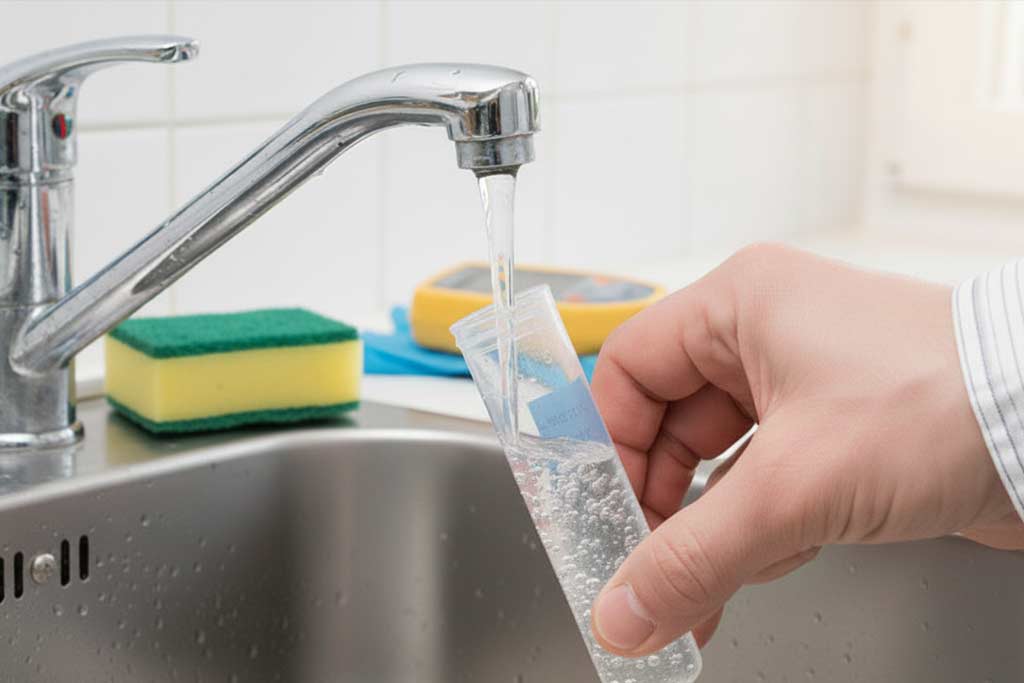
Radon in water requires a specific laboratory analysis that must be requested separately from standard water quality panels. A water sample is collected at the tap and analyzed for radon concentration at a certified laboratory. Results typically take one to two weeks. It cannot be combined with or inferred from a standard hardness, bacteria, or contaminant screen.
What concentration of radon in water is considered actionable?
The EPA has proposed 4,000 pCi/L as the suggested action level for radon in private well water. New Jersey has its own guidance that we walk through with homeowners in the context of their specific results — what the number means for their household, not just whether it clears a threshold.
How soon can I get tested?
We’re typically able to schedule within a few days. Sample collection takes under an hour at your home, and laboratory results for radon-specific analysis are typically back within one to two weeks.
Get Clarity on Radon in Your Montclair Home’s Water
If you’re in Montclair and haven’t tested your water for radon — whether you’re on a private well or simply want a complete picture of your water quality — this is a straightforward question to answer. We serve Montclair and all of Essex County. Call us at (732) 357-1988 or reach out online and we’ll help you determine whether radon in water testing makes sense for your home.