Radon in Water Testing in Morristown, NJ: What Homeowners in Morris County Should Know
Most Morristown homeowners who’ve tested for radon have tested the air. Fewer have tested the water — and in Morris County, that’s a meaningful gap. New Jersey has some of the highest naturally occurring radon levels in the country, and the bedrock geology underlying this part of North Jersey places Morris County in an elevated-risk zone for radon in groundwater. For homes on private wells, that geology directly determines what’s coming out of the tap. For homes on municipal water, the risk is lower but not zero. Either way, the only way to know whether radon in water is a concern at your specific address is to test your water.
This page explains what radon in water is, how it enters homes, when testing makes sense, and why Morris County homeowners have more reason than most to take this question seriously.
What Radon in Water Actually Is — and Why It’s Different From Airborne Radon
Radon is a naturally occurring radioactive gas produced by the decay of uranium in rock and soil. Most homeowners know it as an airborne basement concern — radon seeping through foundation cracks and accumulating in living spaces. What fewer homeowners know is that radon also dissolves into groundwater as it moves through uranium-bearing bedrock, and that water can carry radon into the home through an entirely different pathway.
When radon-containing water is used in the home — for showering, running the dishwasher, doing laundry, or even filling a pot for cooking — the gas is released from the water into the indoor air. Studies have estimated that roughly 10,000 picocuries per liter (pCi/L) of radon in water contributes approximately 1 pCi/L to indoor air radon levels. That’s a meaningful contribution for homes with elevated well water radon, particularly in geological areas like Morris County where baseline levels in groundwater can run significantly high.
Radon in water is invisible, has no taste, and produces no odor. It is not detectable by any means other than testing.
How Radon Enters Morris County Homes Through Water
Morris County’s geology — specifically the crystalline bedrock formations that underlie much of the region around Morristown, Morris Plains, Parsippany, and Madison — is the primary driver of radon in local groundwater. Uranium naturally present in these rock formations decays into radon, which dissolves into the groundwater that private wells draw from. The deeper the well and the more uranium-bearing bedrock the water passes through, the higher the potential radon concentration.
Homes on private wells in Morris County are the most directly at risk. The well draws water directly from local groundwater — there’s no treatment plant between the aquifer and the tap. Whatever radon is present in the aquifer arrives at the home essentially unchanged.
Homes on municipal water in the Morristown area face a lower risk. Municipal water undergoes treatment and aeration processes that reduce radon significantly before distribution. However, some radon can persist through treatment depending on the source and system, and homeowners who want certainty rather than assumption have reason to test regardless of their water source.
When Radon in Water Testing Makes Sense in Morristown
Testing is the right first step in several specific situations — and a reasonable precaution in others:
- Your home is on a private well anywhere in Morris County
- You’ve tested indoor air radon and found elevated levels — waterborne radon may be a contributing factor
- You’ve never tested your well water for radon and have lived in the home for more than a year
- You’re purchasing a home in the Morristown area on a private well and want a complete water quality baseline
- You’re on municipal water and want certainty rather than statistical likelihood
Testing for radon in water is a separate test from a standard water quality panel — it requires a specific radon-in-water analysis at a certified laboratory. It’s not included in a basic hardness or contaminant screen. If you’ve had your water tested but radon wasn’t specifically included, you don’t yet have an answer to this question.
Radon in Water Risk by Water Source — What Morristown Homeowners Should Know
| Scenario | Risk Level | Recommended Action |
|---|---|---|
| Private well in Morris County | Higher — direct groundwater exposure | Test immediately; add to any comprehensive well panel |
| Municipal water in Morristown | Lower — treatment reduces radon significantly | Test if concerned or if indoor air radon is elevated |
| Elevated indoor air radon confirmed | Water may be contributing — unknown without testing | Test water radon as part of full radon assessment |
| New home purchase with private well | Unknown — baseline needed | Test before closing or immediately after |
New Jersey’s Radon Context — Why Morris County Sits in an Elevated Zone
New Jersey consistently ranks among the states with the highest radon levels in the country. Within New Jersey, the risk is not uniform — it follows geology. Morris County, along with parts of Somerset, Hunterdon, Sussex, and Warren counties, sits in the geological zone most associated with elevated radon in both air and groundwater. The crystalline bedrock that gives this part of North Jersey its topography is the same rock formation that produces the highest radon concentrations in New Jersey groundwater.
This doesn’t mean every well in Morristown has a radon problem. It means the baseline risk is higher here than in coastal or sedimentary geology areas of the state — and that testing is a more urgent priority for Morris County well water owners than it would be for homeowners elsewhere in New Jersey.
What Happens After Testing
A radon-in-water test gives you a specific number — a concentration in picocuries per liter — that determines whether action is needed and what kind. If levels are below the EPA’s suggested action level of 4,000 pCi/L for waterborne radon, no treatment is required. If levels are elevated, treatment options exist — aeration systems and granular activated carbon filtration are both established approaches — and the right choice depends on the concentration found and the household’s specific setup.
For more information on what radon in water treatment involves once testing confirms a concern, our radon in water removal page covers the full treatment picture. If you’re approaching water quality more broadly, our water filtration page for Morristown and reverse osmosis installation page cover the additional contaminants worth addressing alongside radon. You can also view our full New Jersey service area for other communities we cover.
Frequently Asked Questions — Radon in Water Testing in Morristown, NJ
Is radon in water dangerous?
Radon in water is a health concern primarily because of its contribution to indoor air radon levels. When water containing radon is used in the home, the gas is released into the air — particularly during showering and other water-agitating activities. Long-term exposure to elevated indoor radon is associated with increased lung cancer risk. The EPA estimates that radon in drinking water causes a small number of cancer cases annually, with the inhalation pathway being the primary concern rather than ingestion directly from the water.
I already tested my indoor air radon — do I still need to test the water?
Yes, if you’re on a private well. Air and water radon are separate measurements addressing separate exposure pathways. An air test tells you the radon concentration in your living spaces. A water test tells you whether your well water is contributing to that concentration. If your air test showed elevated radon and you haven’t identified the source, waterborne radon may be a significant contributing factor — particularly in Morris County’s geology.
How is radon in water tested?
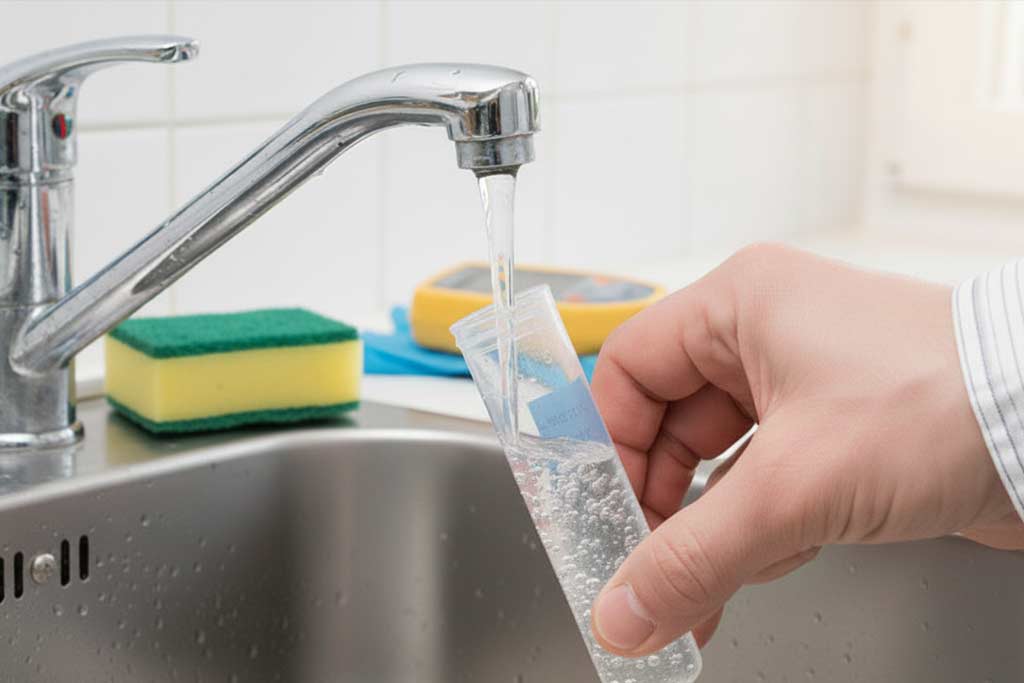
Radon in water requires a specific laboratory analysis — a water sample collected at the tap and analyzed for radon concentration. It’s a separate test from standard water quality panels and needs to be specifically requested. We can arrange radon-in-water testing as part of a comprehensive well water assessment or as a standalone test.
What level of radon in water is considered a problem?
The EPA has proposed an action level of 4,000 pCi/L for radon in private well water, though no federal maximum contaminant level has been finalized. New Jersey has its own guidance for radon in water. We explain the specific numbers in context when test results come back — what the concentration means for your home, not just how it compares to a threshold.
How quickly can I get tested?
We’re typically able to schedule within a few days. The on-site sample collection takes under an hour, and laboratory results are back within approximately one to two weeks for radon-specific analysis.
Find Out Whether Radon in Water Is a Concern in Your Morristown Home
If you’re on a private well in Morris County and haven’t tested for radon in water — this is a straightforward question to answer and a reasonable one to ask. We serve Morristown and all of Morris County. Call us at (732) 357-1988 or reach out online and we’ll help you figure out whether testing makes sense for your specific situation.