Newark’s Water Is Hard. It’s Wearing Out Appliances and Fixtures Across Essex County Every Day.
Hard water is a fact of life in Newark and across Essex County — but it doesn’t have to be. The calcium and magnesium that come standard in the region’s water supply produce a slow, expensive kind of damage: scale inside water heaters, clogged dishwasher spray arms, calcified showerheads, and the kind of skin dryness that no moisturizer fully compensates for. A whole-home water softener installation removes those minerals before they enter your plumbing — protecting everything the water touches, from the pipes in the walls to the appliances in the kitchen.
For Newark homeowners dealing with aging infrastructure and water that already carries lead concerns and disinfection byproduct questions, hard water is the visible layer of a water quality picture worth addressing completely. A softener handles the hardness. Combined with appropriate filtration, it handles the rest.
Why Newark’s Water Runs Hard and What That Means for Your Home
Newark’s municipal water supply draws from surface water sources in the Pequannock, Wanaque, and Charlotteburg watersheds — sources that carry mineral content the treatment process does not remove. Hardness minerals pass through treatment and arrive at Essex County homes at concentrations that produce measurable scale over time. In Newark’s older housing stock — which is substantial — that hard water has often been working through original or partially updated plumbing for decades, compounding the scale buildup in ways that newer construction doesn’t experience to the same degree.
The effects in Newark homes are familiar: the white crust around faucets, the showerhead that loses pressure every few months, the water heater that the plumber says “went early,” and the glassware that comes out of the dishwasher hazy regardless of which detergent is used. These aren’t separate problems — they’re all the same problem. Hard water. And a water softener solves all of them.
What a Whole-Home Water Softener Does for a Newark Home
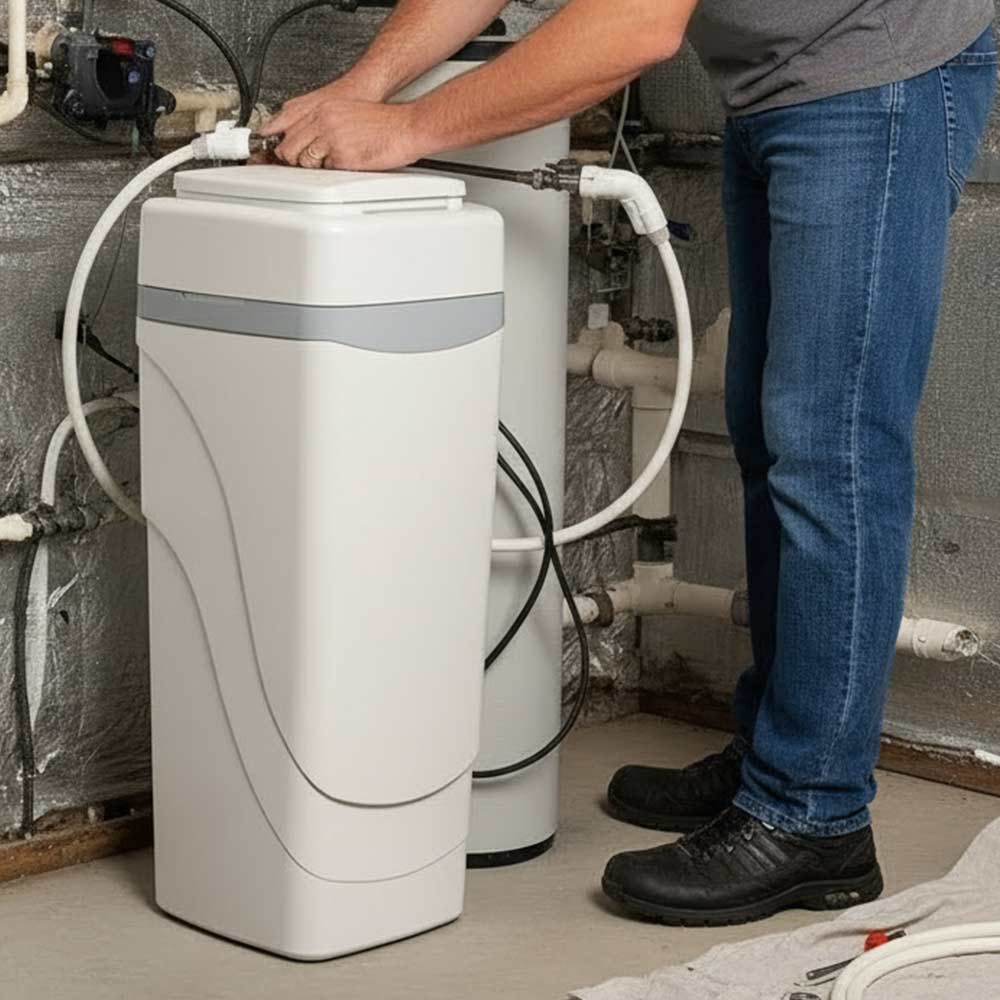
A water softener uses ion exchange to remove calcium and magnesium from your water supply before it enters your home’s plumbing. Sodium ions replace the hardness minerals as water passes through a resin bed, and the resin regenerates automatically on a scheduled cycle. Every faucet, fixture, and appliance in the house receives softened water from the moment of installation.
The benefits arrive immediately and compound over time:
- Scale stops forming on fixtures, tiles, and inside appliances from day one
- Existing scale in water heaters and dishwashers gradually dissolves as softened water flows through
- Soap, shampoo, and cleaning products lather fully — soft water requires significantly less product
- Skin feels genuinely clean after showering rather than coated with mineral film
- Appliances reach their rated lifespans instead of failing years early
- Pipes maintain full flow capacity without mineral buildup restricting diameter
The Long-Term Cost of Untreated Hard Water in Newark
| Hard Water Effect | Real Cost | With a Softener |
|---|---|---|
| Water heater scale | 25–30% energy loss; early replacement | Full efficiency; rated lifespan |
| Dishwasher failure | Clogged components; shortened life | Clean operation; extended life |
| Excess soap and product use | 25–50% more product annually | Full lather with significantly less |
| Fixture descaling | Time and cleaning cost | Scale stops forming |
| Pipe scale accumulation | Reduced flow; eventual pipe work | Full flow maintained |
What Water Softener Installation Costs in Newark
Water softener installation in Newark typically ranges from $3,000 – $12,000+ depending on system type, household size, water hardness level, and installation complexity. A standard whole-home ion exchange softener for a typical Essex County household runs $3,000–$6,000 installed. Larger systems, dual-tank configurations, or combination softener-filtration setups run higher. Newark’s older housing stock sometimes requires additional pipe work during installation, which affects the total.
If you want to confirm your water’s hardness level before committing to a system, a professional water test gives you the specific grains-per-gallon reading that determines the right system size — and surfaces any other water quality concerns, like lead or PFAS, that a combined approach might address more efficiently. Our water softener service page covers what different system types include.
Serving Newark and Surrounding Essex County Communities
We install water softeners throughout Newark and across Essex County, including East Orange, Irvington, Bloomfield, and Belleville — communities sharing the same regional water supply and hard water characteristics. Our full New Jersey service area covers communities statewide.
Frequently Asked Questions — Water Softener Installation in Newark, NJ
Does Newark have hard water?
Yes. Essex County water, including the supply serving Newark, carries moderate hardness from the watershed sources that feed the regional system. The visible effects — scale on fixtures, hazy glassware, dry skin — are consistent indicators. A hardness test gives you the specific number in grains per gallon that determines whether softening is warranted and what size system your household needs.
Can a softener be installed in an older Newark home or apartment building?
Yes, though older homes sometimes require additional pipe work or bypass configuration depending on how the plumbing is arranged. We assess the installation site before scheduling to identify any complications and give you an accurate quote. Most older Newark homes are perfectly suited for softener installation with standard configuration.
Will a water softener help with the lead concerns in Newark?
A standard water softener does not remove lead — it’s designed for hardness minerals only. If your water test reveals both hardness and lead concerns, a combined approach is appropriate: a softener for the hardness and a point-of-use reverse osmosis system at the kitchen tap for lead and other dissolved contaminants. We help you design a solution that addresses everything your specific water quality requires.
How much salt does a softener use?
A properly sized system for a typical household uses roughly 6–10 lbs of salt per regeneration cycle, regenerating every few days. Annual salt cost for most Newark-area households runs $100–$300 depending on usage and local salt prices.
How quickly will I notice a difference?
Most homeowners notice changes within the first shower — the way the water feels on skin is the most immediate indicator. Scale formation stops from day one. Existing scale in appliances begins to dissolve gradually over the following weeks as softened water replaces hard water through the system.
Schedule Your Newark Water Softener Installation
If hard water has been a persistent cost in your Newark home — in appliance wear, cleaning products, and daily discomfort — a water softener installation resolves it at the source. We serve Newark and all of Essex County. Call us at (732) 357-1988 or schedule online.