Most New Jersey homeowners with private wells test for the obvious problems: iron, hardness, coliform bacteria, maybe arsenic. What rarely makes the standard checklist is a category of contaminants that can enter your groundwater silently, persist for years, and cause serious health problems long before anyone connects the dots. Volatile organic compounds, or VOCs, are among the most common chemical contaminants found in private well water across New Jersey, and they are among the most frequently missed. If you have not had a comprehensive well water test that includes a VOC panel, that gap is worth closing.
If your home sits near a former industrial site, a dry cleaner, a gas station, an auto repair shop, or even a landfill, and tens of thousands of NJ homes do, VOC contamination in your well water is a real and testable risk, not a theoretical one.
What Are VOCs and Why Are They in Well Water?
Volatile organic compounds are a broad class of carbon-based chemicals that evaporate easily at room temperature. They are used in industrial solvents, degreasers, fuels, paints, dry-cleaning agents, and a wide range of manufacturing processes. When these chemicals are spilled, leaked, or improperly disposed of, they can penetrate the soil and reach groundwater. For private well owners, that means the water coming out of your tap.
VOCs do not stay put once they enter groundwater. They migrate with the water table, sometimes traveling significant distances from the original contamination source. A leaking underground storage tank from a gas station that closed decades ago can still be contaminating wells in the surrounding area today. That is what makes VOC contamination particularly difficult to catch: the source may be invisible, long gone, or nowhere near your property line.
Common VOCs found in New Jersey well water include:
- Benzene: a component of gasoline and industrial solvents, classified as a human carcinogen by the EPA
- Trichloroethylene (TCE): widely used as a metal degreaser and linked to kidney cancer, liver damage, and nervous system effects
- Tetrachloroethylene (PCE): the primary solvent used in dry cleaning, associated with liver and kidney damage with long-term exposure
- MTBE (methyl tert-butyl ether): a gasoline additive that was phased out nationally but remains in NJ groundwater from legacy underground tank leaks
- Toluene and Xylene: solvents found in paints, adhesives, and petroleum products, associated with neurological effects at elevated levels
- Vinyl Chloride: a breakdown product of TCE and PCE degradation in the ground and one of the more potent carcinogens in this category
New Jersey’s industrial history makes this list particularly relevant. The state has one of the highest concentrations of Superfund sites in the country, a dense network of underground storage tanks, and decades of heavy manufacturing activity in its central and northern regions. If you are on a private well in Morris, Somerset, Hunterdon, Union, or Essex County, or anywhere near a former industrial corridor, VOC testing deserves a spot on your water safety checklist.
How VOCs Enter Your Well
Understanding where VOCs come from helps explain why they are so hard to avoid and so easy to miss. The pathways into groundwater are varied, and many involve contamination events that happened long before the current homeowner moved in.
The most common sources of VOC contamination in NJ private wells include:
- Underground storage tank (UST) leaks: gas stations, auto shops, and heating oil tanks that corrode over time and release petroleum-based VOCs directly into the surrounding soil
- Dry cleaning operations: PCE is the dominant solvent used in dry cleaning and has contaminated groundwater around hundreds of NJ dry cleaning sites, many of which operated for 40 or more years
- Industrial and manufacturing facilities: degreasing operations, electronics manufacturing, and chemical processing generate TCE and other solvents that can contaminate surrounding groundwater when managed improperly
- Landfill leachate: older municipal landfills leach a complex mix of chemicals, including VOCs, into nearby groundwater
- Historical spills and illegal dumping: agricultural properties, former industrial lots, and roadsides with undocumented disposal history
What makes this especially frustrating is that contamination can spread from a source several properties away. Your well may never have been near the original spill site, but groundwater does not respect property lines.
The Health Risks of VOC Exposure Through Drinking Water
Health concerns from VOCs depend on the specific compound, the concentration, and the duration of exposure. Short-term exposure to very high levels can cause headaches, dizziness, nausea, and irritation. Long-term, lower-level exposure is where the more serious risks emerge, and that is exactly the kind of exposure that happens when VOC contamination goes undetected in a home’s well water for months or years.
The EPA has set maximum contaminant levels (MCLs) for a number of VOCs in drinking water. Benzene’s MCL is 5 parts per billion (ppb), a standard that reflects its classification as a known human carcinogen. TCE and PCE each carry MCLs of 5 ppb as well. The New Jersey Department of Environmental Protection (NJDEP) enforces its own standards, which in some cases are stricter than federal EPA limits. You can review current NJDEP groundwater quality standards on the NJDEP Division of Water Supply and Geoscience website.
The concern with private well water is that it is not regulated the way municipal water is. No government agency is routinely monitoring your well. If VOC contamination enters your water supply, the only way to know is to test for it yourself.
There is one more dimension to VOC exposure that many homeowners are not aware of. Because these compounds are volatile by nature, they do not only pose a risk through drinking. When you shower, run a dishwasher, or boil water, VOCs can off-gas from hot water and become airborne inside your home. Inhalation is a real exposure pathway, particularly in bathrooms and kitchens with limited ventilation.
Why Standard Water Tests Often Miss VOCs
This is one of the most important points for NJ well water homeowners to understand. A basic water test that checks for hardness, pH, iron, and bacteria does not test for VOCs. VOC analysis requires a separate, targeted panel sent to a certified laboratory and analyzed using gas chromatography or similar methods.
The full picture of what a water test actually shows often surprises homeowners who assumed their annual test covered the bases. It usually does not, especially for chemical contaminants like VOCs, PFAS, and nitrates, which require their own specific test panels. If you have not had a VOC-specific water test, you cannot assume your water is clear of them. Many homeowners who discover VOC contamination had been living in the home for years with no idea it was there.
Common VOCs Found in NJ Well Water
The following table summarizes some of the most frequently detected VOCs in New Jersey groundwater, along with their primary sources and the health concerns recognized by the EPA and NJDEP.
| VOC | Primary Source in NJ | EPA MCL | Health Concern |
|---|---|---|---|
| Benzene | Gasoline, petroleum UST leaks | 5 ppb | Known human carcinogen |
| Trichloroethylene (TCE) | Industrial degreasers, metal manufacturing | 5 ppb | Kidney cancer, liver damage, neurological effects |
| Tetrachloroethylene (PCE) | Dry cleaners, textile processing | 5 ppb | Liver and kidney damage, probable human carcinogen |
| MTBE | Legacy gasoline additive, UST leaks | Not federally regulated (NJ: 70 ppb) | Kidney and liver damage, possible carcinogen |
| Vinyl Chloride | Breakdown product of TCE and PCE in soil | 2 ppb | Known human carcinogen |
| Toluene | Paints, petroleum, adhesives | 1,000 ppb | Neurological effects with long-term exposure |
VOCs rarely appear alone in contaminated groundwater. A fuel spill, for example, may introduce benzene, toluene, ethylbenzene, and xylene simultaneously, a cluster commonly referred to as BTEX contamination. A comprehensive VOC panel tests for multiple compounds at once, which is why targeted testing matters more than single-contaminant spot checks.
How VOC Contamination Is Treated in Well Water
Proven treatment technologies exist for VOC removal from residential well water. The right system depends on which VOCs are present, their concentrations, and your household’s water usage. That is why testing always comes before treatment decisions.
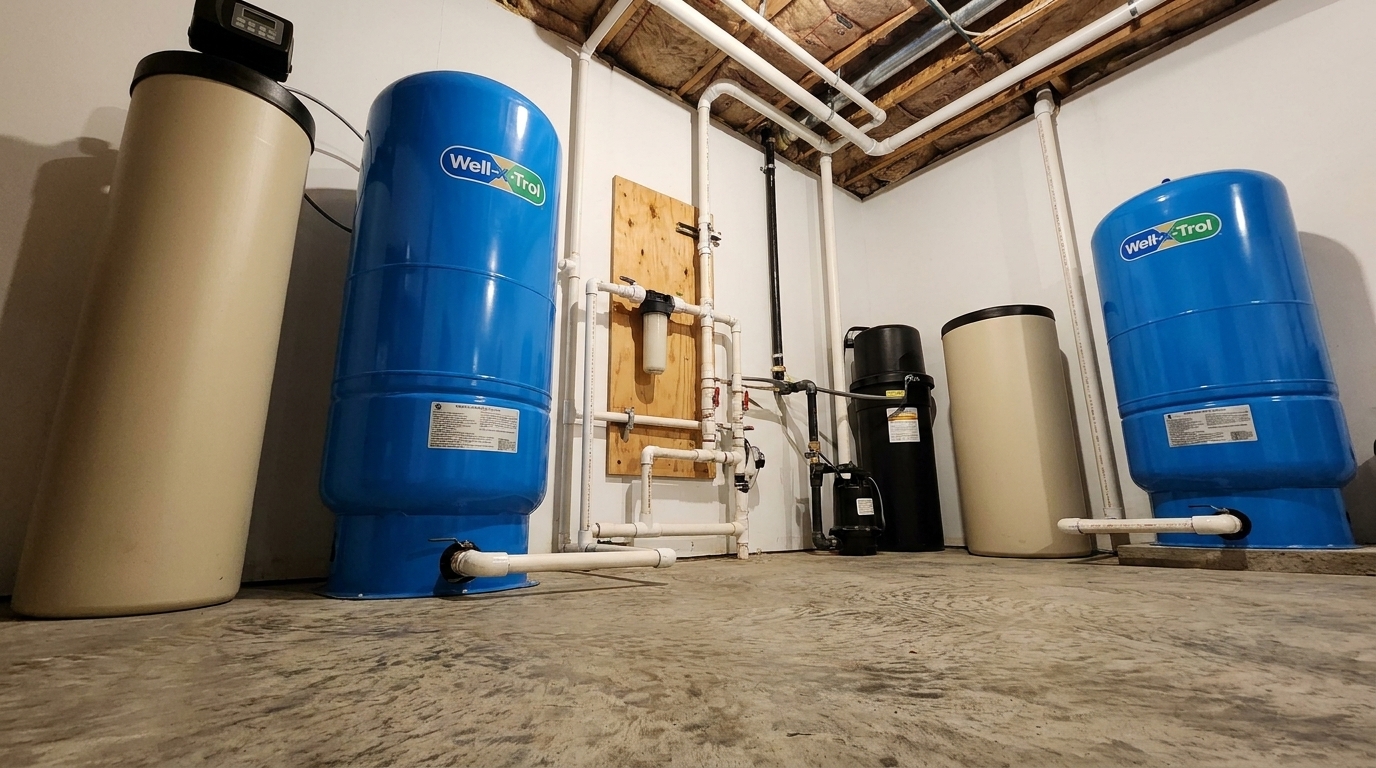
The two most effective approaches for residential VOC removal are granular activated carbon filtration and air stripping. Water filtration using granular activated carbon (GAC) is the most widely used treatment for VOC removal in private wells. Activated carbon has an enormous surface area at the microscopic level, which allows it to adsorb VOC molecules as water passes through. A properly sized and maintained GAC system can reduce benzene, TCE, PCE, and many other VOCs to levels well below regulatory standards. For most NJ homes with confirmed VOC contamination, whole-house GAC filtration is the standard first-line response.
Air stripping takes advantage of VOCs’ volatile nature by exposing contaminated water to a large volume of air, either through a packed tower or spray system. The VOCs transfer from the water into the air stream, where they can be safely vented or captured. Air stripping is highly effective for compounds like benzene, TCE, and MTBE, and is often used alongside GAC for more comprehensive treatment.
Water purification systems using reverse osmosis can add an additional layer of protection at the tap, though they work best as a complement to whole-house treatment rather than a standalone solution for well-wide VOC contamination.
It is also worth understanding how VOC treatment differs from other contaminant categories. PFAS removal and arsenic and toxic contaminant treatment require different systems entirely. Installing the wrong filtration technology will not solve a VOC problem. A comprehensive water test is always the right starting point, because it tells you exactly what you are treating before you commit to a solution.
What NJ Homeowners on Private Wells Should Do Next
If you have never tested your well water for VOCs, or if you are moving into a home with a private well and have not reviewed the contamination history of the surrounding area, here is a clear action path:
- Request a VOC panel from a certified water testing lab. A VOC panel will not be included in a standard water test. Ask specifically for volatile organics analysis when scheduling your test.
- Check the contamination history of your area. The NJDEP maintains publicly accessible data on known contamination sites, Superfund locations, and UST records. If your well is near a flagged site, that is a stronger reason to prioritize testing.
- Do not assume past clean results are still valid. Groundwater contamination plumes migrate over time. A clean test from several years ago does not guarantee the same result today, particularly if new development, tank removals, or spill events have occurred nearby.
- Confirm your current filter covers VOCs before assuming it does. Most iron filters, water softeners, and basic sediment systems do not remove VOCs. The full range of water problems and treatment options varies by contaminant, and a water treatment professional can confirm what your system actually removes.
VOC contamination in well water does not announce itself. There is no smell, no color, no taste to warn you. The only way to know is to test, and if something is there, the right treatment system will handle it reliably.
If you are a New Jersey homeowner on a private well and you have not had a VOC-specific water test, it is worth adding to your list. The team at Jersey Radon can help you understand your water treatment options, evaluate your results, and recommend a filtration solution that matches what is actually in your water. Request a free estimate and get a clearer picture of what is coming out of your well.
