Livingston Homeowners Hold Their Homes to a High Standard. The Water Coming Out of the Tap Should Be No Different.
Livingston’s water quality picture is shaped by Essex County’s geology, the municipal distribution system’s chemistry, and the particular plumbing inside homes built across several decades of construction standards. The chemical taste from chloramine disinfection, the metallic quality from lead solder in older interior plumbing, the iron or manganese mineral content in private well water, and seasonal variation in the municipal supply all contribute to a tap water experience that frequently falls short of what homeowners expect. Understanding what’s causing the specific symptom at your tap is where the solution starts. Water testing in Livingston provides the specific diagnosis that turns frustration into a fixable problem.
Chloramines — The Chemical Taste in Livingston’s Municipal Supply
The Essex County municipal water system uses chloramine as its primary disinfectant — a chlorine-ammonia compound that persists through the distribution network from treatment plant to tap. Chloramine’s stability is what makes it effective for a large distribution system; it’s also what produces the persistent chemical or bleach-like taste and smell that Livingston municipal customers notice, particularly in cold water drawn first thing in the morning.
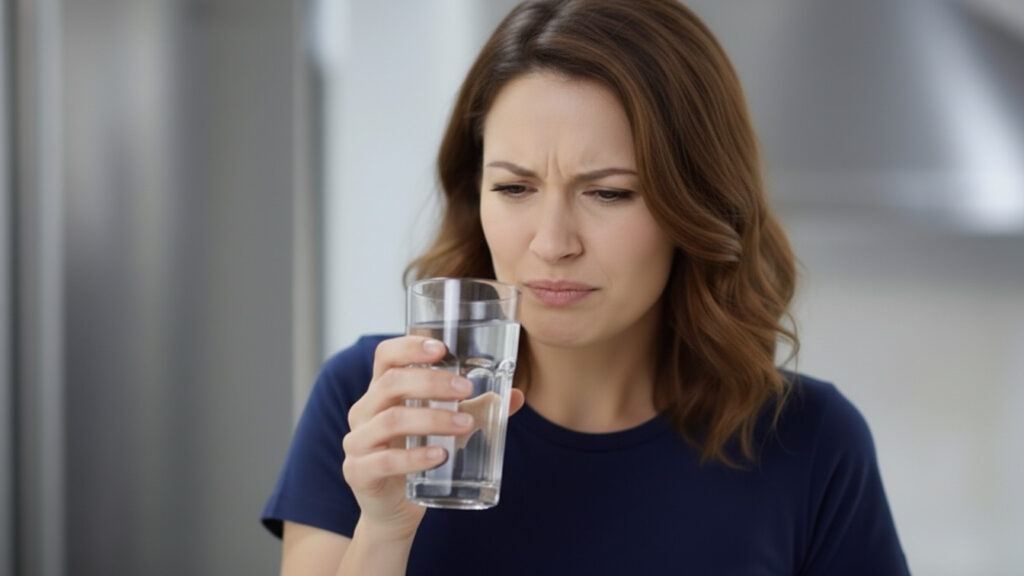
What homeowners notice: a pool-like or bleach smell from running water, a chemical quality in drinking water and hot beverages, and sometimes mild skin sensitivity after extended shower exposure. This is within the EPA’s drinking water standards — but many Livingston homeowners find the taste profile of chloramine-treated water incompatible with the quality standard they apply to everything else in their homes. Carbon-based filtration at the kitchen tap is the most direct and effective fix. Chloramine also produces trihalomethanes and haloacetic acids as disinfection byproducts — regulated but contributing to the overall taste profile.
Lead From Interior Plumbing in Livingston’s Mid-Century Homes
Livingston’s residential character is defined largely by mid-century construction — the ranches, splits, and colonials built from the 1950s through the 1970s that comprise much of the township’s housing inventory. These homes were built when lead solder at interior pipe joints was standard practice. The Essex County municipal supply arrives at Livingston homes lead-free. What happens inside older homes’ plumbing before the water reaches the tap is a property-specific question.
What homeowners notice: a metallic or astringent taste in the first glass drawn in the morning, improving after running the tap for thirty seconds to a minute. This specific pattern — first-draw metallic taste that improves with flushing — is the diagnostic signature of interior plumbing as the source. A tap-level water test at the kitchen faucet answers the question directly. The utility’s annual report cannot tell you what your home’s specific plumbing is contributing.
Iron and Manganese in Livingston Area Private Wells
Any Livingston-area property on a private well drawing from Essex County’s crystalline and mixed bedrock geology encounters the mineral content typical of this geological zone — and iron and manganese are among the most common contributors to metallic taste and staining. Orange-brown staining on toilet tanks, discolored laundry, and a metallic quality to drinking water and coffee are the characteristic signs. These are secondary contaminants regulated for aesthetic rather than direct health reasons at typical concentrations, but they significantly affect water usability and damage appliances over time.
The CDC’s private well water guidance covers what different well water symptoms indicate and when to investigate further. Iron and manganese filtration designed specifically for these minerals is different from a water softener — confirming concentrations through testing before choosing a treatment system prevents the common mistake of installing the wrong solution.
Hydrogen Sulfide — Rotten Egg Smell in Hot Water Systems and Private Wells
The rotten egg odor of hydrogen sulfide in Livingston homes appears in two distinct contexts. In homes on private wells drawing from Essex County bedrock aquifer zones where sulfur-reducing bacteria are active, hydrogen sulfide comes up with the water and appears at all taps. In both well and municipal water homes, a hot-water-only sulfur smell typically indicates a water heater anode rod reaction — bacteria reacting with the magnesium anode rod in the tank rather than anything wrong with the supply.
The distinction — all taps versus hot water only — is the key diagnostic step. Hot-water-only smell points to the tank; all-tap smell consistently points to a groundwater or supply source.
Seasonal Variation — Essex County Source Water Through the Year
Essex County’s municipal supply is affected by seasonal source water quality changes — spring runoff introducing organic material, summer algae growth, fall leaf decomposition. Treatment adjustments in response can produce temporary taste and odor changes at Livingston taps — an earthy or musty quality that appears in spring and fall and typically resolves as the season progresses. Persistent earthy or musty odor at any time of year warrants testing to rule out specific bacterial or organic issues beyond seasonal variation.
What Your Symptom Is Likely Telling You
| Symptom | Likely Cause | What It Means |
|---|---|---|
| Chemical or bleach smell/taste | Chloramine (Essex County municipal) | Normal treatment chemistry; carbon filtration resolves it |
| Metallic taste, worse in morning | Lead solder in mid-century interior plumbing | Property-specific; tap test confirms source and concentration |
| Orange staining on fixtures | Dissolved iron (private well) | Iron in Essex County bedrock aquifer; iron filtration needed |
| Bitter metallic taste from well | Manganese in well water | Secondary contaminant; specific filtration addresses it |
| Rotten egg — hot water only | Water heater anode rod reaction | Tank-specific; anode replacement often resolves it |
| Rotten egg — all taps | Hydrogen sulfide in groundwater | Well water sulfur bacteria; requires treatment |
| Earthy smell — seasonal | Organic inputs to Essex County source water | Typical seasonal variation; persistent cases warrant testing |
Finding the Right Solution
Water testing in Livingston identifies the specific cause. For chloramine and byproducts, whole-home carbon water filtration addresses it effectively. For metallic taste from aging plumbing or well water mineral content, reverse osmosis at the kitchen sink provides the highest level of drinking water purification. We serve Livingston and all of Essex County, including West Orange, Short Hills, Millburn, and Roseland. Our full New Jersey service area covers communities statewide. Additional context on specific water problems is available through our bad tasting water and smelly water resources. The NJ DEP Water Supply program provides state-level context. Call us at (732) 357-1988 or reach out online.
Frequently Asked Questions — Bad Tasting or Smelly Water in Livingston, NJ
Why does my Livingston water taste chemical even though I’m on a regulated municipal supply?
Chloramine disinfection is the source — it’s an EPA-approved and regulated disinfectant, but it produces a persistent chemical taste and smell that doesn’t dissipate as readily as chlorine. An under-sink carbon filter rated for chloramine removes it effectively and noticeably improves drinking water and coffee quality.
My Livingston home is from 1964 — should I test my tap water specifically for lead?
Yes. Homes from that era commonly have lead solder at interior pipe joints. The first-draw metallic taste pattern in the morning is a specific indicator. A tap-level water test at your kitchen faucet measures lead concentration directly — the utility’s annual report reflects plant-level conditions, not what your specific home’s plumbing may be contributing.
My hot water smells like rotten eggs but the cold water is fine — is my water supply affected?
When the sulfur smell is exclusively in hot water, the water heater is almost certainly the source — not the municipal supply. Sulfur-reducing bacteria reacting with the tank’s magnesium anode rod is the standard explanation. Replacing the anode rod with a zinc or aluminum alternative or treating the tank typically resolves the smell.
Does Livingston’s water quality change at different times of year?
Yes — Essex County’s municipal supply is affected by seasonal source water variation. Spring runoff and fall leaf decomposition change the organic content of source water, and treatment adjustments in response can temporarily affect taste and odor. This seasonal variation is expected and typically not a health concern. Carbon filtration at the kitchen tap buffers much of this variation throughout the year.