Water Treatment & Radon Mitigation Company Near Millburn, NJ
We specialize in radon mitigation and provide water softening/treatment solutions with the highest quality systems available in the market to keep your home and family safe.

Worried About The Water Quality or Radon In Your Home?
Get A Fast, Free, & Honest Quote Today
Protecting your home starts with clean, safe water and a healthy indoor environment. From whole-home water filtration and purification to targeted solutions for specific issues (like radon removal), our services are built around improving everyday water use throughout your home. Contact us today for a free estimate and learn how you can improve comfort, safety, and long-term peace of mind."*" indicates required fields
Common Water Problems Affecting Homes in Millburn, NJ
The system serving Millburn draws on the Passaic River, Canoe Brook, the Brunswick aquifer, glacial sand and gravel, and igneous and metamorphic rock formations. Those five sources do not share a chemistry, and the blend reaching any given street shifts with demand and season, which is why the complaints we hear here are not consistent month to month. Professional water testing can help identify the source of these issues and determine the right treatment solution for your home.
- Hardness That Moves – Scale on fixtures and heating elements that gets worse in some stretches of the year than others as the source mix changes. Water Softener Installation
- Unconfirmed Service Line Material – Not knowing whether lead, galvanized, or copper connects the main to your house. Water Filtration & Treatment
- Chlorine Taste & Odor – A chemical note at the tap that sharpens during the utility’s annual disinfectant maintenance window. Water Smells Like Chlorine
- Discolored Water After Street Work – Brown or yellow water following a main break, hydrant flushing, or excavation nearby. Rust Colored Water Stains
- Dry Skin & Stiff Laundry – Tight skin after showering and towels that never soften, the standard signature of untreated hardness. Dry, Itchy Skin & Hair
- Radon In Water – Dissolved radon on well properties that leaves the water and enters household air at every fixture. Radon Removal Solutions
Water Treatment Services Available in Millburn, NJ

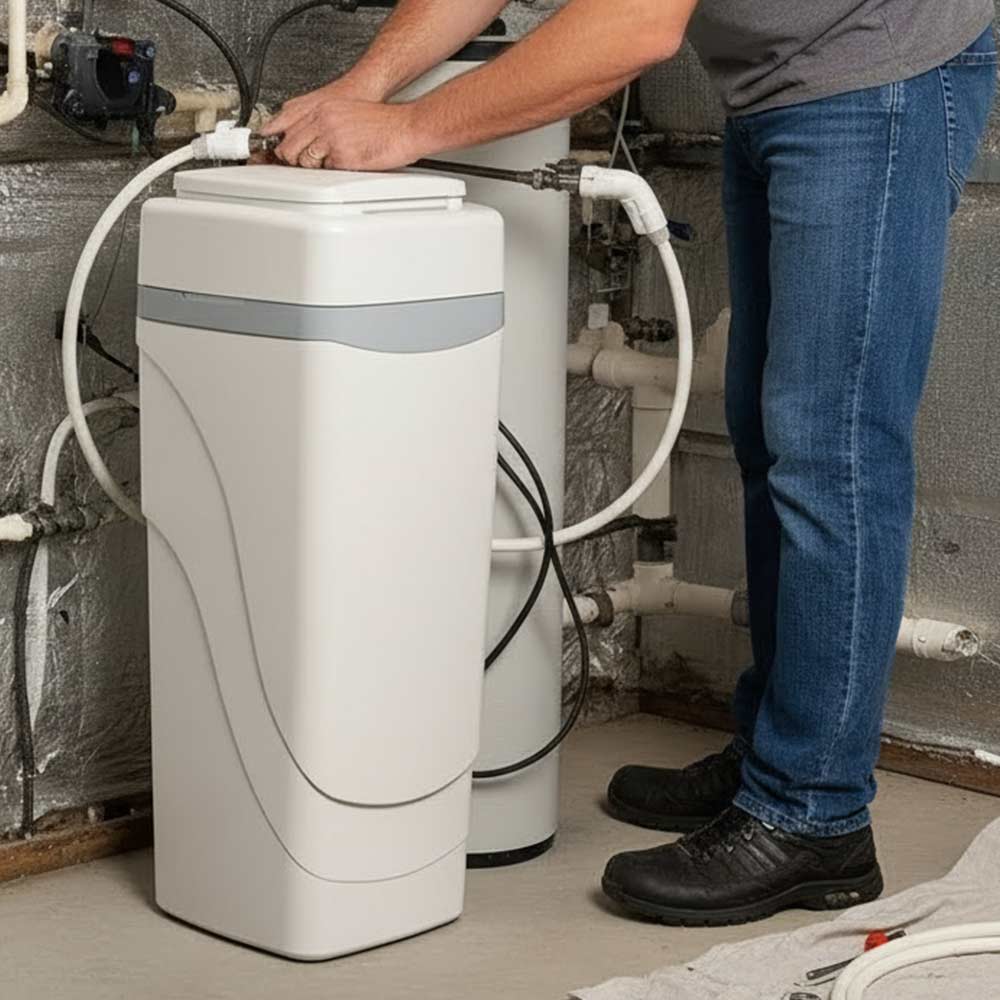


Jersey Radon & Water provides water treatment, water testing, and radon mitigation for homeowners across Millburn, Short Hills, and the neighboring communities of Maplewood, Springfield, Summit, South Orange, and Livingston. Millburn sits inside New Jersey American Water’s Passaic Basin system, which serves roughly 269,000 people, and the Canoe Brook Water Treatment Plant that treats much of that supply is located here in the township.
On radon, Millburn Township is Tier 2 under the NJDEP radon tier system, with 416 of 5,143 tested homes at or above the EPA action level of 4 pCi/L, or 8 percent. That rate sits in the middle of a steep local gradient, and the township’s own terrain is part of why.
Thirty-Six Thousand Lines In This System Have Never Been Identified
The state’s profile for the Passaic Basin system lists 4,369 service lines confirmed as lead and 36,038 of unknown composition. Unknown outnumbers confirmed lead by more than eight to one, which means the statistically likely answer for a Millburn address is not that your line is lead and not that it is safe. It is that nobody has looked yet.
That is a different problem than a confirmed hazard, and it calls for a different response. Filtration certified for lead reduction gives you protection that does not depend on the answer, and it covers the interior piping and solder joints inside an older Millburn or Short Hills house, which no utility replacement program reaches regardless of what the inventory eventually says.
A Blended Supply Makes One Water Test A Snapshot
When the system leans on surface water from the Passaic and Canoe Brook, taste and disinfection byproducts drive the complaints. When it leans on the aquifer and rock formations, mineral content climbs instead. Both are compliant. Neither is constant.
The practical consequence is that a single reading taken in one month will not tell you the range your house actually sees. Sizing equipment off that one number is how softeners end up undersized for half the year.
Large Homes Need Equipment Sized For Flow, Not Just For Hardness
Millburn and Short Hills carry a housing stock with serious square footage: multiple full baths, high-demand fixtures, irrigation, and in many cases a finished lower level with its own plumbing. A softener correctly sized for a three-bath colonial will run in a near-constant regeneration cycle in a house with six, which shortens resin life and leaves hard water bleeding through during peak demand.
Service flow rate and grain capacity both have to match the house. Softener installation done properly here starts with fixture count and peak draw, not with a model number.
The Ground Under Millburn Changes As You Climb
The township runs from the Rahway River valley up into the Watchung ridge, and that rise means the rock and soil beneath a house on one side of town is not what sits beneath a house on the other. Radon tracks the uranium content directly under a specific foundation, so a township-wide figure of 8 percent describes an average across varied ground rather than a reading that applies to your address.
The surrounding numbers make the same point from outside the border. Maplewood records 5 percent, South Orange and West Orange 8 percent each, Summit 12 percent, Chatham 15 percent, and Berkeley Heights 18 percent. Harding Township, a short drive west, is Tier 1 at 41 percent.
Sprawling Foundations Need More Than One Suction Point
A home that has grown through two or three additions does not sit on one continuous slab. Each pour has its own sub-slab conditions, and a single suction point placed in the original basement will not draw from under a 1990s family room addition on a separate footing. Diagnostic testing establishes how far suction actually extends before the design is set.
A properly engineered sub-slab depressurization system vents soil gas above the roofline, with the sump pit, slab joints, and utility penetrations sealed so the fan pulls soil gas instead of conditioned air. On larger homes that sometimes means two suction points and a correctly sized fan rather than a standard single-point install, and a post-mitigation test is what confirms the design covered the whole footprint.
Reverse Osmosis Is Where The Strictest Standard Belongs
Whole-house treatment is built to handle volume and is not designed to chase dissolved solids or PFAS. Reverse osmosis and purification systems handle those at a single fixture, which is where drinking and cooking water gets used and where a tighter standard changes anything.
Well Properties Carry A Longer Test List
If a property here draws from its own well rather than the utility, testing and treatment fall entirely to the owner, and the parameters expand: coliform bacteria, nitrates, arsenic, iron and manganese, and radon in water, which compounds the indoor air reading you are already taking.
What Does Water Treatment Cost Near Millburn, NJ?
Water treatment and radon mitigation costs in Millburn can vary based on several factors, including home size, whether the property uses well water or municipal water, contamination severity, plumbing accessibility, and ongoing maintenance requirements. Homes with more significant water quality issues or larger water usage demands may require larger or more advanced systems, which can increase installation and equipment costs.
| Service | Typical Cost Range |
|---|---|
| Professional Water Testing | $150 – $500+ |
| Whole House Water Filtration System | $1,000 – $4,500+ |
| Reverse Osmosis System | $300 – $2,000+ |
| Water Softener Installation | $1,000 – $3,500+ |
| Iron or Sulfur Filtration System | $1,500 – $5,000+ |
| UV Water Purification System | $800 – $2,500+ |
| Radon Testing | $150 – $250+ |
| Radon Mitigation System | $1,000 – $3,500+ |
The best way to determine accurate pricing is through professional water testing and an on-site evaluation. This helps identify the specific contaminants affecting the home and ensures the recommended system is properly sized for the property and water usage needs.
