When homeowners ask us what water treatment equipment we install and why, the answer is Hague Quality Water. As an authorized dealer and installer of Hague water treatment products, we have made a deliberate choice to work with one brand rather than sourcing equipment from multiple suppliers based on price. That choice comes down to build quality, performance consistency, and the kind of long-term reliability that matters when a system is running 24 hours a day inside someone’s home. This guide explains what Hague systems are, how they differ from the alternatives, and why we trust them for the homes we service. You can see everything we offer on our water treatment products page.
Hague Quality Water is an American manufacturer with decades of experience producing residential water treatment equipment. Their systems are built in the United States, certified to NSF/ANSI standards, and designed for the kind of varied and challenging water chemistry that private well homeowners encounter across different geologies and aquifer systems. That last point matters significantly for well water homes where hardness, iron, pH, and other parameters combine in ways that generic big-box equipment is rarely engineered to handle well.
What Hague Makes and What Each System Addresses
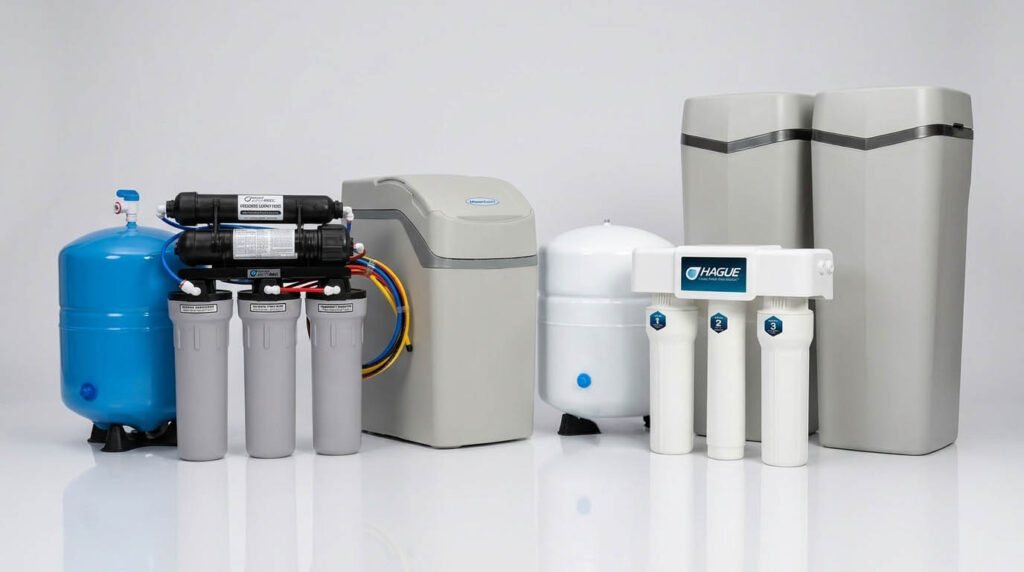
Hague’s product line covers the core residential water treatment categories: softening, filtration, and drinking water purification. Understanding what each product does and which water quality problems it addresses helps homeowners evaluate whether a specific system is the right fit for their situation.
The WaterMax Signature Series Water Softener
The WaterMax is Hague’s flagship water softener and the system we most commonly install for well water homeowners dealing with hard water. It uses ion exchange to remove calcium and magnesium from the water supply before it enters the home’s distribution plumbing, eliminating scale buildup on fixtures and inside appliances, restoring proper soap lathering, and improving the skin and hair effects of hard water throughout the household.
What distinguishes the WaterMax from standard softeners is its multi-media tank design. Rather than a simple resin bed, the WaterMax uses a combination of media that addresses hardness alongside low levels of iron, sediment, and taste and odor issues in a single unit. For well water homes where hardness and low-level iron commonly appear together, this integrated approach avoids the need for a separate pre-filter while protecting the softener resin from iron fouling that shortens equipment life in standard single-media systems.
The WaterMax also uses a demand-initiated regeneration controller that tracks actual water usage and regenerates only when resin capacity is genuinely depleted, rather than on a fixed timer schedule. This reduces salt consumption, reduces water waste from unnecessary regeneration cycles, and adapts automatically to seasonal changes in household water usage. For a complete overview of what water softener installation involves and what it costs, our guide on water softener installation covers the full process in detail.
The Hague H3600 WaterMax Filtration System
For homeowners with more complex water quality issues, the H3600 WaterMax combines softening with whole-house filtration in a single integrated system. It addresses hardness, iron, hydrogen sulfide odor, sediment, and taste and odor issues through a multi-stage treatment process in one cabinet, reducing the equipment footprint compared to separate softener and filter installations.
This system is particularly well-suited to well water with multiple issues that need to be addressed in sequence before the water enters household plumbing. Rather than designing a treatment train with separate components for each contaminant and managing multiple maintenance schedules, the H3600 consolidates treatment into a single unit with a single regeneration and backwash cycle. Our guide on what a whole-house water filtration system does covers how integrated systems like this compare to multi-component treatment approaches.
The Hague Platinum Series Reverse Osmosis System
For drinking water purification at the kitchen tap, Hague’s Platinum Series reverse osmosis system provides multi-stage filtration that removes a broad spectrum of contaminants from the water used for drinking and cooking. Reverse osmosis is the appropriate solution for health-based contaminants including PFAS, arsenic, nitrates, lead, and uranium that require more than softening or standard carbon filtration to address effectively.
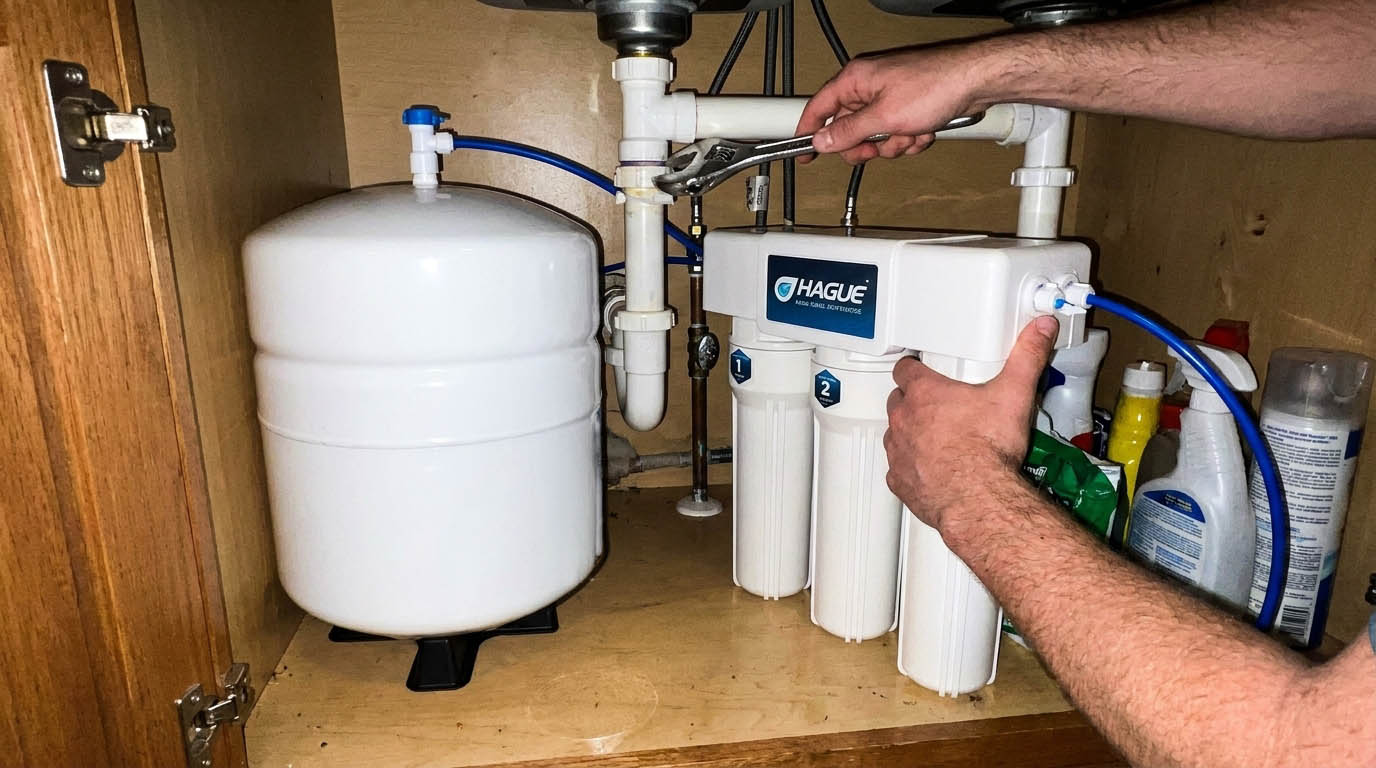
The Platinum Series uses a sediment pre-filter, a carbon pre-filter, a semi-permeable reverse osmosis membrane, and a post-filter carbon stage to produce purified water stored in a pressurized tank beneath the sink. A dedicated faucet at the sink provides access to the purified water independently from the regular cold water supply. Membrane replacement every two to three years maintains performance. For homes where both whole-house hardness treatment and drinking water purification are needed, the combination of a WaterMax softener with a Platinum Series RO under the kitchen sink covers both levels of treatment efficiently. Our water purification service page covers reverse osmosis installation in more detail.
Why We Choose Hague Over Big-Box and Generic Alternatives
The residential water treatment market includes a wide range of equipment at significantly different quality and price points. Big-box store softeners and no-name filtration systems are available at lower upfront costs than Hague equipment. Understanding why we don’t install them explains what the price difference actually buys.
Build quality is the most straightforward difference. Hague systems use higher-grade internal components, more durable valve bodies, and corrosion-resistant materials throughout. For equipment running continuously in a basement or utility room, the difference between commercial-grade internal components and consumer-grade alternatives becomes visible in lifespan. A well-maintained Hague softener lasts 20 years or more. Generic softeners from big-box retailers frequently require valve replacement or full system replacement within 8 to 12 years under normal well water conditions.
Engineering for real water chemistry is the second difference. Hague systems are designed and tested for the range of conditions found in actual residential well water, including iron co-contamination, hardness above 15 GPG, low pH, and the other challenging characteristics that well water in regions with varied geology regularly produces. Generic systems are often tested and rated under ideal laboratory conditions that don’t reflect what the equipment encounters in service. The WaterMax’s multi-media approach reflects genuine engineering for real-world water rather than a simplified ion exchange system optimized for easy manufacturing.
Dealer support and service accountability is the third difference. When you purchase Hague equipment through an authorized dealer like Jersey Radon, you have a local professional responsible for the installation quality, the system settings, and the ongoing service. When a big-box softener fails, the homeowner is on their own. Hague’s authorized dealer network means there is always a local professional available who knows the system and can service it correctly. You can review Hague’s full product line and certifications directly at haguewater.com.
Certifications and Standards
Hague water treatment products are certified to NSF/ANSI standards — the independent testing and certification framework that governs performance claims for residential water treatment equipment in the United States. NSF/ANSI Standard 44 covers cation exchange water softeners, validating that a system actually achieves the hardness reduction it claims. NSF/ANSI Standard 58 covers reverse osmosis systems, validating contaminant reduction performance for each specific compound the system claims to address.
These certifications matter because they represent third-party verification of performance rather than manufacturer claims. A softener that claims to reduce hardness to near zero without NSF/ANSI 44 certification has not had that claim independently verified. When we install a Hague system, the certifications mean the performance specifications are real and documented, not marketing language.
Matching the Right Hague System to Your Water
The right Hague system for a specific home depends entirely on what a comprehensive water test shows. A homeowner with moderate hardness and no other issues needs a different system than a homeowner with very high hardness, elevated iron, and low pH. Installing any system, including a quality Hague product, without first understanding the water chemistry it needs to address is working backwards.
Our process starts with a water test. The test results tell us what the water actually contains, which determines which Hague system addresses the confirmed issues at the appropriate capacity for the household’s water usage. From there, the installation is designed around the specific water conditions rather than a generic recommendation. Our water testing service provides the comprehensive baseline that makes system selection accurate rather than approximate. And our water softener installation service covers the full process from test results through installation and post-installation verification.
Even well-built Hague equipment eventually needs a service decision, and our guide on how to decide between a softener repair and a full replacement walks through the factors that matter. Softening and filtration address minerals and sediment, but they don’t touch every risk in NJ well water — our guide on PFAS contamination and what well water homeowners need to know covers a separate category of contaminant that calls for its own treatment.
The Right Equipment Makes the Difference
Water treatment equipment that is properly matched to your water chemistry, correctly sized for your household, and built to last makes a meaningful difference compared to a generic system that was selected by price. Hague’s track record, engineering quality, and certified performance are why we install their systems rather than alternatives that may cost less upfront but require more maintenance, deliver inconsistent results, or fail sooner than equipment should.
If you want to understand which Hague system makes sense for your home’s water, reach out to our team for a free consultation. We will start with your water test results and recommend a system built around what your water actually contains.
