Edison Homeowners Know Their Water Has Problems. Arsenic Is Probably Not the One They’ve Thought About.
Hard water, iron staining, PFAS from the Raritan watershed — Edison homeowners who pay attention to water quality have a list of concerns that’s already reasonably long. Arsenic tends not to make it. And yet Middlesex County’s groundwater has documented arsenic contamination from both naturally occurring geological sources and, in parts of the county near historically industrial areas, from industrial activity that deposited arsenic in soil and groundwater over decades. For any Edison home on a private well, that dual-source risk profile makes arsenic a contaminant worth specifically testing for. A professional water test that includes arsenic is the only way to know what your well is actually producing.
Two Sources, One Contaminant — Why Arsenic Risk in Middlesex County Is More Complex Than in Other Parts of New Jersey
In northern New Jersey’s crystalline bedrock counties — Morris, Hunterdon, Sussex — arsenic in well water is almost entirely a naturally occurring geological concern. The bedrock contains arsenic-bearing minerals, groundwater dissolves them, and private wells draw that groundwater into homes. Middlesex County’s picture is more layered. The county has both sedimentary and mixed geological formations that produce lower naturally occurring arsenic than the crystalline bedrock zone — but it also has a history of industrial land use along the Route 1 and Route 9 corridors that introduced arsenic into soil and groundwater at specific sites through pesticide manufacturing, chemical production, and industrial waste disposal.
For Edison private well owners, the relevant risk depends on location within the township — proximity to historically industrial land, well depth, and local geology all affect what a specific well is drawing from. The variation between neighboring wells can be significant, which is precisely why regional generalizations are less useful than a test of the specific well in question. Nearby Metuchen, Woodbridge, Piscataway, and East Brunswick share the same regional water characteristics and the same dual-source arsenic consideration for private well owners.
Municipal Water vs. Private Wells — Where the Protection Ends
The majority of Edison homes draw from Middlesex County utility sources — treated water that undergoes processing to meet federal arsenic standards before reaching distribution. Municipal water customers have the protection of a regulated system with mandatory testing and public reporting. For most Edison municipal customers, arsenic is not the primary drinking water concern.
Private well owners in Edison’s less-developed areas have no equivalent protection. No government program monitors private wells for arsenic. No mandatory testing requirement applies. Whatever the local geology and land use history have deposited in the groundwater arrives at a private well tap unchanged and untreated. The homeowner’s responsibility for knowing what’s in the water — and acting on it — is total.
The Chronic, Silent Nature of Arsenic Exposure
Arsenic in drinking water does not produce immediate symptoms. It doesn’t change how water tastes, smells, or looks. Its health effects develop through long-term cumulative exposure — making it one of the most difficult water quality concerns to connect to the water source without explicit testing. The EPA classifies arsenic as a known human carcinogen. Long-term exposure has been associated with elevated risk of bladder, lung, and skin cancers, along with cardiovascular and neurological effects. For children and during pregnancy, arsenic exposure carries additional developmental concerns. A family can drink from an arsenic-containing well for years without any symptom that would prompt them to test the water. This is not grounds for panic — it’s grounds for testing.
Arsenic Risk by Scenario — Edison Area Homeowners
| Scenario | Risk Level | Recommended Action |
|---|---|---|
| Private well near historically industrial areas in Edison | Higher — geological and industrial arsenic sources both possible | Test immediately; include in any comprehensive well panel |
| Private well in rural or less-developed Edison areas | Moderate — naturally occurring geological arsenic possible | Test as part of any comprehensive well baseline |
| Edison municipal water customer | Lower — utility treatment and mandatory testing apply | Review annual water quality report; test if concerned |
| Well water, never tested for arsenic | Unknown — no baseline established | Test now; arsenic requires a specific laboratory analysis |
| Home purchase with private well | Unknown — prior testing may be outdated or incomplete | Test before or immediately after closing |
What Testing Involves and What the Results Mean
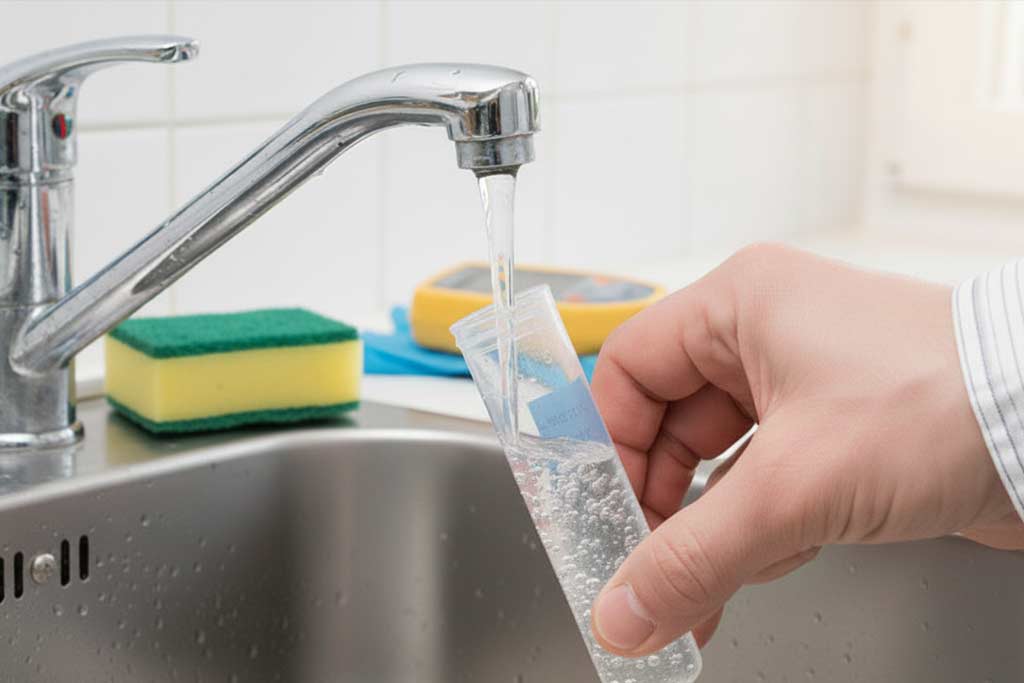
An arsenic test requires a water sample collected at the tap and submitted to a certified laboratory for specific arsenic analysis. It’s not part of a standard water quality panel — it must be explicitly requested. The result is a concentration in micrograms per liter compared to the federal action level of 10 ppb. Our professional water testing page covers what a comprehensive assessment includes. If arsenic is found at levels that warrant treatment, our arsenic removal page covers the options. For the broader water quality picture in Edison, our Edison water testing page covers the full range of local concerns. Our full New Jersey service area covers communities statewide.
Frequently Asked Questions — Arsenic in Drinking Water in Edison, NJ
Is arsenic in well water a concern in Middlesex County?
Yes — from both naturally occurring geological sources and, in parts of the county near historically industrial land, from industrial contamination. The risk profile varies by location within the county, which is why testing a specific well gives more useful information than a regional estimate.
How does industrial history affect arsenic risk in Edison?
Historical industrial activity along Route 1 and Route 9 in Middlesex County introduced arsenic into soil and groundwater at specific sites through manufacturing processes and waste disposal. Private wells near those areas may draw from groundwater with industrial arsenic in addition to any naturally occurring geological contribution. Location within the township matters for assessing risk.
Can I detect arsenic in my water at home?
No. Arsenic at health-relevant concentrations is completely undetectable without laboratory analysis. It has no taste, no smell, and no visual indicator. A certified laboratory test specifically ordered for arsenic is the only reliable detection method.
Is arsenic automatically included in a water quality test?
No. It must be specifically requested. Standard panels covering hardness, bacteria, iron, PFAS, and other contaminants do not include arsenic unless it’s explicitly ordered.
How quickly can testing be arranged?
We can typically schedule within a few days. Sample collection at your home takes under an hour, and laboratory results return within one to two weeks.
Find Out Whether Arsenic Is in Your Edison Home’s Water
If you’re on a private well in Edison or anywhere in Middlesex County and haven’t specifically tested for arsenic — this is a straightforward question that deserves a direct answer. We serve Edison and all of Middlesex County. Call us at (732) 357-1988 or reach out online.