Do You Need Information About Chances of Arsenic In Your Jersey City, NJ Home’s Drinking Water?
Call Us For A Free Estimate: (732)357-1988

Jersey City’s Water Headlines Are About PFAS and Lead. Arsenic Is the Contaminant That Hasn’t Made Them Yet.

Jersey City homeowners who pay attention to water quality have a well-developed list of concerns — PFAS from the dual-watershed supply, lead from the aging plumbing in the city’s dense older housing stock, chloramine disinfection byproducts from the municipal treatment process. Arsenic tends not to appear on that list. And in a predominantly municipal water city, that’s largely appropriate — the Jersey City water utility is required to test for arsenic, meet the federal standard, and report publicly. For most Jersey City residents, arsenic in the municipal supply is addressed at the treatment level. But “addressed at the treatment level” and “completely absent from concern” are different things, and for any property in Hudson County on a private well, and for any homeowner who wants a complete picture of what might be in their drinking water, a professional water test specifically including arsenic is the only way to move from assumption to data.

Hudson County’s Geological Context and What It Means for Arsenic

Arsenic enters groundwater through contact with arsenic-bearing geological formations — a process driven entirely by the geology beneath the surface, not by industrial activity. Hudson County’s geology is complex — the county sits at the eastern edge of New Jersey’s Piedmont province, with mixed bedrock formations that include both sedimentary and crystalline geological units. The crystalline units in portions of northern Hudson County are associated with higher naturally occurring arsenic than the purely sedimentary geology of South Jersey, though the risk profile is generally lower than the highest-risk counties of Morris, Hunterdon, and Sussex.

For Jersey City’s predominantly municipal water customer base, the utility’s treatment processes address arsenic before distribution. For any property in Hudson County on a private well — uncommon but not absent — the geological contribution to groundwater arsenic arrives at the tap unchanged. No regulatory requirement mandates private well arsenic testing. No government program monitors private wells. The homeowner’s responsibility is complete. Nearby Hoboken, Bayonne, Union City, and Secaucus share the same regional water supply and the same considerations for any private well owners in those communities.

The Health Impact of Arsenic — Why Invisible Exposure Still Matters

Arsenic in drinking water at concentrations relevant for long-term health has no taste, no smell, and no visual indicator. Its health effects develop through cumulative exposure over years — not through acute events or obvious symptoms. The EPA classifies arsenic as a known human carcinogen. Long-term elevated exposure has been associated with increased risk of bladder, lung, and skin cancers. Chronic exposure also carries cardiovascular and neurological associations. For families with young children or during pregnancy, developmental considerations add additional weight to the testing decision. A household can drink arsenic-containing water for years with no symptom that would connect to the water. The absence of obvious signs is not evidence of safety — it’s the nature of the exposure pathway.

What Municipal Treatment Covers — And Its Limits

Jersey City’s municipal water supply — drawing from the Hackensack and Passaic River watersheds — is treated before distribution and must meet the federal arsenic maximum contaminant level of 10 micrograms per liter. The utility tests regularly and publishes annual water quality reports. For most Jersey City residents, arsenic in the treated municipal supply is addressed. The limits of that protection are at the treatment plant level — it covers what the utility produces, not what happens inside aging building plumbing, and it doesn’t apply to private wells anywhere in the area.

Arsenic Risk by Scenario — Jersey City Area Homeowners

Scenario Risk Level Recommended Action
Private well in Hudson County Moderate — mixed geology produces naturally occurring arsenic Test as part of any comprehensive well baseline
Jersey City municipal water customer Lower — utility treatment and mandatory testing apply Review annual water quality report; test if concerned
Well water, never tested for arsenic Unknown — no baseline established Test now; arsenic requires a specific laboratory analysis
Property purchase with unknown water history Unknown — prior testing may be outdated or absent Test before or immediately after closing
Near historically industrial areas in Hudson County Potentially higher — industrial arsenic sources possible Test with full contaminant screen including arsenic

What Testing Involves and What Comes After

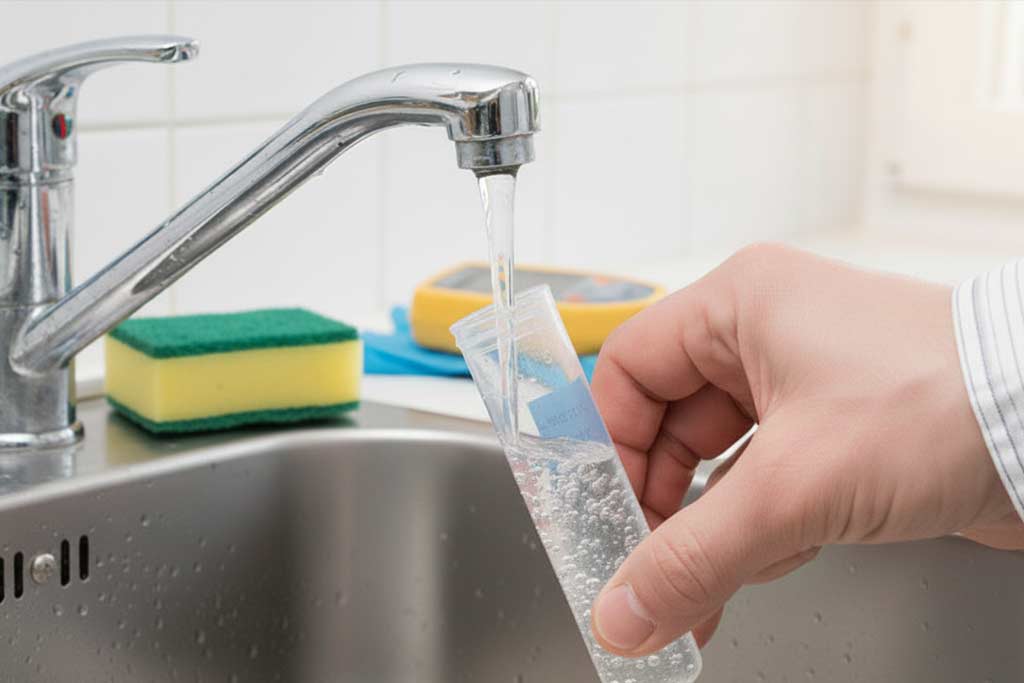
An arsenic test requires a water sample collected at the tap and submitted to a certified laboratory for specific arsenic analysis — must be explicitly requested, not part of any standard panel. Our professional water testing page covers what a comprehensive assessment includes. If arsenic is found at levels warranting action, our arsenic removal page covers treatment options. For the broader water quality picture in Jersey City, our Jersey City water testing page covers local concerns. Our full New Jersey service area covers communities statewide.

Frequently Asked Questions — Arsenic in Drinking Water in Jersey City, NJ

Is arsenic in Jersey City’s municipal water a concern?

For most municipal customers, the risk is low — the utility is required to meet federal arsenic standards, tests regularly, and reports publicly. Arsenic becomes a more direct concern for any property in the area on a private well, where no regulatory protection applies, or for anyone who wants to supplement the utility’s plant-level reporting with a direct test at their specific tap.

Can the arsenic risk in Hudson County be compared to northern New Jersey?

Hudson County’s mixed geological profile generally produces lower naturally occurring arsenic concentrations than the crystalline bedrock counties of northern New Jersey — Morris, Hunterdon, Sussex — where the risk is most concentrated. The concern for Jersey City area private well owners is present but at a lower baseline level than for well owners in those northern counties.

Is arsenic detectable without laboratory testing?

No. Arsenic at health-relevant concentrations has no taste, no smell, and no visual indicator. Laboratory testing specifically ordered for arsenic is the only reliable detection method.

Is arsenic testing part of a standard water quality panel?

No. It must be specifically requested as a separate laboratory analysis. Standard panels covering bacteria, PFAS, lead, hardness, and other contaminants do not include arsenic unless explicitly ordered.

How quickly can testing be arranged?

We typically schedule within a few days. Sample collection takes under an hour at your home or building, and laboratory results return within one to two weeks.

Get a Clear Answer on Arsenic in Your Jersey City Area Water

If you’re in Jersey City on a private well or want to supplement the municipal supply’s plant-level reporting with a direct tap test — a professional water assessment that specifically includes arsenic gives you the most relevant answer. We serve Jersey City and all of Hudson County. Call us at (732) 357-1988 or reach out online.

Do You Need Information About Chances of Arsenic In Your Jersey City, NJ Home’s Drinking Water?
Call Us For A Free Estimate: (732)357-1988

Learn About Solving Water-Related Risks In You Home

Request Information About Chances of Arsenic In Your Jersey City, NJ Home’s Drinking Water Today!

Or call (732)357-1988

Call-Us