Livingston Homeowners Protect Their Investment at Every Level. Their Well Water’s Arsenic Content Remains an Open Question.
Livingston is a community where home maintenance is taken seriously — systems are serviced, systems are upgraded, and water quality has increasingly made the conversation. Lead, PFAS, chloramine byproducts — these have gotten attention. Arsenic in well water tends not to. And yet Essex County’s crystalline and mixed bedrock geology places it squarely within New Jersey’s most elevated zone for naturally occurring arsenic in groundwater. For any Livingston home on a private well, that geology is directly relevant to what’s in the drinking water — and the only way to know what it means for a specific property is to test that specific well. A professional water test that explicitly includes arsenic is where this question gets answered.
Essex County’s Arsenic Geology — Why This Part of New Jersey Has Higher Baseline Risk
Arsenic enters groundwater through contact with arsenic-bearing rock formations — a geological process that has nothing to do with industrial activity or contamination events. New Jersey’s arsenic risk follows its geology with remarkable consistency. The crystalline bedrock zone running through Essex, Morris, Hunterdon, Sussex, Somerset, and Warren counties is the region of the state where naturally occurring arsenic in private well water is most frequently documented and most concentrated. Essex County sits within this zone. The bedrock underlying Livingston’s established neighborhoods — the same geology that drives above-average radon levels throughout North Jersey — also produces elevated arsenic in groundwater at concentrations that vary by well depth, location, and local rock formation.
New Jersey Geological and Water Survey studies have consistently found private wells in Essex County’s bedrock geology with arsenic above the federal action level of 10 parts per billion. The variation between neighboring wells can be significant — two properties in the same neighborhood can have meaningfully different arsenic levels depending on the specific aquifer zone their wells draw from. A regional comparison tells you less than a test of the specific well. Nearby West Orange, Short Hills, Millburn, and Roseland homeowners on private wells share the same Essex County geological profile and the same baseline arsenic risk.
Municipal Water Provides Protection — Private Wells Do Not
The majority of Livingston homes draw from the Essex County municipal water system — treated surface water that is processed to meet federal arsenic standards before reaching distribution. Municipal customers have the protection of a regulated utility with mandatory testing and public annual reporting. For private well owners in Livingston’s less-developed areas, no equivalent protection exists. No government program monitors private wells for arsenic. No regulatory requirement mandates testing. Whatever arsenic the local bedrock geology releases into the groundwater arrives at the private well tap unchanged and untreated. The homeowner bears sole responsibility for knowing and acting.
The Silent Accumulation — What Arsenic Does Over Time
Arsenic in drinking water does not announce itself. It has no taste at health-relevant concentrations, no smell, no visual indicator. Its effects develop through cumulative long-term exposure — years of drinking, cooking, and preparing food with arsenic-containing water building toward health consequences that have no obvious early connection to the water. The EPA classifies arsenic as a known human carcinogen — elevated long-term exposure has been associated with increased risk of bladder, lung, and skin cancers. Cardiovascular and neurological effects have also been associated with chronic arsenic exposure. For families with young children or during pregnancy, the developmental implications add particular urgency. A family can draw from an arsenic-containing well for years, even decades, with no symptom that would connect their health to the water. Testing is the only way to interrupt this with actual information.
Arsenic Risk by Scenario — Livingston Area Homeowners
| Scenario | Risk Level | Recommended Action |
|---|---|---|
| Private well in Essex County bedrock geology | Higher — crystalline bedrock is a documented natural arsenic source | Test immediately; include in any comprehensive well panel |
| Livingston municipal water customer | Lower — utility treatment and mandatory testing apply | Review annual water quality report; test if concerned |
| Well water, never tested for arsenic | Unknown — no baseline established | Test now; arsenic requires a specific laboratory analysis |
| Home purchase with private well | Unknown — prior testing may be outdated | Test before or immediately after closing |
| Well tested more than 3 years ago | Uncertain — groundwater chemistry can shift over time | Retest; arsenic levels in wells are not static |
What Testing Involves and What the Results Mean
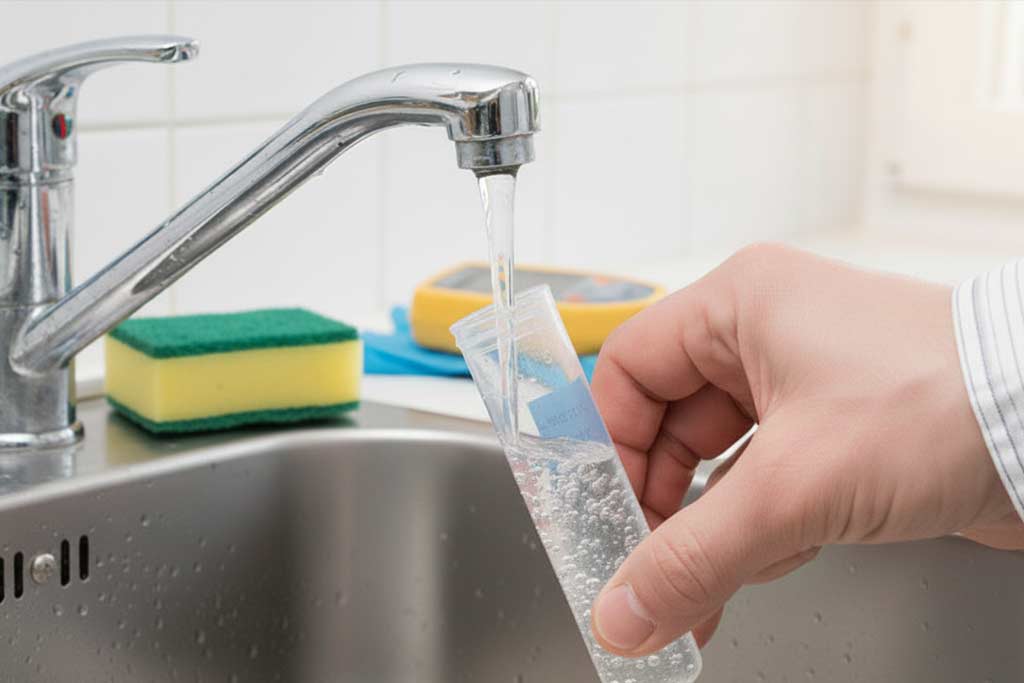
An arsenic test requires a water sample collected at the tap and submitted to a certified laboratory for specific arsenic analysis — not included in any standard water quality panel, must be explicitly requested. A comprehensive well water baseline for an Essex County home should include arsenic alongside bacteria, nitrates, pH, hardness, iron, manganese, PFAS, and radon in water. Our professional water testing page covers what a full assessment includes. If arsenic is found at levels warranting action, our arsenic removal page covers the treatment options. For the broader water quality picture in Livingston, our Livingston water testing page covers the full range of local concerns. Our full New Jersey service area covers communities statewide.
Frequently Asked Questions — Arsenic in Drinking Water in Livingston, NJ
Is arsenic in well water common in Essex County?
It’s documented frequently enough that testing is a standard recommendation for any Essex County home on a private well. The county’s crystalline and mixed bedrock geology is associated with naturally occurring arsenic in groundwater throughout northern New Jersey. New Jersey Geological Survey studies have found elevated arsenic in private wells across Essex County. Individual well concentrations vary significantly — a specific well test is the only meaningful data for a specific property.
How is arsenic in well water different from the PFAS concerns in Essex County?
They’re entirely separate concerns. PFAS in Essex County water comes from industrial sources that contaminated the water system — a human-caused contamination event. Arsenic in private well water in Essex County comes from the geological formations the groundwater moves through — a naturally occurring process with no human cause. Different sources, different chemistry, different tests, different treatment approaches. A comprehensive well water panel should address both.
Can I detect arsenic in my well water at home?
No. Arsenic at health-relevant concentrations is completely undetectable without laboratory analysis. No taste, smell, or visual indicator distinguishes arsenic-containing water from clean water. Laboratory testing is the only reliable detection method.
Is arsenic included in a standard water quality test?
No. It must be explicitly requested as a separate laboratory analysis. Standard panels covering hardness, bacteria, pH, iron, and PFAS do not include arsenic unless it’s ordered specifically.
How quickly can testing be arranged?
We typically schedule within a few days. Sample collection takes under an hour at your home, and laboratory results return within one to two weeks.
Find Out Whether Arsenic Is in Your Livingston Home’s Water
If you’re on a private well in Essex County and arsenic hasn’t been part of your water quality testing — this is the question worth answering with data rather than assumption. We serve Livingston and all of Essex County. Call us at (732) 357-1988 or reach out online.