Princeton Homeowners Research Everything. Arsenic in Their Well Water Often Goes Unresearched.
Princeton attracts people who investigate before they decide — school ratings, contractor reviews, environmental records. And yet arsenic in private well water, which has been documented in Mercer County groundwater at concentrations above the federal action level, rarely makes the list of things Princeton homeowners have specifically tested for. The Potomac-Raritan-Magothy aquifer system that supplies much of Princeton Township’s private well water passes through geological formations that naturally produce arsenic in groundwater. That’s not a theory — it’s documented in New Jersey geological survey data. A professional water test that specifically includes arsenic is the only way to know whether it applies to your well.
How Arsenic Gets Into Princeton Area Groundwater — The Geological Explanation
Arsenic is a naturally occurring element present in bedrock and soil. It enters groundwater through contact with arsenic-bearing rock formations — a slow process driven entirely by geology, not by industrial activity or contamination events. The Potomac-Raritan-Magothy aquifer system underlying much of Mercer County passes through geological formations that include arsenic-bearing minerals. As groundwater moves through these formations over long timescales, it dissolves and carries trace arsenic into the wells that Princeton Township homeowners draw from.
The arsenic risk profile in Central Jersey is somewhat lower than in the crystalline bedrock counties of northern New Jersey — Morris, Hunterdon, Sussex — where arsenic in well water is most concentrated. But “somewhat lower” is not zero. Mercer County’s aquifer has produced documented arsenic levels above 10 parts per billion at private well monitoring points, and the variation between individual wells within the same aquifer zone is significant enough that a regional average tells you very little about your specific property. Nearby West Windsor, Plainsboro, Lawrence Township, and Hopewell homeowners on private wells share the same aquifer system and the same baseline considerations.
Why Arsenic Is Uniquely Dangerous — It Gives You No Warning
Most water quality problems announce themselves eventually. Iron leaves orange staining. Hard water builds scale. Chloramine has a smell. Arsenic at the concentrations relevant for long-term health does none of those things. Water containing arsenic at or above the federal action level of 10 parts per billion is visually identical to clean water, smells exactly the same, and tastes exactly the same. There is no sensory signal. The only way to detect arsenic is a laboratory test specifically ordered to look for it.
This matters because arsenic’s health effects are driven by cumulative long-term exposure, not by acute events. The EPA classifies arsenic as a known human carcinogen — long-term exposure through drinking and cooking with arsenic-containing water has been associated with elevated risk of bladder, lung, and skin cancers. Beyond cancer, chronic arsenic exposure has been linked to cardiovascular effects, peripheral nervous system impacts, and in children and during pregnancy, developmental and cognitive concerns that make testing particularly important for families with young children or anyone planning a pregnancy.
A family can drink from a well with elevated arsenic for years, sometimes decades, with no symptom that would lead them to connect their water to a health concern. This is not a reason for alarm — it’s a reason to test.
The Private Well Regulatory Gap That Princeton Homeowners Should Understand
The federal maximum contaminant level for arsenic — 10 micrograms per liter — applies to public water systems. It does not apply to private wells. Private well owners in New Jersey are not subject to mandatory arsenic monitoring, reporting requirements, or regulatory enforcement. No government agency is testing your private well for arsenic on your behalf. The responsibility for knowing what’s in your well water, and for acting on it, rests entirely with the homeowner.
Princeton Borough municipal water customers are in a different position — the utility is required to test, meet the federal standard, and publish annual water quality reports. Municipal customers should review those reports. For Princeton Township private well owners, no equivalent protection exists. Testing is the homeowner’s responsibility alone.
Arsenic Risk by Scenario — Princeton Area Homeowners
| Scenario | Risk Level | Recommended Action |
|---|---|---|
| Private well in Princeton Township / Mercer County | Moderate to higher — PRM aquifer has documented arsenic | Test immediately; include in any comprehensive well panel |
| Princeton Borough municipal water customer | Lower — utility treatment and reporting requirements apply | Review annual water quality report; test if concerned |
| Well water, never tested for arsenic | Unknown — no baseline established | Test now; arsenic is not included in standard panels |
| Home purchase with private well | Unknown — prior testing may be outdated | Test before or immediately after closing |
| Well tested more than 3 years ago | Uncertain — aquifer chemistry can shift | Retest; arsenic levels in wells are not static |
What Testing Involves and What to Do With the Results
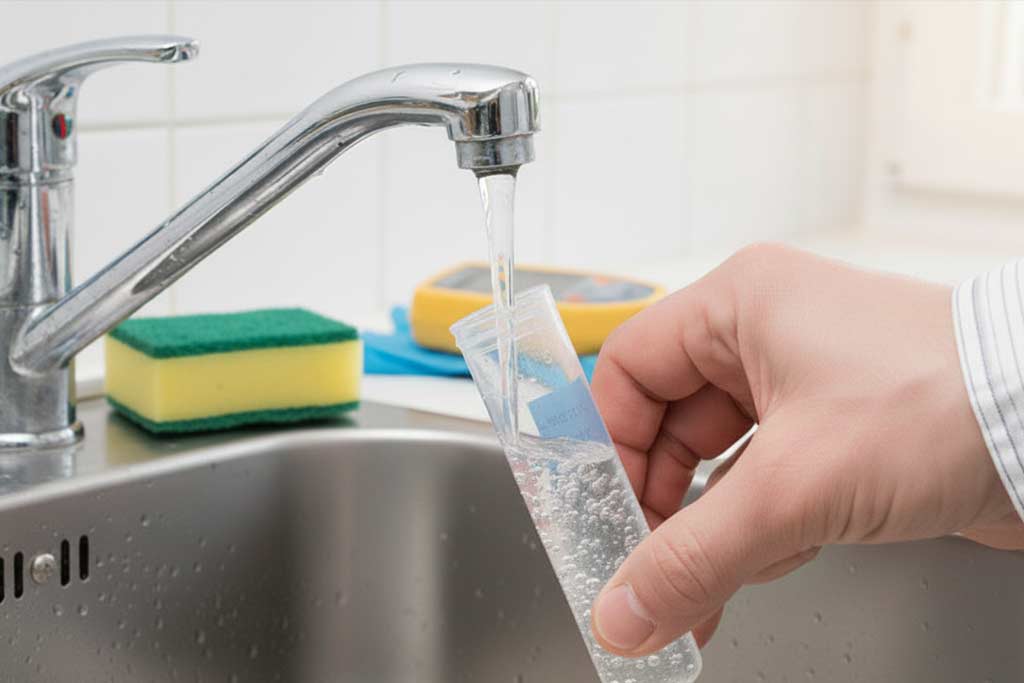
An arsenic test requires a water sample collected at the tap and submitted to a certified laboratory for specific arsenic analysis. It must be explicitly requested — standard well water panels covering bacteria, nitrates, hardness, and pH do not include arsenic unless it’s ordered. The result is a concentration in micrograms per liter that determines whether the federal action level has been exceeded and what, if anything, needs to be done about it.
A comprehensive well water baseline for a Princeton Township home should include arsenic alongside bacteria, nitrates, pH, hardness, iron, manganese, PFAS, and radon in water. Our professional water testing page covers what a comprehensive assessment includes and how to get started. If arsenic is found at levels warranting action, our arsenic removal page covers the treatment picture. For the broader water quality context in Princeton, our Princeton water testing page covers the full range of local concerns. Our full New Jersey service area covers communities statewide.
Frequently Asked Questions — Arsenic in Drinking Water in Princeton, NJ
Has arsenic been found in Princeton area private wells?
Yes. The Potomac-Raritan-Magothy aquifer system has produced documented arsenic concentrations above the federal action level at private well monitoring points in Mercer County. The variation between individual wells is significant — two neighboring properties can have meaningfully different arsenic levels depending on local geology and well depth. Testing a specific well is the only reliable way to assess that well’s arsenic risk.
Is arsenic more of a concern in Princeton Township than the Borough?
Princeton Township’s private well owners face the core risk — they draw directly from local groundwater with no treatment reducing arsenic before it reaches the tap. Princeton Borough municipal customers have the protection of a regulated utility that tests, treats, and reports publicly. Township well owners have none of those protections unless they test independently.
What does arsenic do to the body over time?
Long-term exposure to elevated arsenic in drinking water has been associated with elevated cancer risk — bladder, lung, and skin cancers in particular — as well as cardiovascular and neurological effects. The effects are cumulative and don’t produce early warning symptoms that would connect them to the water source. This is why testing, rather than waiting for symptoms, is the appropriate approach.
Is arsenic testing part of a standard well water panel?
No. It must be specifically requested. If arsenic wasn’t explicitly listed on your previous water test results, you haven’t tested for it. A separate laboratory analysis specifically for arsenic is required.
How quickly can I get my Princeton well tested for arsenic?
We can typically schedule within a few days. Sample collection at your home takes under an hour, and laboratory results return within one to two weeks.
Find Out Whether Arsenic Is in Your Princeton Home’s Water
If you’re in Princeton Township on a private well and haven’t specifically tested for arsenic — this is the question that deserves a direct answer, not an assumption. We serve Princeton and all of Mercer County. Call us at (732) 357-1988 or reach out online.