Toms River Homeowners Have Been Asking Hard Questions About Their Water for Decades. Arsenic Deserves to Be One of Them.
Ocean County has a water quality history that made national news — contamination events, groundwater plumes, Superfund sites. That history created a generation of Toms River homeowners who are more likely than most to ask what’s in their water. And yet arsenic — a naturally occurring contaminant with no taste, no smell, and no visible sign — rarely comes up in those conversations. The Cohansey aquifer that supplies much of Ocean County’s private well water passes through geological formations that produce naturally occurring arsenic in groundwater. For Toms River homeowners on private wells, that’s a documented concern worth specifically testing for. A professional water test that includes arsenic belongs on any comprehensive Ocean County well water checklist.
The Geological Source of Arsenic in Ocean County Groundwater
Arsenic enters groundwater through contact with arsenic-bearing geological formations — a process driven entirely by the natural chemistry of rock and water. The Cohansey and Kirkwood-Cohansey aquifer systems that supply Ocean County’s private wells pass through sedimentary formations that contain arsenic at naturally occurring concentrations. As groundwater moves through these formations, it dissolves and carries arsenic into the wells that private well owners draw from.
Ocean County’s sedimentary geology produces lower naturally occurring arsenic concentrations than the crystalline bedrock counties of northern New Jersey — Morris, Hunterdon, Sussex — where arsenic in well water is most concentrated and most frequently documented. But the distinction is relative, not absolute. Arsenic has been detected above the federal action level of 10 parts per billion in private wells in Ocean County, and the variation between individual wells within the same aquifer zone is significant enough that a regional comparison tells you little about your specific property. Nearby Brick, Lakewood, Manchester Township, and Berkeley Township homeowners on private wells share the same aquifer system and the same baseline considerations.
Why the Private Well-Municipal Water Distinction Matters
Toms River’s municipal water supply is treated before distribution — the utility tests for arsenic, meets the federal standard, and publishes annual water quality reports that customers can access. For municipal water customers, arsenic is addressed at the treatment level before water reaches homes. The concern is more direct for Ocean County homeowners on private wells, where no treatment or regulatory requirement stands between the aquifer and the tap. Whatever arsenic concentration the local geology produces in the groundwater arrives at a private well unchanged. The homeowner’s responsibility for knowing what’s in the water — and for acting on it — is complete.
This matters particularly in Toms River and surrounding Ocean County, where the area’s environmental history has created a culture of water quality awareness that should extend to naturally occurring contaminants like arsenic, not just to the industrial and chemical contamination that has historically drawn more attention.
What Long-Term Arsenic Exposure Means for Health
Arsenic’s health effects develop through cumulative long-term exposure — not through any single glass of water or short-term ingestion. There’s no acute reaction, no immediate symptom, and no sensory signal that connects the water to a health concern in the early stages. The EPA classifies arsenic as a known human carcinogen. Long-term exposure through drinking and cooking with arsenic-containing water has been associated with elevated risk of bladder, lung, and skin cancers. Chronic exposure has also been linked to cardiovascular effects and neurological impacts. For children and during pregnancy, the developmental considerations add additional urgency to testing for families at any stage of life.
A family can draw from an arsenic-containing well for years without any symptom that would prompt them to test the water. This is the nature of chronic low-level exposure — silent, cumulative, and entirely preventable once identified. Testing is the only way to identify it.
Arsenic Risk by Scenario — Toms River Area Homeowners
| Scenario | Risk Level | Recommended Action |
|---|---|---|
| Private well drawing from Cohansey aquifer | Moderate — naturally occurring arsenic documented in Ocean County | Test as part of any comprehensive well baseline |
| Toms River municipal water customer | Lower — utility treatment and mandatory testing apply | Review annual water quality report; test if concerned |
| Well water, never tested for arsenic | Unknown — no baseline established | Test now; arsenic requires a specific laboratory analysis |
| Home purchase with private well | Unknown — prior testing may be outdated | Test before or immediately after closing |
| Well near historically contaminated areas | Higher — industrial arsenic possible alongside natural sources | Test immediately with VOC and full contaminant screen |
What Testing Involves and What Comes Next
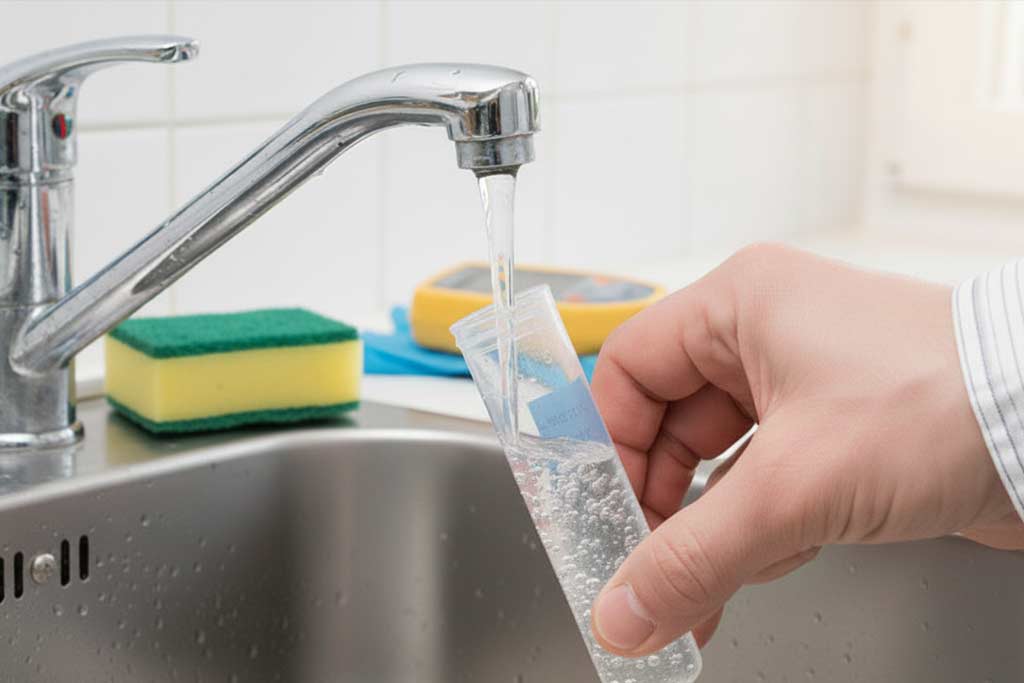
An arsenic test requires a water sample collected at the tap and submitted to a certified laboratory for specific arsenic analysis. It must be explicitly requested — it’s not part of a standard well water panel covering bacteria, nitrates, iron, hardness, and pH. A comprehensive Ocean County well water baseline should include arsenic alongside those standard parameters, plus PFAS, VOCs given the area’s contamination history, and radon in water. Our professional water testing page covers what a comprehensive assessment includes. If arsenic is found at levels warranting action, our arsenic removal page covers the treatment picture. For the broader water quality context in Toms River, our Toms River water testing page covers the full range of local concerns. Our full New Jersey service area covers communities statewide.
Frequently Asked Questions — Arsenic in Drinking Water in Toms River, NJ
Is arsenic a natural concern in Ocean County well water?
Yes. The Cohansey and Kirkwood-Cohansey aquifer systems that supply Ocean County’s private wells pass through formations that produce naturally occurring arsenic in groundwater. Concentrations are generally lower than in northern New Jersey’s crystalline bedrock counties, but arsenic has been detected above the federal action level in Ocean County private wells. The variation between individual wells means testing a specific well is the only reliable assessment.
Given Toms River’s environmental history, should I be especially concerned about arsenic?
Toms River’s documented contamination history involved primarily volatile organic compounds from industrial sources — a different contaminant class than naturally occurring arsenic. For wells near historically contaminated areas, arsenic testing is appropriate alongside VOC screening as part of a comprehensive panel. For wells in areas without proximity to known contamination sites, naturally occurring geological arsenic is the primary consideration.
Can I detect arsenic by any means other than testing?
No. Arsenic at health-relevant concentrations is completely undetectable without laboratory analysis. No taste, smell, or visual indicator distinguishes arsenic-containing water from clean water. A certified laboratory test specifically ordered for arsenic is the only reliable approach.
Is arsenic included in a standard well water panel?
Not automatically. Arsenic must be specifically requested as a separate analysis. Standard panels covering bacteria, nitrates, iron, hardness, and pH do not include arsenic unless it’s explicitly ordered.
How quickly can I arrange testing?
We typically schedule within a few days. Sample collection at your home takes under an hour, and results return from the laboratory within one to two weeks.
Find Out Whether Arsenic Is in Your Toms River Home’s Water
If you’re a Toms River homeowner who’s been thorough about water quality and hasn’t specifically tested for arsenic — this is the straightforward next question to answer. We serve Toms River and all of Ocean County. Call us at (732) 357-1988 or reach out online.