One of the most common questions homeowners face after receiving a water test result is whether to treat the whole house or just the drinking water at the kitchen tap. The answer is not one-size-fits-all. It depends entirely on which contaminants are in your water, what health and household risks they create, and which exposure pathways matter for each specific issue. Our whole-house water filtration service and our point-of-use purification options address different problems, and understanding the distinction before choosing a system saves money and ensures the treatment you install actually solves what needs solving.
This guide explains what point-of-use and whole-house treatment each accomplish, which contaminants call for which approach, when a combination of both makes sense, and how to use your water test results as the decision framework rather than a salesperson’s recommendation.
What Point-of-Use Treatment Does
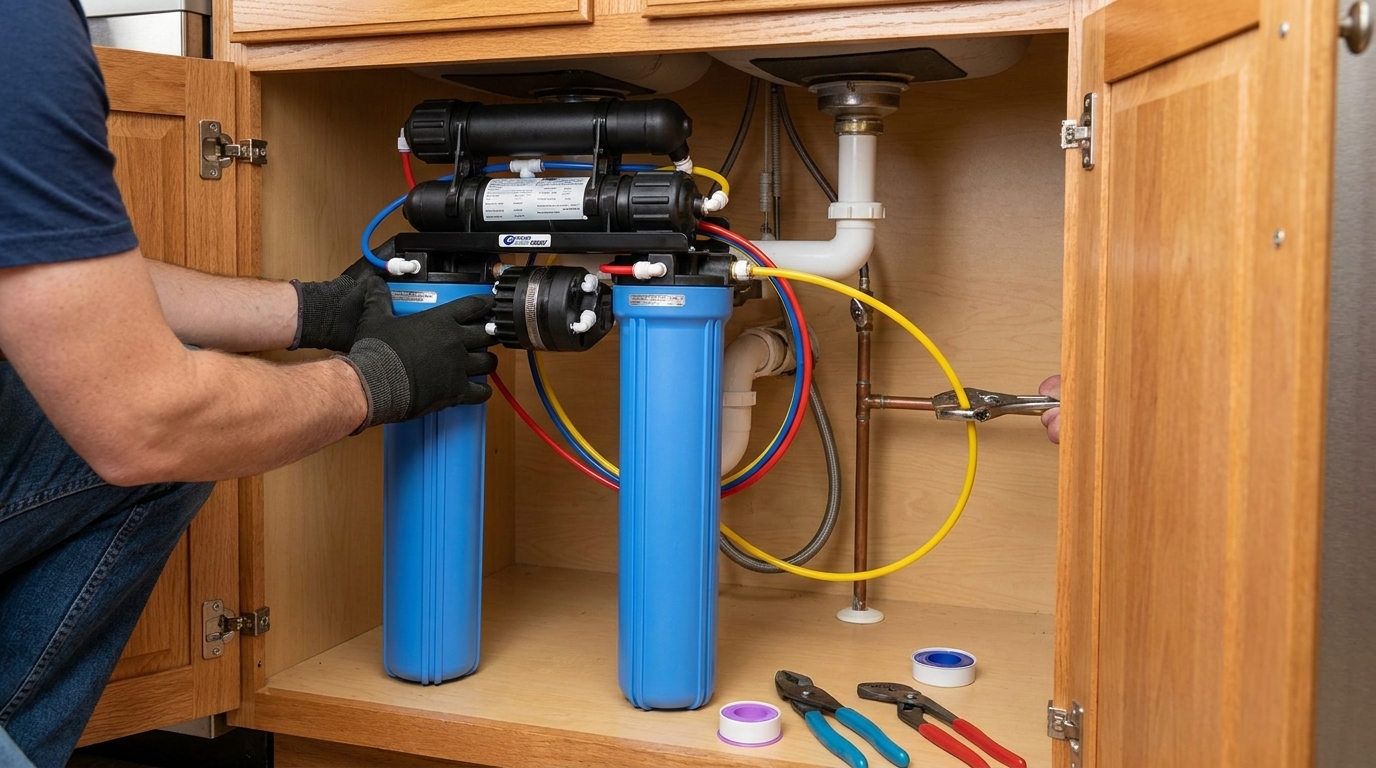
A point-of-use (POU) system treats water at the specific fixture where it is installed. The most common residential POU systems are under-sink reverse osmosis units, countertop filters, and faucet-mount filters. They treat only the water that flows through that particular tap. Every other water outlet in the home, including every other drinking tap, the shower, the bathtub, the washing machine, and the dishwasher, receives untreated water.
The strength of point-of-use treatment is depth of removal at the point of consumption. A properly certified reverse osmosis system removes PFAS, arsenic, nitrates, lead, uranium, and many other contaminants at 90 to 99 percent efficiency from the water at that tap. For contaminants whose primary health risk is ingestion through drinking and cooking, a POU system at the kitchen sink addresses the exposure pathway that matters most at a fraction of the cost of whole-house treatment.
The limitation is obvious: a POU system protects one tap. If contamination affects your water in a way that creates risk beyond that single tap, a POU system alone is insufficient.
What Whole-House Treatment Does
A whole-house or point-of-entry (POE) system installs on the main water supply line where it enters the home, treating every drop of water before it reaches any fixture. Every tap, the shower, the bathtub, the laundry, the dishwasher, the ice maker, and the water used for cooking and drinking all receive treated water.
The strength of whole-house treatment is comprehensive coverage. For contaminants that affect plumbing and appliances, that are released into indoor air through water use, or that create risk through skin contact and inhalation in the shower, whole-house treatment is the appropriate level of protection. A point-of-use filter under the kitchen sink does nothing for scale buildup in your water heater, iron staining in your toilet, or radon gas released into the bathroom air when you shower.
The tradeoff is cost. Whole-house systems are more expensive to purchase and install than point-of-use systems, and for contaminants whose risk is limited to ingestion, the extra cost of treating all the water in the home rather than just the drinking water at one tap may not be justified.
Contaminant by Contaminant: Which Approach Is Right
The right treatment level for any specific contaminant depends on how it creates health risk and how it affects the home. Here is how the most common well water contaminants map to treatment approach.
Hardness (Calcium and Magnesium)
Hardness requires whole-house treatment. Scale builds up inside water heaters, washing machines, dishwashers, and pipes throughout the home. Soap performance and skin and hair effects are experienced in every shower and every sink. A point-of-use softener at the kitchen tap does nothing for the rest of the house. Ion exchange water softening at the point of entry is the standard approach, treating all the water entering the home before it reaches any fixture. Our water softener installation service covers whole-house softening in detail.
Iron and Manganese
Iron and manganese require whole-house treatment. Staining occurs on every fixture in the home that contacts the water. Iron fouling affects the water heater, the washing machine, and any other appliance using water. A point-of-use filter at the kitchen tap does not prevent orange staining in the toilet bowl, rust deposits in the laundry, or scale buildup inside the water heater. Oxidizing filtration at the point of entry is the appropriate approach.
Hydrogen Sulfide (Sulfur Smell)
Hydrogen sulfide odor is present from every tap in the home and is released into indoor air during showering and dishwashing. Whole-house treatment at the point of entry is required to address the odor comprehensively. A point-of-use carbon filter at the kitchen tap removes the smell from drinking water but does nothing for the shower, the laundry, or the dishwasher.
Arsenic
Arsenic is primarily an ingestion risk. Dermal absorption during bathing is generally considered a minor exposure pathway at typical residential well water concentrations. For most homeowners with arsenic above the EPA’s 10 ppb MCL, a point-of-use reverse osmosis system at the kitchen sink addresses the primary exposure pathway at significantly lower cost than whole-house arsenic removal. Whole-house arsenic treatment is appropriate when concentrations are very high, when multiple family members use multiple taps for drinking and cooking, or when the homeowner prefers comprehensive whole-house protection.
PFAS
PFAS exposure through drinking and cooking is the primary ingestion risk. A point-of-use reverse osmosis system certified for PFAS removal at the kitchen sink addresses the primary exposure pathway effectively. Some research suggests that PFAS exposure through skin contact during bathing may be a secondary exposure pathway at high concentrations, but for most residential situations point-of-use treatment at the kitchen tap is the appropriate and cost-effective starting point.
Nitrates
Nitrates are an ingestion risk, particularly for infants under six months of age where they cause methemoglobinemia. Point-of-use reverse osmosis at the kitchen sink addresses the primary exposure pathway. For households with infants, the kitchen tap RO must be used for all formula preparation and infant drinking water. Bathing in nitrate-containing water is not considered a significant exposure pathway.
Lead
Lead is primarily an ingestion risk through drinking and cooking. Point-of-use treatment at the kitchen sink with a certified RO or NSF/ANSI 53 certified carbon block filter addresses the primary exposure pathway. For homes where lead is entering from the well or supply line rather than household plumbing, a whole-house treatment approach may be warranted to protect all water outlets.
Uranium
Uranium exposure through drinking water is primarily an ingestion risk affecting kidney function. Point-of-use reverse osmosis at the kitchen sink is the standard and most cost-effective treatment approach for most homeowners. Our post on uranium in well water covers the health risk and treatment options in detail.
Bacteria and Biological Contamination
Biological contamination requires whole-house disinfection. Bacteria in well water create risk through every water contact point in the home, including the shower, where waterborne pathogens can be inhaled as aerosols. UV disinfection at the point of entry provides whole-house biological protection without adding chemicals to the water. A point-of-use filter at the kitchen sink does not protect against bacteria in the shower or laundry. Our post on what a positive coliform test means covers the full response protocol for biological contamination.
Radon in Water
Waterborne radon is released into indoor air during showering and other water use throughout the home. Whole-house treatment is required because the primary exposure pathway is inhalation of radon released from every water outlet, not ingestion at the kitchen tap. An aeration system or whole-house GAC filter at the point of entry addresses the complete exposure pathway.
When a Combination of Both Is the Right Answer
For many well water homes with multiple water quality issues, the most effective and cost-efficient approach is a combination of whole-house treatment for the issues that affect the entire home, plus point-of-use treatment at the kitchen sink for health-based contaminants whose primary risk is ingestion.
A typical combination for a well water home with hardness, iron, and arsenic might look like this: a whole-house iron filter and water softener at the point of entry address the iron staining and hardness throughout the home, protecting appliances and plumbing and improving water quality everywhere. A reverse osmosis system under the kitchen sink provides the final stage of purification for drinking and cooking water, removing arsenic and any other health-based contaminants from the water used for consumption.
This combination approach addresses the full range of water quality issues at the appropriate level of treatment for each, at a total cost that is typically lower than trying to achieve everything with a single whole-house treatment system. Our whole-house water filtration guide covers how point-of-entry systems are designed and sequenced for homes with multiple contaminants, and our guide on water softener vs water filter covers the comparison between those two specific treatment approaches in detail. For a deeper look at how these decisions fit into choosing the right company and the right process, our guide on how to choose a water treatment company covers what the complete professional engagement should look like.
Your Water Test Results Are the Decision Framework
The right treatment approach for your home is not determined by what is most commonly installed in your area, what a salesperson recommends, or what a neighbor has in their basement. It is determined by what your water test shows. A water test that reveals only moderate hardness and no health-based contaminants points toward a whole-house softener as a complete solution. A water test that reveals hardness, iron, arsenic, and PFAS points toward a combination approach with whole-house iron and hardness treatment plus point-of-use purification for the health-based contaminants.
The test comes first. The system design follows from what the test shows. NSF certification standards at nsf.org provide the benchmark for verifying that any system installed actually performs as claimed for the contaminants it is supposed to address. Our water testing service provides the comprehensive baseline that makes treatment decisions accurate rather than approximate. And our water problems page covers the full range of contaminants we address and the treatment options available for each.
The Right Answer Depends on Your Water
Point-of-use and whole-house water treatment are not competing approaches. They address different things, and for most homes with more than one water quality issue, both play a role in a complete treatment system. Understanding which contaminants call for which level of protection is what turns a water test result into an actionable, correctly scoped treatment plan.
If you want help interpreting your water test results and determining whether point-of-use, whole-house, or a combination approach is right for your home, reach out to our team for a free consultation. We will start with your water and build a recommendation around what it actually contains.
