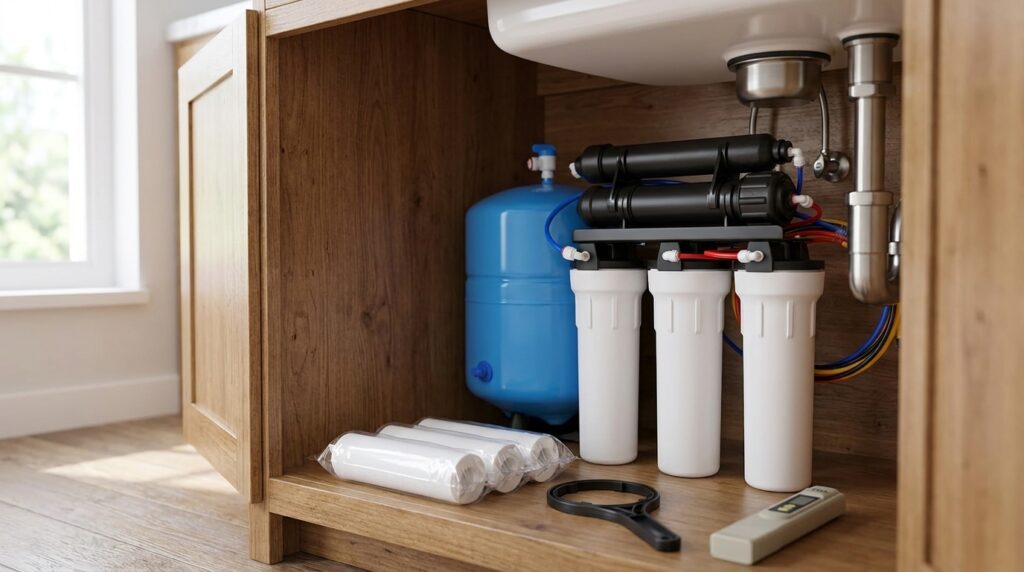
A reverse osmosis system is only as good as its last filter change. Each stage protects the next, and the membrane at the center is the most expensive part to replace. Manufacturers publish their own intervals, and they do not all agree: GE’s guidance has prefilters and postfilters changing about every six months and the membrane every three to five years, while ESP Water Products puts the membrane at 24 months. This guide covers what each stage does, how to read those ranges, and what New Jersey well and city water do to the schedule.
Which RO filters need changing?
Most under-sink systems stack several stages, and each one wears out for a different reason. The table lists the common stages, what each does, and what tends to shorten its life. Your model may omit some of them, so check the manual for the exact set.
| Stage | What it does | What shortens its life |
|---|---|---|
| Sediment prefilter | Strains sediment and silt before they reach later stages | Sandy or cloudy water, heavy sediment load |
| Carbon prefilter | Removes chlorine and other chemicals that wear the membrane, and improves taste and odor | Chlorinated city water, heavy daily use |
| RO membrane | Rejects dissolved solids, the main purification step | Hard or mineral-heavy water, spent prefilters upstream |
| Polishing (post) filter | Final taste and odor clean-up after the storage tank | Time in service |
| Remineralization filter, if fitted | Adds minerals back for taste | Time in service |
How often should each stage be replaced?
The manual for your model is the authority. As reference points, GE’s support page lists prefilters and postfilters at about six months and the membrane at three to five years. ESP Water Products lists the sediment and carbon prefilters at 6 to 12 months, the membrane at 24 months, and the polishing filter at 12 months.
The gap between those membrane figures is the reason to start from the manual and adjust with testing, not the calendar alone. A system on clean water can run toward the long end. A system fed hard, sandy, or heavily chlorinated water may need changes sooner.
Does New Jersey water change the schedule?
Source water decides which stage works hardest. Private wells often carry sediment, iron, and hardness, which load the early stages. Our guides to sediment in well water and iron in well water cover those problems, and a professional water test shows which ones apply to your supply.
City water customers have a different load. Disinfectant chemicals land on the carbon stage, which exists to protect the membrane. Some manufacturers write their schedules for softened water and say unsoftened supply may call for earlier changes, so hardness belongs in the conversation too.
Signs it is time to change a stage
The calendar gives a starting point, and the system gives warnings. Watch for these:
- Slower flow at the RO faucet
- A change in taste or odor in the water
- A drop in TDS reduction below the manufacturer’s threshold
- A reminder light on the faucet, if your model has one
- More time in service than the manual’s interval allows
What does a TDS reading tell you?
TDS, total dissolved solids, is the measurement most often used to judge membrane health. A meter reads the water going in and the RO water coming out, and the percentage drop shows how well the membrane is rejecting solids. GE’s guidance calls for a new membrane when TDS reduction falls below 75 percent, and for checking TDS once a year. Our guide to what a TDS number means explains how to read the result.
What happens if you skip a change?
Spent prefilters let sediment and chlorine reach the membrane, which shortens its life and turns a cartridge swap into a membrane replacement. Output slows, taste worsens, and TDS reduction drops, which means the system is removing less than it was installed to remove.
Do it yourself or schedule service
Cartridge changes are a short job on most under-sink units, and the manual lists the steps. If the RO unit sits downstream of other treatment, such as iron removal or a softener, a service visit can check the whole setup, since a problem upstream shortens the life of everything after it.
Where RO fits with the rest of your treatment
Replacement timing is one part of the picture. If you are still deciding between RO and whole-house treatment, our comparison of reverse osmosis and whole-house filtration covers how they differ. If you already have RO and want to know whether the water entering it is adding wear, contact Jersey Radon and we can test the supply and go over treatment options for your home.
