If you’ve been researching hard water solutions in New Jersey, you’ve likely come across two very different products marketed in similar ways. Salt-free water conditioners are often described as softeners without the salt. That framing is appealing. It’s also incomplete.
Traditional water softeners and salt-free conditioners don’t just take different approaches to the same problem. They solve different versions of it. Knowing which one your home actually needs starts with understanding how each works.
Softening Removes Minerals. Conditioning Changes How They Behave.
A water softener removes calcium and magnesium from the water through a process called ion exchange. These two minerals are the source of hard water and the cause of most of the damage hard water does to NJ homes. When they’re removed, the water is genuinely soft.
A salt-free conditioner does not remove calcium and magnesium. It changes how those minerals behave so they’re less likely to form scale on pipes and surfaces. The water still contains the same mineral load it did before. It hasn’t been softened. It’s been conditioned.
This distinction matters because the problems each product solves are different. Homeowners who don’t know this going in sometimes invest in a conditioner expecting softener results, then end up confused when the dry skin, soap lathering, and spotty dish issues don’t go away.
How Ion Exchange Water Softeners Work
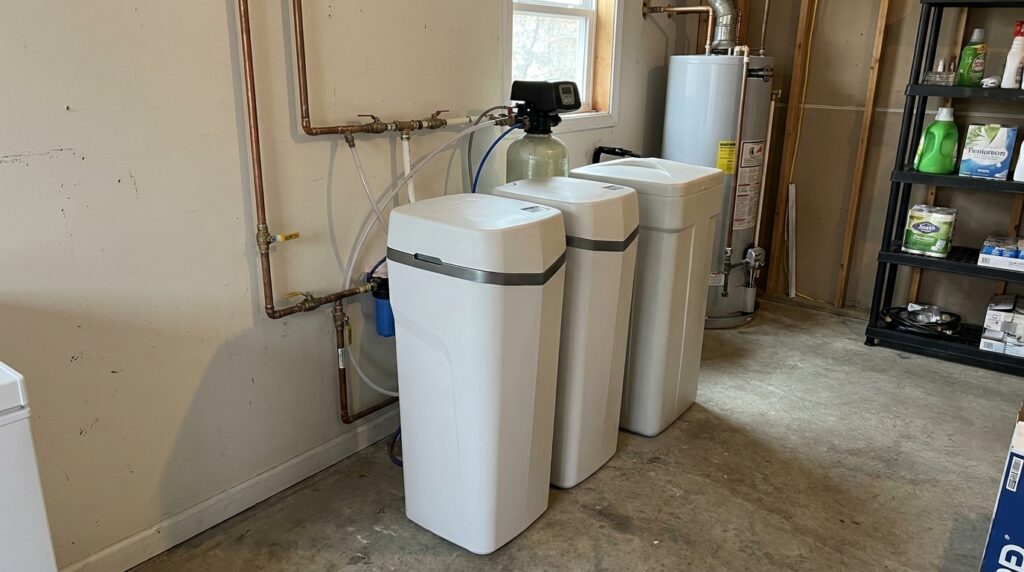
Traditional water softeners run incoming hard water through a resin tank filled with sodium-charged beads. Calcium and magnesium ions in the water attach to the resin, and sodium ions are released in their place. The result is water with significantly lower mineral content.
Over time the resin becomes saturated with calcium and magnesium and needs to be recharged. The softener flushes the resin with a salt brine solution, which restores the beads and sends the captured minerals down the drain. This is the regeneration cycle, and it’s why salt-based softeners require a steady salt supply and produce a small amount of wastewater.
According to the U.S. Environmental Protection Agency, hard water is one of the most widespread aesthetic water quality concerns in residential settings, and ion exchange is the most established technology for addressing it. The results are consistent: no scale on fixtures, better soap performance, improved skin and hair feel, and less wear on appliances and plumbing over time.
Professional water softener installation in New Jersey typically includes a site assessment, water hardness testing, and system sizing based on household usage. The system runs continuously in the background and requires regular salt refills based on water hardness and how much water the household uses.
How Salt-Free Conditioners Work
Salt-free systems use a process called template-assisted crystallization, or TAC. As water passes through the conditioning media, calcium and magnesium molecules are converted into microscopic crystals that stay suspended in the water rather than bonding to pipe walls, fixtures, and heating elements.
The minerals don’t leave the water. But in crystalline form, they’re far less likely to adhere to surfaces and build up as hard scale. Salt-free conditioners require no salt, no electricity, and produce no wastewater. There’s no regeneration cycle and minimal maintenance involved.
These are genuine advantages, and for some households in some conditions, a salt-free conditioner is a reasonable fit. What’s equally important to understand is what they don’t do.
A salt-free conditioner will not:
- Reduce the mineral content of the water
- Resolve dry skin and hair problems caused by calcium and magnesium
- Improve soap lathering, which depends on actual removal of hardness minerals
- Produce the silky feel associated with genuinely softened water
- Register as a change on a standard water hardness test strip
If any of those outcomes are part of what you’re trying to solve, a conditioner is not the right tool for the job.
Comparing the Two Side by Side
The clearest way to see the difference is to map each system against the problems NJ homeowners most commonly want to address.
| Problem or Feature | Water Softener | Salt-Free Conditioner |
|---|---|---|
| Removes calcium and magnesium | Yes | No |
| Reduces scale on fixtures and pipes | Yes | Yes (most conditions) |
| Reduces limescale and crusty buildup | Yes | Partially |
| Improves soap lathering | Yes | No |
| Addresses dry skin and hair | Yes | No |
| Requires salt | Yes | No |
| Requires electricity | Yes | No |
| Produces wastewater | Yes | No |
| Requires regular maintenance | Yes | Minimal |
| Reliable in very hard water | Yes | Performance varies |
Why NJ Well Water Makes This Choice More Clear-Cut
New Jersey well water, particularly in Somerset, Hunterdon, Morris, Warren, and Sussex counties, frequently falls into the very hard classification. Template-assisted crystallization works reliably in moderate hardness ranges. In very hard water conditions, the scale-prevention performance of salt-free systems becomes less consistent. For homes with well water that tests well into the hard or very hard range, an ion exchange softener is the more dependable long-term solution.
Iron is another factor that shapes this decision in NJ well water homes. Salt-free conditioners are not designed to address iron, and elevated iron concentrations can interfere with conditioning media over time. A traditional softener handles modest iron levels well, and pairing a softener with dedicated iron filtration is a proven approach for NJ homes dealing with both problems simultaneously.
The appeal of a salt-free system, particularly the lower maintenance requirement, is real. But a system that doesn’t fully solve the problem isn’t actually saving you effort over the long run. If the water still causes scale damage, skin and hair complaints, and appliance wear, the maintenance savings don’t offset what the system isn’t doing.
If you’re not certain how hard your water is or what else is in it, a professional water test is the right place to start. Choosing a treatment system without knowing what the water actually contains leads to the wrong equipment more often than not.
How Jersey Radon Helps NJ Homeowners Choose the Right System
Jersey Radon installs water softening systems throughout New Jersey, including Hague water treatment equipment, which we are certified to install and service. When a homeowner contacts us about hard water, we start with a water analysis before recommending anything. The right system depends on what’s actually in the water, not on which product is trending in online search results.
We work with homeowners dealing with:
- Hard water causing scale buildup, appliance damage, and spotted dishes
- Dry skin, flat hair, and soap that never fully lathers in the shower
- Combined hardness and iron problems that need a layered treatment approach
- Confusion about conflicting marketing claims between salt-free and salt-based products
If you’re weighing water treatment options for a New Jersey home and want a clear answer based on what your water actually contains, contact Jersey Radon for a free estimate. We test the water, explain the options, and recommend a system based on what we find.
