Summit Homeowners Expect a Lot From Their Homes. The Water Flowing Through Pre-War Plumbing Often Falls Short of That Standard.
Summit’s residential inventory is built around its historic homes — pre-war colonials, postwar ranches, and mid-century properties that give the city its character and command premium prices. Those same homes frequently have interior plumbing that predates modern materials standards, sitting in contact with water that has its own chemistry challenges: chloramine disinfection from New Jersey American Water’s Raritan supply, soft water corrosivity that makes metal dissolution from older pipe joints more aggressive than in harder-water areas, and seasonal source water variation from the Raritan watershed. The tap water experience that results frequently doesn’t match the quality standard Summit homeowners apply to everything else in their homes. Professional water testing in Summit identifies the specific cause so the solution actually fits the problem.
Chloramines and the Raritan Supply
Summit’s New Jersey American Water supply uses chloramine disinfection — a chlorine-ammonia compound that persists through the distribution network to every tap it serves. The Raritan River system is a surface water source with organic inputs from agricultural runoff, natural organic material, and watershed drainage that reacts with chloramine during distribution to produce trihalomethanes and haloacetic acid byproducts. These byproducts are regulated but contribute to the flat, chemical, or slightly medicinal taste that Summit homeowners notice in their tap water.
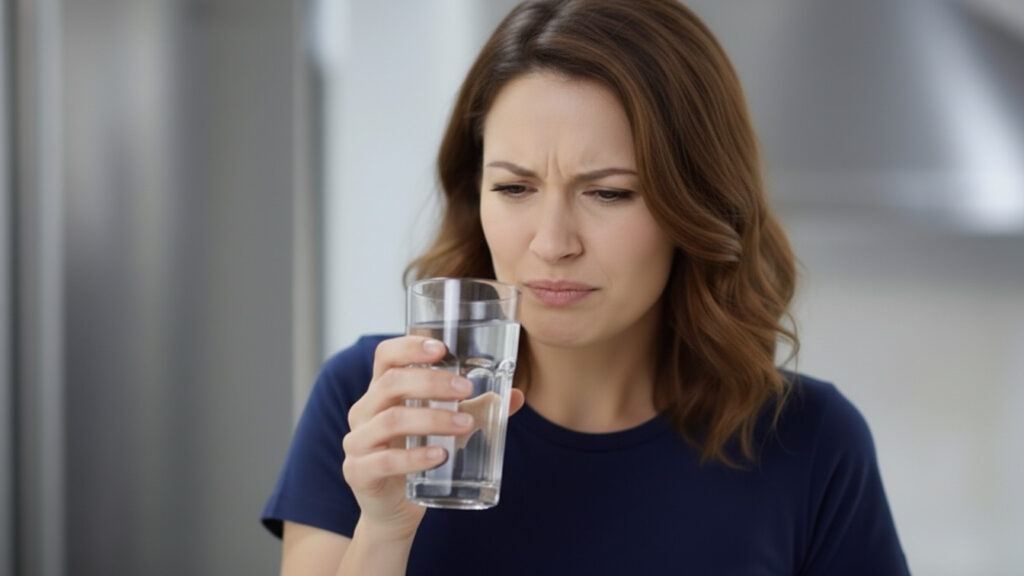
What homeowners notice: a bleach or pool-like smell from the faucet, a chemical quality in drinking water and coffee, and sometimes mild skin sensitivity in the shower. The EPA’s drinking water standards regulate chloramine at safe levels — but the taste it produces in Raritan surface water is genuinely off-putting to many Summit homeowners. Carbon-based filtration at the kitchen tap removes chloramine and its byproducts effectively.
Lead and Metallic Taste From Summit’s Older Homes
Summit’s pre-war housing inventory was built when lead solder at interior pipe joints was standard practice. New Jersey American Water’s treated supply arrives at Summit homes lead-free. What happens inside those homes’ aging plumbing is a property-specific question — and it’s one that the soft water characteristic of the Raritan supply makes more relevant than it would be in harder-water areas.
Soft, slightly acidic water is more corrosive to interior plumbing than neutral or hard water. In Summit’s older homes, the combination of decades-old lead solder and soft Raritan water has been working together to introduce dissolved metals into the water. The first-draw metallic taste in the morning is the characteristic signal. The tap-level water test at the kitchen faucet is the direct answer. The CDC’s drinking water resources cover what these patterns indicate.
Seasonal Raritan Watershed Variation
The Raritan River system’s water quality shifts with the seasons — spring agricultural runoff, summer algae growth in reservoirs, fall leaf decomposition all affect the organic profile of source water and require treatment adjustments. Summit homeowners occasionally notice a seasonal earthy or musty quality to their water in spring and fall. This is expected variation for Raritan watershed customers and typically resolves as the season progresses.
Hydrogen Sulfide — Hot Water Odor From the Tank
Summit is on municipal water, so groundwater hydrogen sulfide is uncommon. When Summit homeowners report a rotten egg smell specifically in hot water — and cold water is fine — the water heater is almost certainly the source. Sulfur-reducing bacteria reacting with the tank’s magnesium anode rod produce hydrogen sulfide in the hot water tank. This is resolved at the tank level rather than through supply-side treatment.
What Your Symptom Is Likely Telling You
| Symptom | Likely Cause | What It Means |
|---|---|---|
| Chemical or bleach smell/taste | Chloramine (NJAW Raritan supply) | Surface water treatment; carbon filtration resolves it |
| Metallic taste, worse in morning | Lead solder/copper corrosion in older plumbing | Amplified by Raritan soft water; tap test confirms source |
| Rotten egg — hot water only | Water heater anode rod reaction | Tank-specific; anode replacement usually resolves it |
| Earthy smell — seasonal | Raritan watershed organic inputs | Expected seasonal variation; carbon filtration buffers it |
| Flat, chemical aftertaste in coffee | Chloramine disinfection byproducts | Point-of-use carbon filtration addresses this directly |
| Blue-green staining on fixtures | Copper corrosion from soft, acidic water | Soft water dissolving pipe materials; tap test recommended |
Finding the Right Solution
Water testing in Summit identifies the specific cause. For chloramine and Raritan byproducts, whole-home carbon water filtration addresses it effectively. For metallic taste from aging plumbing — particularly relevant given Summit’s soft water corrosivity — reverse osmosis at the kitchen sink provides the highest level of drinking water purification including metal reduction. We serve Summit and Union County, including New Providence, Chatham, Berkeley Heights, and Millburn. Our full New Jersey service area covers communities statewide. Additional context is available through our bad tasting water and smelly water resources. The NJ DEP Water Supply program provides state-level context. Call us at (732) 357-1988 or reach out online.
Frequently Asked Questions — Bad Tasting or Smelly Water in Summit, NJ
Summit’s water quality reports look fine — why does my tap water taste bad?
Annual consumer confidence reports reflect conditions at the treatment plant level. What arrives at your specific tap — after traveling through aging distribution infrastructure and the interior plumbing of a Summit home that may be 80 or 100 years old — is a property-specific question the utility report can’t answer. The chloramine taste, the metallic quality from older pipe joints, and the soft water corrosivity that accelerates metal dissolution all happen between the treatment plant and your glass.
Is the metallic taste in my Summit home’s water a lead concern?
If the taste is worst in the first draw in the morning and improves after running the tap, it’s specifically pointing to interior plumbing as the source. In Summit’s pre-1986 construction — which is a large portion of the housing inventory — lead solder at pipe joints is common. The soft Raritan water’s corrosivity makes lead dissolution more likely than in harder-water areas. A tap-level water test at the kitchen faucet gives you a specific answer for your home.
Does a water filter help with the chemical taste in Summit’s tap water?
Yes — a carbon-based under-sink filter or whole-home filtration system rated for chloramine removes the chemical taste and smell effectively. For Summit homeowners also concerned about metallic taste from older plumbing, reverse osmosis at the kitchen tap addresses both simultaneously and provides the highest level of drinking water purification available for residential use.
Why does Summit water taste different in spring?
Spring agricultural runoff changes the organic content of the Raritan River supply. Treatment adjusts in response, which can produce a temporary earthy or different-tasting quality at Summit taps. This is characteristic of treating a surface water source and typically resolves as spring progresses and source water chemistry stabilizes.