
Every homeowner asking about radon aeration wants the same thing first: a number. The honest answer is that there isn’t one flat number, because the system a well actually needs depends on what’s in the water and how the house uses it.
What you can control is understanding the variables that move the price up or down, so a quote makes sense instead of feeling arbitrary.
Why There Is No Flat Price for Radon Aeration Systems
Two homes on the same street can need very different equipment. One well might have a radon concentration just above the point where treatment makes sense, while the other needs a larger, more aggressive setup. Household size, water usage, and existing plumbing all factor in too.
That’s why a real quote follows a water test and a look at your plumbing, not a guess based on square footage. Understanding what a radon aeration system involves installing makes the variables below easier to place.
Radon Concentration in Your Well Sets the Baseline
The starting radon level in your well water is the first thing that shapes system design. Higher concentrations generally call for more contact time between water and air, which can mean a larger aeration chamber or a multi-stage setup rather than a compact single-tank unit.
This is also where how radon gets into well water in the first place matters for pricing, not just for understanding the problem. Wells drawing from certain rock formations tend to run higher, and that starting point drives everything downstream in the design.
Equipment Type and Household Water Demand Change the Number
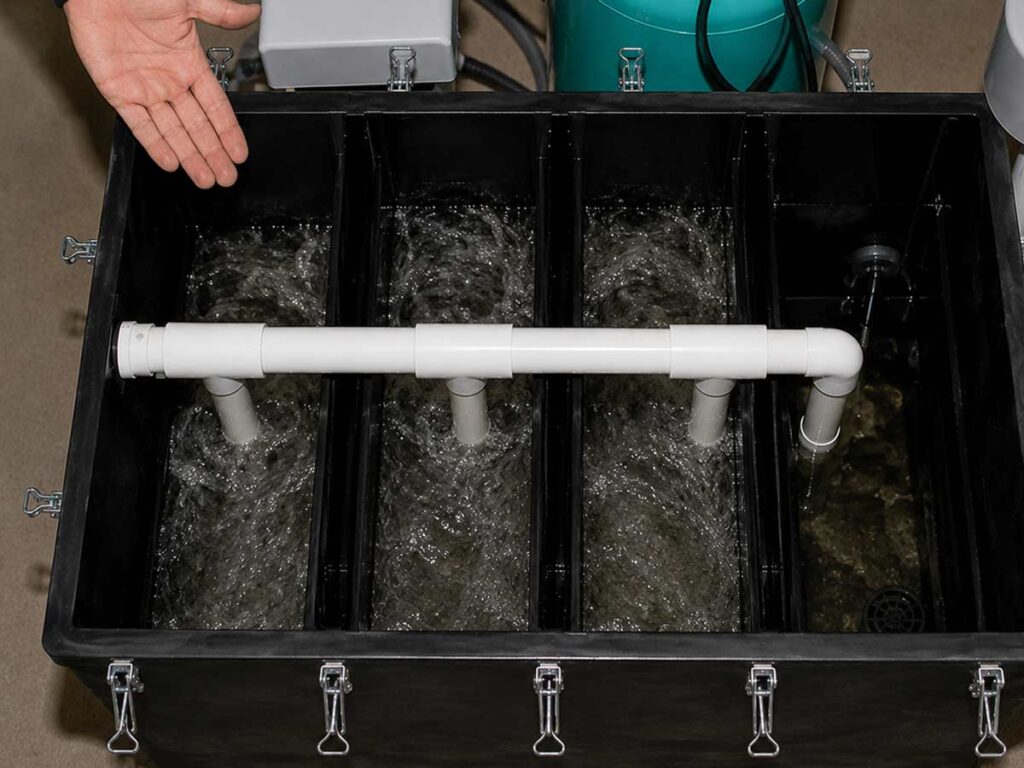
Aeration method is not one-size-fits-all. Spray aeration, diffused bubble systems, and packed tower designs all come with different equipment costs and footprints, and the right choice depends on flow rate and available space as much as radon level.
A household running multiple bathrooms, a sprinkler system, or high daily water use needs equipment sized for that demand. Undersizing to save money upfront usually shows up later as inconsistent radon reduction or a system working harder than it should.
Installation Complexity Adds Its Own Line Items
The unit itself is only part of the job. Installation conditions can add meaningfully to the total.
- Where the well line enters the house and how far it is from a usable vent path
- Whether existing plumbing needs modification to route water through the aerator
- Space constraints in a basement, crawlspace, or mechanical room
- Electrical work needed for blowers and repressurization pumps
- Pretreatment already in place, or needed, for sediment or hardness
A straightforward basement install with a clear vent path costs less to execute than a tight mechanical closet requiring rerouted plumbing and new electrical.
What Usually Gets Bundled With the Aeration Unit
Quotes rarely cover just the aeration chamber on its own. Most complete systems include a handful of supporting components, each adding its own cost to the total.
| Component | Why It Affects Cost |
|---|---|
| Repressurization pump | Restores water pressure lost during atmospheric aeration |
| Pressure tank | Reduces pump cycling and stabilizes household pressure |
| Sediment or pretreatment filter | Protects the aerator when iron, manganese, or sediment is present |
| Vent line and exterior termination | Length and routing depend on where the mechanical space sits relative to an exterior wall |
| Post-installation water test | Confirms the system is actually reducing radon to the expected level |
Skipping any of these to lower the upfront number usually means paying for it later, either in equipment strain or in radon levels that don’t come down as far as expected.
How Jersey Radon and Water Treatment Prices and Sizes These Systems
A number that isn’t built around your actual water test is a guess dressed up as a quote. Jersey Radon and Water Treatment starts every aeration project with well water testing, then designs and prices the system around your radon concentration, water demand, and installation conditions rather than a generic package.
If you want a real answer instead of a ballpark, schedule a free estimate and get pricing based on what your well is actually producing.
