Your Montclair Home Has Character. Its Pipes May Have Arsenic.
Montclair’s older homes are part of what makes the community worth living in — the architecture, the history, the bones of a house built to last. What those homes also have, in many cases, is plumbing that was installed in an era when arsenic in well water wasn’t on anyone’s radar. Essex County’s geological profile places it in New Jersey’s elevated-risk zone for naturally occurring arsenic in groundwater, and for any Montclair-area home drawing from a private well, that geology is directly relevant to what’s coming out of the tap. A professional water test that specifically includes arsenic is the only way to know whether it’s a concern at your specific address.
This page explains what arsenic in water is, how Essex County’s geology creates the conditions for it, what long-term exposure actually means for health, and why the absence of any visible sign is exactly what makes it worth testing for.
The Invisible Contamination That Has No Taste, No Smell, and No Warning
Arsenic is a naturally occurring element present in bedrock and soil throughout New Jersey. It enters groundwater through a simple process — water moves through arsenic-bearing rock formations, dissolves trace amounts of the element, and carries it into the aquifer that a private well draws from. There’s no industrial accident, no pipe failure, no visible event that signals its presence. It accumulates in groundwater over geological time, and it arrives at the tap in water that looks, smells, and tastes exactly like clean water. The only way to detect it is a laboratory test specifically ordered to look for it.
For Montclair homeowners on municipal water, the risk is lower — Essex County’s treated water supply undergoes processing that reduces arsenic before distribution. But for any property in the area connected to a private well, the geological baseline of Essex County’s crystalline and mixed bedrock creates real and documented arsenic risk in groundwater. Nearby Verona, Glen Ridge, Bloomfield, and West Orange share the same Essex County geological context.
What Essex County’s Geology Means for Arsenic in Well Water
New Jersey’s crystalline bedrock zone — running through Essex, Morris, Hunterdon, Somerset, Sussex, and Warren counties — is the region of the state with the highest documented naturally occurring arsenic in groundwater. The arsenic-bearing minerals in this bedrock dissolve slowly into the aquifer water that private wells draw from, producing concentrations that vary by location but that have been found above the federal action level of 10 parts per billion at numerous monitoring points across Essex County.
Montclair’s geology sits within this zone. Studies by the New Jersey Geological and Water Survey have consistently found that private wells in Essex County’s bedrock geology carry higher arsenic risk than wells in the sedimentary geology of South and coastal New Jersey. The variation between neighboring wells is significant enough that a test at a specific well is the only meaningful data point — regional averages and neighboring test results don’t tell you what your well is producing.
The Health Concern — What Happens Over Years, Not Days
Arsenic’s effects on the human body are not acute — they’re chronic. There’s no immediate reaction, no taste that warns you, no early symptom that connects to the water. Long-term exposure to arsenic in drinking water at elevated concentrations has been associated with increased risk of bladder, lung, and skin cancers — the EPA classifies arsenic as a known human carcinogen. Beyond cancer risk, prolonged arsenic exposure has been linked to cardiovascular disease, peripheral neuropathy, and immune system effects. In children and during pregnancy, arsenic exposure carries additional developmental and cognitive concerns that make testing an urgent priority for families with young children.
A family can drink arsenic-containing well water for years — sometimes for decades — without experiencing any symptom that would prompt them to connect it to the water. The nature of chronic low-level exposure is that it doesn’t announce itself. This is not a reason for panic. It is a reason to test.
Arsenic Risk by Scenario — Montclair Area Homeowners
| Scenario | Risk Level | Recommended Action |
|---|---|---|
| Private well in Essex County bedrock geology | Higher — crystalline bedrock is a documented arsenic source | Test immediately; include in any comprehensive well panel |
| Montclair municipal water customer | Lower — treatment reduces arsenic before distribution | Review annual water quality report; test if concerned |
| Well water, never tested for arsenic | Unknown — no baseline established | Test now; arsenic requires a specific lab analysis |
| Home purchase with private well | Unknown — prior testing may not be current | Test before closing or immediately after |
| Well tested more than 3 years ago | Uncertain — groundwater chemistry can shift | Retest; arsenic levels in wells can change |
What Testing Involves and What Comes After
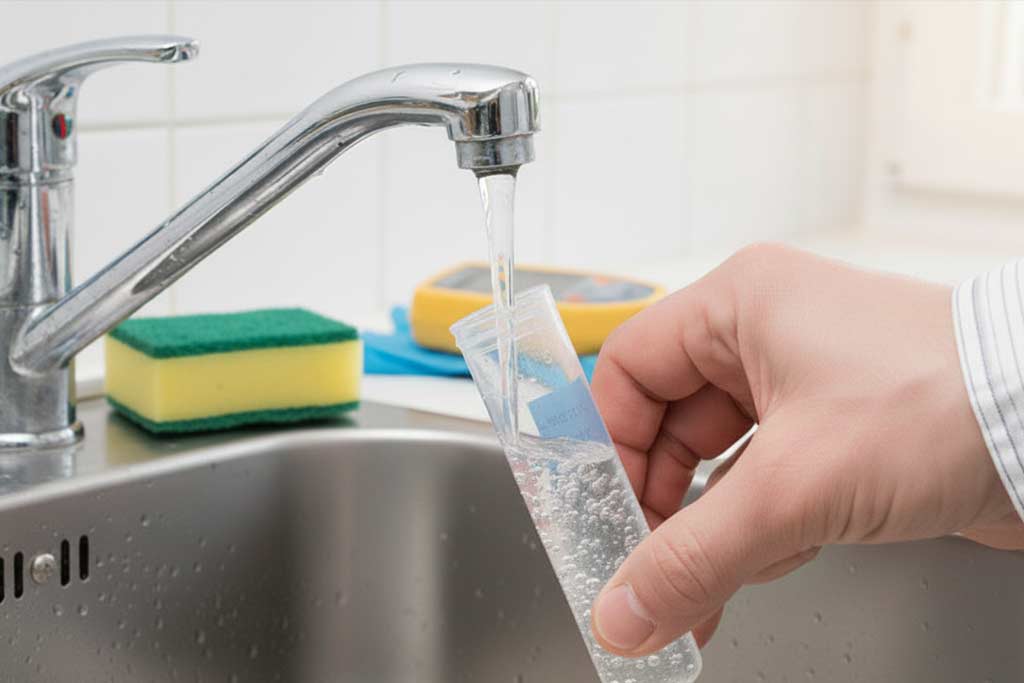
An arsenic test requires a water sample collected at the tap and submitted to a certified laboratory for specific arsenic analysis. It is not included in a standard water quality panel covering hardness, bacteria, or common contaminants — it must be explicitly requested. The result is a concentration in micrograms per liter that can be compared to the federal action level of 10 ppb and used to determine whether treatment is warranted.
A complete well water baseline for a Montclair-area home should include arsenic alongside bacteria, nitrates, pH, hardness, iron, manganese, and — given Essex County’s geological profile — radon in water. Our professional water testing page covers what a comprehensive assessment includes. If arsenic is confirmed at levels that warrant action, our arsenic removal page covers what treatment involves. For the full water quality picture in Montclair, our Montclair water testing page covers the range of concerns specific to this community. Our full New Jersey service area covers communities statewide.
Frequently Asked Questions — Arsenic in Drinking Water in Montclair, NJ
Is arsenic in well water a documented concern in Essex County?
Yes. Essex County’s crystalline and mixed bedrock geology is associated with naturally occurring arsenic in groundwater throughout northern New Jersey. New Jersey Geological Survey studies have found elevated arsenic concentrations in private wells across the county. The variation between individual wells is significant, which is why testing a specific well is the only meaningful way to assess arsenic risk at a given property.
My Montclair home is on municipal water — should I still think about arsenic?
For municipal water customers, treatment significantly reduces arsenic risk before distribution. Your utility is required to test and publish annual water quality reports — reviewing those reports is the appropriate first step for municipal customers. If the report shows arsenic approaching the federal limit, or if you have ongoing water quality concerns, direct testing at your tap provides additional certainty.
What are the signs of arsenic exposure from drinking water?
There are no reliable early signs. Chronic low-level arsenic exposure doesn’t produce symptoms that would specifically connect to drinking water in the early stages. This is precisely what makes testing the only responsible approach — by the time symptoms associated with long-term arsenic exposure appear, years of exposure have already occurred.
Is arsenic included in a standard water quality test?
No. It must be explicitly requested as a separate laboratory analysis. If your previous water test didn’t specifically list arsenic as a tested parameter, you don’t have an answer to this question for your well.
How do I arrange testing?
Call us or reach out online. We can arrange arsenic testing as part of a comprehensive well water assessment or as a standalone test. Sample collection at your home takes under an hour, and laboratory results typically return within one to two weeks.
Find Out Whether Arsenic Is in Your Montclair Home’s Water
If you’re on a private well in Essex County and arsenic hasn’t been part of your water quality testing — this is the question worth answering. We serve Montclair and all of Essex County. Call us at (732) 357-1988 or reach out online.