Summit Homeowners Do Their Due Diligence on Everything. Arsenic in the Drinking Water Rarely Makes the Checklist.
Summit is a community that attracts thorough people — homeowners who investigate before they buy, maintain before things break, and pay attention to the details of what they’re living with. Water quality has increasingly made that conversation, with PFAS from the Raritan watershed and lead from pre-war plumbing getting meaningful attention. Arsenic in well water is the concern that consistently doesn’t make the list. And yet Union County’s geological profile places it in a transitional zone where naturally occurring arsenic in groundwater is a real and documentable concern for private well owners. For the majority of Summit homeowners on municipal supply, New Jersey American Water’s treatment provides protection. For anyone on a private well, and for anyone who wants the full picture, a professional water test that specifically includes arsenic is where the conversation moves from assumption to data.
Union County’s Geological Position — The Arsenic Risk Context for Summit Well Owners
Arsenic in groundwater is primarily a geological phenomenon — the rock and sediment that groundwater moves through determines what it picks up. New Jersey’s arsenic risk follows its geology with consistency: the crystalline bedrock counties of the north — Morris, Hunterdon, Sussex — produce the highest naturally occurring arsenic concentrations in private well water. South Jersey’s sedimentary geology produces the lowest. Union County sits in a transitional position between these zones — moderately elevated relative to the southern counties, lower than the northern counties where arsenic in well water is most frequently documented.
For Summit private well owners, this transitional position means arsenic belongs on a comprehensive well water testing panel — not because the risk is as high as in Morris County, but because “moderate” still means present, and individual wells within the same geological zone can vary significantly based on depth and local rock formation. Nearby New Providence, Chatham, Berkeley Heights, and Millburn homeowners on private wells share the same Union County geological context and the same considerations.
What Arsenic Does to the Body — The Long-Term Picture
Arsenic’s effects develop through cumulative long-term exposure, not through any single event. It produces no acute reaction, no taste or smell that signals its presence, and no early symptom that would connect to the water. The EPA classifies arsenic as a known human carcinogen — chronic elevated exposure is associated with increased risk of bladder, lung, and skin cancers. Cardiovascular and neurological effects have also been linked to long-term arsenic exposure. For families with young children or during pregnancy, the developmental implications add additional urgency to the testing decision.
A family can drink from an arsenic-containing well for years, sometimes decades, without a symptom that would lead them to connect their health concerns to the water. This is the nature of chronic low-level exposure — silent accumulation with no early warning. Testing interrupts that process with actual information. The absence of symptoms is not evidence of safety.
The Regulatory Gap — Why Private Well Owners Bear This Responsibility Alone
The federal arsenic maximum contaminant level — 10 micrograms per liter — applies to public water systems, not private wells. Summit’s New Jersey American Water supply is subject to mandatory arsenic testing, must meet that standard, and publishes annual water quality reports. Private well owners in the Summit area have none of these protections. No government program monitors private wells for arsenic. No regulatory requirement mandates testing. The responsibility for knowing what’s in the well and acting on it belongs entirely to the homeowner.
Arsenic Risk by Scenario — Summit Area Homeowners
| Scenario | Risk Level | Recommended Action |
|---|---|---|
| Private well in Union County transitional geology | Moderate — higher than South Jersey, lower than northern NJ bedrock counties | Test as part of any comprehensive well baseline |
| Summit municipal water customer | Lower — NJAW treatment and mandatory testing apply | Review annual water quality report; test if concerned |
| Well water, never tested for arsenic | Unknown — no baseline established regardless of regional risk | Test now; arsenic requires a specific laboratory analysis |
| Home purchase with private well | Unknown — prior testing may be outdated or incomplete | Test before or immediately after closing |
| Well tested more than 3 years ago | Uncertain — groundwater chemistry can shift over time | Retest; arsenic levels in wells are not static |
What Testing Involves and What the Results Mean
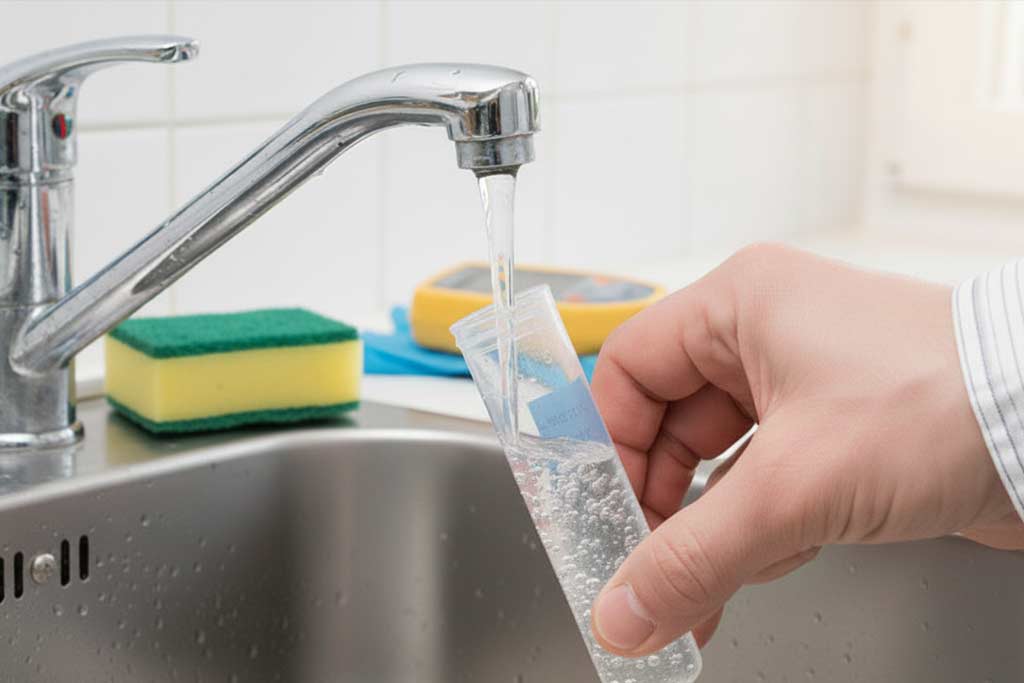
An arsenic test requires a water sample collected at the tap and submitted to a certified laboratory for specific arsenic analysis — must be explicitly requested, not part of any standard panel. A comprehensive well water baseline for a Summit-area home should include arsenic alongside bacteria, nitrates, pH, hardness, iron, PFAS, and radon in water. Our professional water testing page covers what a full assessment includes. If arsenic is found at levels warranting action, our arsenic removal page covers the treatment options. For the broader water quality picture in Summit, our Summit water testing page covers the full range of local concerns. Our full New Jersey service area covers communities statewide.
Frequently Asked Questions — Arsenic in Drinking Water in Summit, NJ
Is arsenic a concern for Summit private well owners?
Yes — at a moderate level relative to northern New Jersey’s highest-risk counties. Union County’s transitional geological position means naturally occurring arsenic is present in groundwater at concentrations that warrant testing as part of any comprehensive well baseline. Individual well concentrations vary significantly within the same geological zone, which is why testing a specific well is more informative than a regional comparison.
How does arsenic risk in Summit compare to Morristown?
Morris County’s crystalline bedrock geology produces higher naturally occurring arsenic in groundwater than Union County’s transitional geology. Morristown private well owners are in a higher baseline risk zone for arsenic than Summit private well owners. Both deserve to test — the difference is in the baseline probability, not in whether the question is worth answering.
Can I detect arsenic without laboratory testing?
No. Arsenic at health-relevant concentrations has no taste, no smell, and no visual indicator. Laboratory testing specifically ordered for arsenic is the only reliable detection method. Home test strips do not provide the accuracy of certified laboratory analysis at drinking water action levels.
Is arsenic testing included in a standard water quality panel?
No. It must be explicitly requested. Standard panels covering bacteria, hardness, PFAS, lead, and other contaminants do not include arsenic unless specifically ordered.
How quickly can testing be scheduled?
We typically schedule within a few days. Sample collection takes under an hour at your home, and laboratory results return within one to two weeks.
Find Out Whether Arsenic Is in Your Summit Home’s Water
If you’re on a private well in Union County and haven’t specifically tested for arsenic — this is a straightforward question that deserves a direct answer. We serve Summit and all of Union County. Call us at (732) 357-1988 or reach out online.