Clifton Draws From the Passaic River. The Taste at Your Tap Reflects More Than Just What the Treatment Plant Does.
Clifton’s water comes from the Passaic Valley Water Commission — a treated municipal supply drawing from the Passaic River, one of New Jersey’s most organically and chemically complex surface water sources. The PVWC treats to regulatory compliance. What arrives at a specific Clifton tap — after traveling through aging distribution infrastructure and the interior plumbing of homes that frequently predate modern materials standards — is a more layered question. Chloramine chemistry, disinfection byproducts from the Passaic River’s high organic load, lead from older interior plumbing, and seasonal source water variation all contribute to the taste and smell profile Clifton homeowners experience. Professional water testing in Clifton identifies which of these is driving the specific symptom at your address.
Chloramines and the Passaic River’s Organic Load
The Passaic Valley Water Commission uses chloramine disinfection — a chlorine-ammonia compound that maintains its effectiveness through long distribution networks. The Passaic River carries a high organic load from industrial and natural watershed inputs, and chloramine reacting with that organic material during distribution produces disinfection byproducts at concentrations that tend to be more noticeable than in groundwater-sourced systems. Trihalomethanes and haloacetic acids form as the chemistry proceeds — regulated but contributing to the flat, medicinal, or chemical quality Clifton homeowners notice in their tap water.
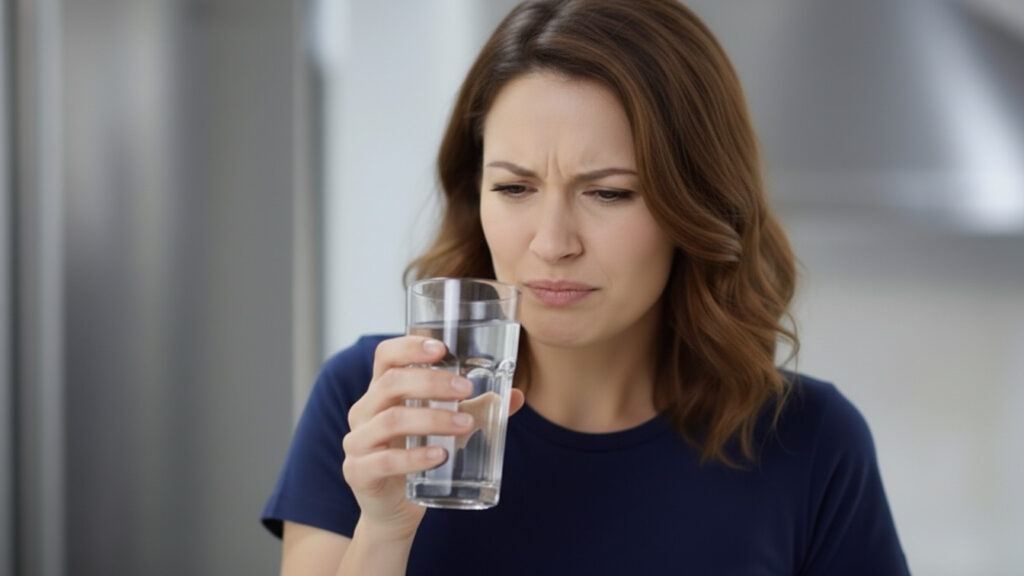
What homeowners notice: a bleach-like smell from the faucet, a chemical taste in drinking water and coffee, and sometimes mild skin or eye sensitivity in the shower. These are within the EPA’s drinking water standards — but the taste of surface water treated with chloramine, particularly from an organically loaded river source, is more pronounced than many Clifton homeowners would choose if given the option. Carbon-based filtration at the kitchen tap is the most direct and effective solution.
Lead From Clifton’s Older Housing Stock
Clifton has a significant inventory of pre-war and postwar homes — dense residential neighborhoods where mid-century construction with lead solder at interior pipe joints is common. The PVWC’s treated water arrives at Clifton homes lead-free. What happens inside the plumbing of a specific older Clifton home before the water reaches the glass is a property-specific question the distribution system can’t answer.
What homeowners notice: a metallic or astringent taste in the first glass drawn in the morning, improving significantly after running the tap for thirty seconds to a minute. This first-draw metallic taste pattern specifically indicates interior plumbing as the source. A tap-level water test at the kitchen faucet determines whether and how much lead is entering the water from the home’s specific plumbing — which the utility’s annual report cannot tell you.
Seasonal Variation — The Passaic River Through the Year
The Passaic River’s water quality changes with the seasons — spring runoff, summer algae growth in reservoir and river systems, fall leaf decomposition all affect the organic content of source water and require treatment adjustments that can temporarily affect the taste and odor profile at Clifton taps. An earthy or musty quality in spring and fall is characteristic of Passaic River supply and typically resolves as the season changes. The CDC’s drinking water resources cover when taste and odor changes warrant further investigation.
Hydrogen Sulfide — The Hot Water Smell That Isn’t a Supply Problem
When Clifton homeowners report a rotten egg smell specifically in hot water — and cold water at the same tap smells fine — the source is almost always the water heater rather than the municipal supply. Sulfur-reducing bacteria reacting with the magnesium anode rod in older water heaters produce hydrogen sulfide gas in the tank. Replacing the anode rod with a zinc or aluminum alternative typically resolves the smell without any supply-side treatment.
What Your Symptom Is Likely Telling You
| Symptom | Likely Cause | What It Means |
|---|---|---|
| Chemical or bleach smell/taste | Chloramine (PVWC disinfection) | Passaic River surface water chemistry; carbon filtration helps |
| Flat, medicinal coffee taste | Chloramine byproducts | High organic load in Passaic source; point-of-use filtration |
| Metallic taste, worse in morning | Lead solder in older interior plumbing | Property-specific; tap test confirms source and level |
| Rotten egg smell — hot water only | Water heater anode rod reaction | Tank-specific issue; anode replacement usually resolves it |
| Earthy smell — spring or fall | Passaic River seasonal organic inputs | Expected seasonal variation; persistent cases warrant testing |
| Stronger chemical smell than usual | PVWC adjusting treatment for source water changes | Typically temporary; carbon filtration buffers this variation |
Finding the Right Solution
Water testing in Clifton identifies what’s actually driving the taste or smell at your tap. For chloramine and byproducts, whole-home carbon water filtration or an under-sink filter addresses it effectively. For metallic taste from aging interior plumbing, reverse osmosis at the kitchen sink provides the highest level of drinking water purification including metal reduction. We serve Clifton and Passaic County, including Paterson, Passaic, Nutley, and Bloomfield. Our full New Jersey service area covers communities statewide. Additional context is available through our bad tasting water and smelly water resources. The NJ DEP Water Supply program provides state-level context. Call us at (732) 357-1988 or reach out online.
Frequently Asked Questions — Bad Tasting or Smelly Water in Clifton, NJ
Why does Clifton’s water have a stronger chemical smell than some neighboring towns?
The Passaic River carries a higher organic load than groundwater-sourced supplies. When chloramine reacts with that organic material during distribution, it produces disinfection byproducts at concentrations that are more noticeable than in lower-organic-load water systems. This is a characteristic of treating a surface water source with a complex organic profile — not a treatment failure.
Should I be concerned about lead in my older Clifton home’s tap water?
If your home was built before 1986, lead solder at interior pipe joints is common — standard construction practice of that era. The PVWC supply is lead-free. The first-draw metallic taste pattern in the morning is a specific indicator that interior plumbing may be contributing lead. A tap-level water test at the kitchen faucet gives you a specific answer for your address.
The chemical smell from my Clifton water is stronger in summer — why?
Summer water temperatures warm the distribution water, accelerating the rate of chloramine byproduct formation and increasing the volatility of those compounds at the tap. Treatment adjustments may also occur as the PVWC responds to seasonal source water quality changes. Carbon filtration at the kitchen tap buffers this seasonal variation significantly.
My Clifton hot water smells like rotten eggs but cold water is fine — is this a plumbing issue?
Yes — almost certainly. Hot-water-only sulfur smell indicates a water heater issue rather than a supply problem. Sulfur-reducing bacteria reacting with the tank’s magnesium anode rod is the standard explanation. This doesn’t require whole-home treatment — just attention to the water heater itself.