Short Hills Homes Are Maintained to an Exacting Standard. The Water Coming Out of the Taps Often Isn’t.
Short Hills is a community where quality is taken seriously at every level of the home — the systems, the finishes, the details. Water quality at the tap tends to be the gap. Essex County’s municipal supply delivers chloramine-disinfected water with a chemical taste profile to every home on the network. Short Hills’ substantial inventory of mid-century homes — ranches, colonials, and splits built before 1986 — commonly has lead solder at interior pipe joints that contributes to first-draw metallic taste. And seasonal source water variation from the Essex County system produces occasional earthy or taste-profile changes that surprise homeowners who expect consistency. Understanding which of these is driving the specific symptom at your tap is the starting point. Professional water testing in Short Hills moves you from symptom to specific cause to the right solution.
Chloramines — The Chemical Taste From Essex County’s Municipal Supply
Short Hills is part of Millburn Township, served by the Essex County municipal water system — treated water that uses chloramine as its primary disinfectant. Chloramine is a chlorine-ammonia compound that persists through the distribution network from the treatment plant to every tap it serves. Its stability is what makes it effective across a large distribution system; it’s also what produces the persistent chemical or bleach-like taste and smell that Short Hills homeowners notice, particularly in cold water first thing in the morning.
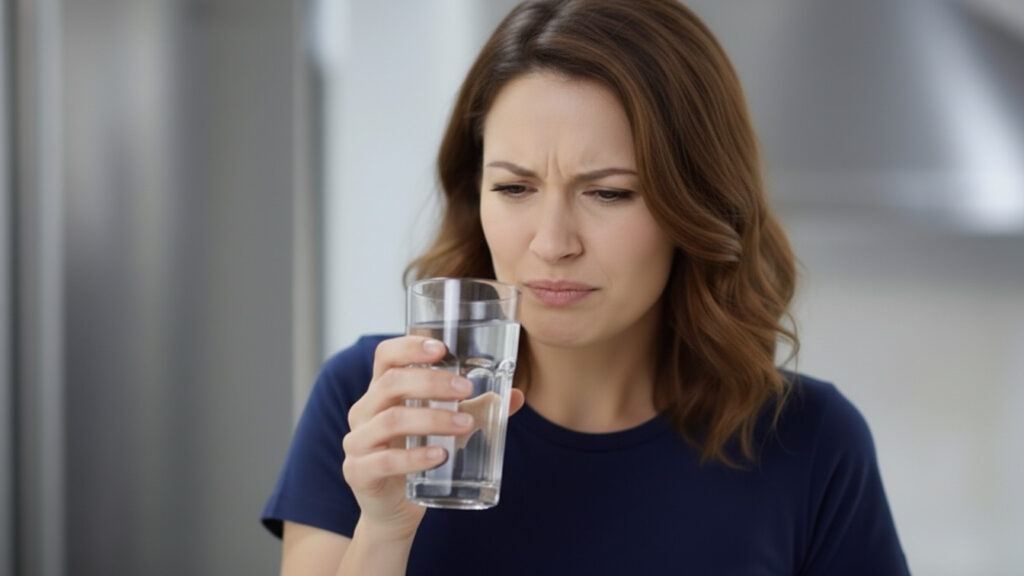
What homeowners notice: a pool-like or bleach smell from the faucet, a chemical quality in drinking water and coffee, and sometimes mild skin sensitivity after extended shower exposure. This is within the EPA’s drinking water standards — but the taste of chloramine-treated water is genuinely off-putting to many Short Hills homeowners who expect better from their tap. Carbon-based filtration at the kitchen tap removes chloramine and its byproducts effectively. Chloramine also produces trihalomethanes and haloacetic acid byproducts as it reacts with organic material during distribution — regulated but contributing to the taste profile.
Lead and Metallic Taste in Short Hills’ Mid-Century Homes
Short Hills’ mid-century residential inventory — the homes that define the community’s character and support its property values — was built largely between the 1950s and the mid-1980s, predominantly before lead-free solder requirements were adopted in 1986. Lead solder at interior pipe joints is common in these homes. The Essex County municipal supply arrives at Short Hills homes lead-free. What happens inside the plumbing of a specific older home before the water reaches the glass is a property-specific question.
What homeowners notice: a metallic or astringent taste in the first glass drawn in the morning, improving significantly after running the tap for thirty seconds to a minute. This specific first-draw pattern is the diagnostic signature of interior plumbing as the metallic taste source — water sitting overnight in contact with older pipe materials. A tap-level water test at the kitchen faucet answers this directly. The utility’s annual report cannot tell you what your home’s specific plumbing contributes to the water between the distribution main and your glass. The CDC’s drinking water resources cover what these patterns indicate.
Seasonal Source Water Variation
Essex County’s municipal supply is affected by seasonal source water quality changes — spring runoff introducing organic material from vegetation and soil, fall leaf decomposition affecting reservoir water quality, summer conditions favoring algae growth. Treatment adjusts in response, and those adjustments can produce temporary taste and odor changes at Short Hills taps — an earthy or musty quality in spring and fall that’s characteristic of surface water treatment and typically resolves as the season progresses. Persistent earthy or musty taste at any time of year warrants testing to rule out specific bacterial or organic causes beyond normal seasonal variation.
Hydrogen Sulfide — The Hot Water Odor That Isn’t the Supply
Short Hills is on the Essex County municipal water system, so groundwater hydrogen sulfide is not a concern. When the rotten egg smell appears specifically in hot water — and cold water at the same tap is fine — the water heater is almost always the source. Sulfur-reducing bacteria reacting with the water heater’s magnesium anode rod produce hydrogen sulfide in the hot water tank. Replacing the anode rod with a zinc or aluminum alternative typically resolves it without any supply-side treatment.
What Your Symptom Is Likely Telling You
| Symptom | Likely Cause | What It Means |
|---|---|---|
| Chemical or bleach smell/taste | Chloramine (Essex County municipal) | Normal treatment chemistry; carbon filtration resolves it |
| Metallic taste, worse in morning | Lead solder in mid-century interior plumbing | Property-specific; tap test confirms source and concentration |
| Earthy smell — spring or fall | Essex County source water seasonal variation | Expected seasonal change; persistent cases warrant testing |
| Rotten egg smell — hot water only | Water heater anode rod reaction | Tank-specific; anode replacement usually resolves it |
| Flat, chemical aftertaste in coffee | Chloramine disinfection byproducts | Point-of-use carbon filtration addresses this directly |
| Taste improvement after running the tap | Interior plumbing corrosion overnight | First-draw pattern; tap test confirms what the plumbing is contributing |
Finding the Right Solution
Water testing in Short Hills identifies what’s driving the taste or smell at your specific tap. For chloramine and Essex County byproducts, whole-home carbon water filtration or an under-sink carbon filter addresses the taste effectively. For metallic taste from mid-century interior plumbing, reverse osmosis at the kitchen sink provides the highest level of drinking water purification including lead and metal reduction. We serve Short Hills and all of Essex County, including Millburn, Livingston, Summit, and Maplewood. Our full New Jersey service area covers communities statewide. Additional context on specific water problems is available through our bad tasting water and smelly water resources. The NJ DEP Water Supply program provides state-level context on New Jersey drinking water quality. Call us at (732) 357-1988 or reach out online.
Frequently Asked Questions — Bad Tasting or Smelly Water in Short Hills, NJ
My Short Hills kitchen was recently renovated — why does the water still taste chemical?
Kitchen renovation replaces visible fixtures and supply lines within the kitchen. It doesn’t change the chloramine chemistry in the Essex County municipal supply that produces the chemical taste — that arrives from the distribution system regardless of what fixtures are installed. An under-sink carbon filter at the new kitchen tap removes chloramine and its byproducts effectively.
Should I test for lead even though my Short Hills home has been renovated?
Yes — if the home was built before 1986. Renovation addresses the visible plumbing — new fixtures, supply lines within the kitchen, the faucet itself. It typically doesn’t address the main service line, basement supply runs, or lateral connections upstream of the kitchen where lead solder may still be present. The metallic first-draw taste is the indicator. A tap-level water test at the kitchen faucet gives you a specific answer for your home’s current plumbing configuration.
Is the seasonal earthy taste in Short Hills water a health concern?
For most homeowners, seasonal earthy taste is an aesthetic concern rather than a health issue — it reflects organic inputs to Essex County’s source water and treatment adjustments in response. If the earthy taste is persistent across seasons rather than appearing seasonally, testing rules out specific bacterial or organic causes beyond routine variation.
Does reverse osmosis address both the chemical taste and the metallic taste in Short Hills water?
Yes — reverse osmosis at the kitchen tap removes chloramine and its byproducts (addressing the chemical taste) and removes dissolved metals from interior plumbing corrosion (addressing the metallic first-draw taste) simultaneously. For Short Hills homeowners whose tap water has both concerns, reverse osmosis is the single most effective solution for drinking and cooking water quality.