New to NJ Well Water? Here’s Why Your Water Tastes or Smells Different From City Water
If you’ve spent most of your life drinking municipal water and you’ve just moved into a home in New Jersey with a private well, the water is going to taste different. Maybe it tastes slightly metallic. Maybe there’s a faint earthy or musty quality to it. Maybe it smells faintly of sulfur when you run the hot tap, or has a mineral heaviness that city water never had. Maybe it just tastes flat, or slightly off, in a way you can’t quite put your finger on.
This is one of the most universal experiences of new well water homeowners, and it generates a lot of anxiety — particularly because the differences are real and noticeable, and because the natural next question is whether the water is safe to drink. The honest answer is that taste and smell differences between well water and municipal water are normal, expected, and in many cases not an indication of anything dangerous. But some taste and smell changes do signal water quality issues that warrant testing and treatment. Knowing the difference between the two is what this guide is about.
We’ll walk through the most common taste and smell complaints from new NJ well water homeowners, what causes each one, what it means for your health, and when to take action versus when to simply adjust to a different water profile than what you’re used to.
Why Well Water Tastes Different From Municipal Water in the First Place
Municipal water and private well water are fundamentally different products, even when they’re drawn from the same general aquifer system. Municipal water goes through treatment — typically filtration, disinfection with chlorine or chloramine, pH adjustment, and in some cases fluoridation and softening — before it reaches your tap. That treatment process standardizes the water, removes naturally occurring minerals and compounds, and produces a consistent, controlled product that tastes more or less the same from year to year.
Private well water is untreated groundwater, delivered directly from the aquifer to your tap. Everything dissolved in that groundwater — minerals, gases, trace organic compounds, the geological fingerprint of the rock and soil formations it passed through — comes with it. The water you’re tasting when you drink from a private well reflects the specific geology of your property and your aquifer, and that geology varies significantly across New Jersey.
Municipal water also typically contains residual chlorine from the disinfection process, which gives it a characteristic faint chemical taste that many people have been drinking their whole lives without noticing. When you switch to well water with no chlorine, the absence of that background note can itself make the water taste different — sometimes in a way that initially seems off but is actually the absence of the chlorine flavor you were used to.
Metallic Taste: Iron, Manganese, and Low pH
A metallic taste in well water is one of the most common complaints from new well water homeowners in New Jersey, and it has a few distinct causes worth distinguishing.
Iron is the most frequent culprit. New Jersey groundwater across a wide range of counties and aquifer systems contains naturally elevated iron levels, and even dissolved iron at concentrations just above the EPA’s 0.3 mg/L secondary standard produces a noticeable metallic taste. Iron-flavored water is particularly pronounced in cold drinking water and in beverages like coffee and tea, where the iron compounds interact with the beverage’s natural compounds. Homes in Toms River, Brick, Howell, Freehold, and throughout Ocean and Monmouth counties frequently encounter iron-related metallic taste from the coastal plain aquifer, as do homeowners in many parts of Somerset, Hunterdon, and Morris counties drawing from bedrock wells.
Manganese produces a similar metallic or slightly bitter taste at elevated concentrations and often accompanies iron in NJ well water. As we covered in our post on brown and orange well water in New Jersey, manganese is both a taste and aesthetic issue and — at higher concentrations — a genuine health concern, particularly for infants and young children. If the metallic taste in your well water is accompanied by dark staining on fixtures, manganese is likely part of the picture.
Low pH — acidic water — can also produce a metallic taste, and it can do so even without elevated iron or manganese in the source water, by leaching copper from household plumbing. Water with a pH below about 6.8 is corrosive to copper pipes and brass fixtures, and the copper it dissolves produces a distinctive metallic taste. A blue-green staining on sinks and fixtures alongside a metallic taste is a classic sign of copper leaching from corrosive water. This is worth taking seriously both for the taste issue and because elevated copper in drinking water has health implications at higher concentrations.
Sulfur or Rotten Egg Smell: Hydrogen Sulfide
A sulfur smell — the rotten egg odor — in well water is caused by hydrogen sulfide gas, and it’s one of the most immediately noticeable and objectionable water quality issues new well water homeowners encounter. It’s also one of the most treatable. The smell can range from barely detectable to strongly unpleasant, and it can be present in cold water, hot water, or both depending on the source.
Naturally occurring hydrogen sulfide dissolved in groundwater from sulfur-bearing geological formations is the most common cause in NJ, and it produces a consistent sulfur smell every time water is used. Sulfur bacteria in the well system produce a more variable, intermittent odor and often create a slimy residue inside the toilet tank. The anode rod in the water heater reacting with certain water chemistries produces a sulfur smell specifically in hot water only. Each cause has a different treatment approach.
We covered the causes, diagnosis, and treatment of rotten egg smell in NJ well water in detail in our dedicated post on what that rotten egg smell in your NJ home’s water actually means. If hydrogen sulfide odor is your primary water quality concern, that guide walks through the full diagnostic and treatment process.
Earthy, Musty, or Dirt-Like Taste and Smell
An earthy, musty, or soil-like taste and smell in well water is less alarming than sulfur but equally noticeable to homeowners accustomed to treated municipal water. This taste profile is most commonly caused by geosmin and 2-methylisoborneol (MIB) — organic compounds produced by certain bacteria and blue-green algae in soil and groundwater. These compounds are detectable by the human nose and palate at extraordinarily low concentrations — parts per trillion — which means even a tiny amount produces a noticeable earthy flavor.
Geosmin and MIB are not considered health hazards at the concentrations found in drinking water. They’re the same compounds responsible for the characteristic smell of rain on dry soil — petrichor — and for the earthiness of certain vegetables and mushrooms. But in drinking water, the flavor is usually unwelcome. Granular activated carbon (GAC) filtration is highly effective at removing geosmin and MIB and is the standard treatment for earthy or musty taste and odor problems in well water.
Tannins — organic compounds leached from decaying vegetation and organic matter in soil — can also produce an earthy or slightly woody taste in well water, often accompanied by a yellowish-brown color. Tannins are more common in shallow wells drawing from the water table in areas with high organic content in the soil, and are particularly prevalent in parts of southern New Jersey including Burlington, Ocean, and Atlantic counties where the coastal plain geology includes significant organic deposits. A tannin-specific anion exchange resin filter addresses this issue effectively.
Chlorine Taste or Chemical Smell
A chlorine taste or chemical smell in private well water is unusual and warrants investigation, because unlike municipal water, private wells are not chlorinated as part of normal operation. If your well water smells or tastes of chlorine, there are a few possible explanations worth considering.
The most common is that the previous owners had a chlorine injection system installed — either to address bacterial contamination or as part of an iron and sulfur treatment system — and the system is still operating. Check for a chemical feed pump near the pressure tank. If one is present, the chlorine taste is coming from the treatment system, and you’ll want to understand what it’s treating for and whether it’s still needed based on your own water test results.
A recent shock chlorination of the well — a treatment sometimes performed before a home sale to address bacterial contamination — can leave residual chlorine taste that gradually clears as the treated water is flushed through the system. If the taste appeared immediately after moving in and is gradually diminishing, this is the likely explanation.
In rare cases, a strong chemical smell in well water can indicate VOC contamination from industrial sources — solvents, fuel compounds, or other chemicals that have entered the groundwater. VOC contamination tends to produce a more complex chemical or solvent-like smell rather than a simple chlorine note, and it’s worth testing for VOCs if the chemical smell is strong, persistent, and doesn’t resemble chlorine specifically. For new homeowners near former industrial sites or underground storage tanks in communities across Morris, Middlesex, Union, or Essex counties, VOC testing is a standard recommendation regardless of whether you notice anything in the taste or smell.
Salty or Brackish Taste
A salty taste in well water is less common in most of New Jersey but deserves mention for homeowners in specific areas. High sodium or chloride in groundwater can produce a distinctly salty flavor, and it occurs naturally in coastal areas where saltwater intrusion into the freshwater aquifer is a concern — parts of Cape May, Atlantic, and Ocean counties along the Jersey Shore, and particularly on barrier islands and near tidal zones, can have saltwater intrusion issues that affect well water quality.
Elevated road salt application over many decades can also contribute chloride to shallow groundwater in heavily traveled corridors, and this is an increasingly documented issue in parts of northern New Jersey. A salty taste in well water should prompt testing for sodium and chloride levels. The EPA’s secondary standard for chloride is 250 mg/L and for sodium there is a guideline of 20 mg/L for people on sodium-restricted diets. Reverse osmosis is the most effective treatment for elevated sodium and chloride in drinking water.
An improperly calibrated water softener can also introduce excess sodium into the water — softened water contains sodium in proportion to the hardness minerals that were removed, and a softener regenerating too frequently or set to a hardness level higher than your actual water hardness will add more sodium than necessary. If you moved into a home with a pre-existing softener and the water tastes noticeably salty, checking the softener’s hardness setting and regeneration frequency is a good first step. Our post on hard water vs. soft water in New Jersey covers water softener operation and calibration in more detail.
Flat or Tasteless Water
Some new well water homeowners report the opposite of mineral-heavy water — water that tastes unusually flat, bland, or almost empty compared to the municipal water they’re accustomed to. This is typically a sign of very low total dissolved solids (TDS) — water that has very few dissolved minerals. While not a health concern, very low TDS water can taste flat because the mineral content that gives water its characteristic flavor profile is absent.
This is occasionally a sign that a reverse osmosis system or aggressive carbon filtration is stripping nearly all dissolved content from the water. If a treatment system is installed and the water tastes noticeably flat, checking whether the system is over-treating for your actual water chemistry — or whether a remineralization stage might improve the palatability — is worth discussing with a water treatment professional.
When Taste and Smell Are Warning Signs vs. Normal Adjustment
This is the core question for new well water homeowners, and it deserves a direct answer. Some taste and smell differences between well water and municipal water are normal, expected, and not indicative of health-relevant contamination. A faint mineral taste from calcium and magnesium hardness is not dangerous. A very mild earthy note from naturally occurring organic compounds in the soil is not dangerous. The absence of chlorine flavor after a lifetime of municipal water is not dangerous.
But some taste and smell changes are signals that require testing and potentially treatment. A strong metallic taste warrants testing for iron, manganese, copper, and pH. A rotten egg smell warrants testing for hydrogen sulfide and sulfur bacteria. A chemical or solvent smell warrants testing for VOCs. A salty taste warrants testing for sodium, chloride, and possible saltwater intrusion. And any taste or smell change that appears suddenly in water that was previously normal warrants immediate testing for bacteria and a broader panel to identify what’s changed.
The most important thing to understand is that taste and smell are incomplete indicators of water quality — and their absence is not a guarantee of safety. Arsenic, nitrates, PFAS, radon, and many other serious well water contaminants are completely tasteless and odorless. A well water that tastes and smells perfectly fine can still contain contaminants at levels that pose long-term health risks. This is the fundamental reason why comprehensive water testing is non-negotiable for private well owners, regardless of whether the water seems fine to the senses.
As we covered in our post on what your NJ home inspection doesn’t tell you about water quality, the contaminants most likely to be missed during the home purchase process are precisely those that give no sensory signal. A comprehensive water test from a state-certified laboratory is the only way to know what’s actually in your well water.
What to Do About Taste and Smell Issues in Your NJ Well Water
The path from identifying a taste or smell problem to resolving it runs through a water test — every time. The specific treatment for metallic taste caused by iron is different from the treatment for metallic taste caused by low pH and copper leaching. The treatment for sulfur smell from dissolved hydrogen sulfide is different from the treatment for sulfur smell from iron bacteria. Installing the wrong system wastes money and doesn’t fix the problem.
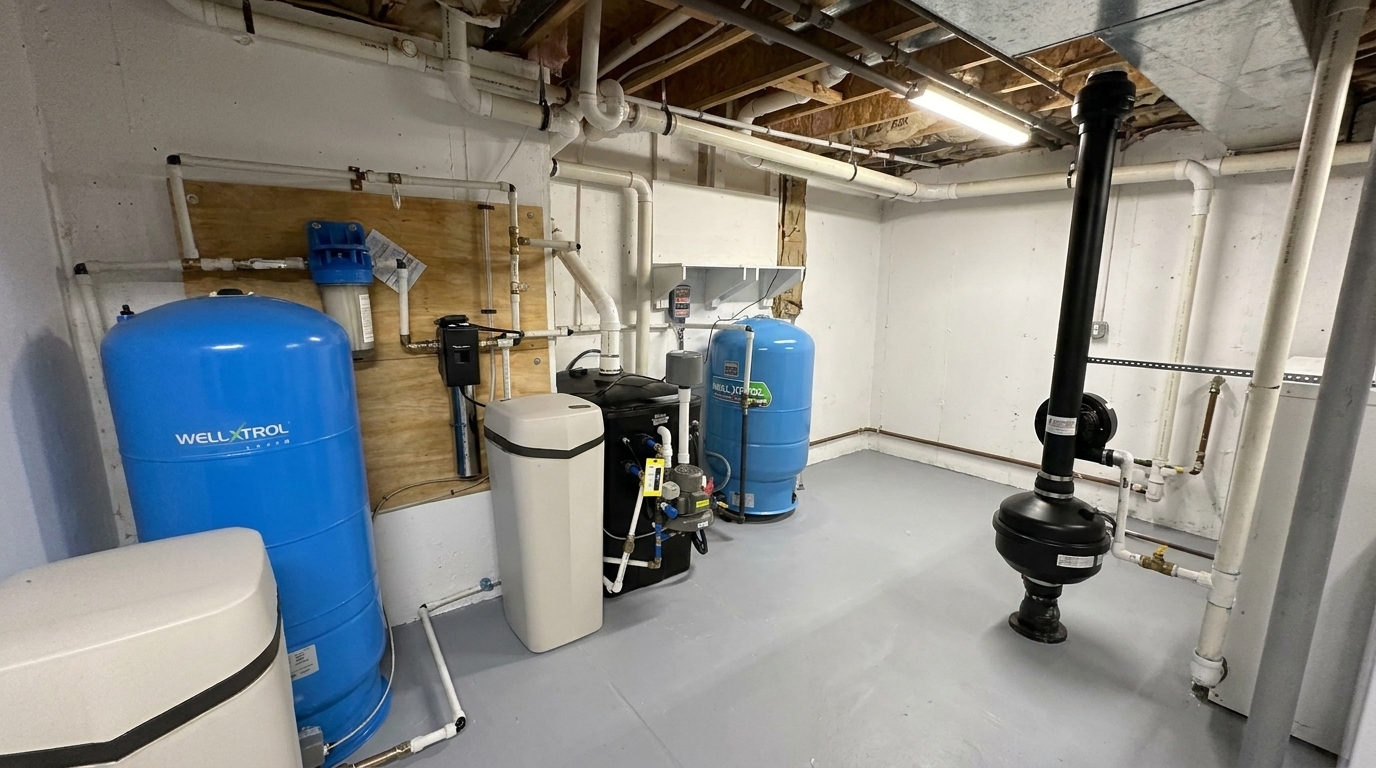
Our water testing service provides the comprehensive panel needed to identify what’s actually causing your taste and smell concerns, including all the parameters relevant to NJ well water quality for your specific region. Once the test results are in hand, our whole-house water filtration and bad tasting water treatment options address the confirmed causes with the right technology — whether that’s iron filtration, carbon treatment, pH neutralization, softening, UV disinfection, or a combination approach for more complex water chemistry.
If you’ve just moved into a home with a private well in New Jersey and you’re experiencing water that tastes or smells noticeably different from what you’re used to — and you want to know whether it’s a normal adjustment or a signal that something needs attention — our checklist for new NJ well water homeowners at the 30-day water safety guide walks through the full first-month testing and assessment process.
Your Water Should Taste Right — and Be Safe
Taste and smell are the first things you notice about your well water, and they matter. Water that tastes off is water you won’t want to drink — and staying properly hydrated with water you avoid is its own problem. But beyond the quality-of-life dimension, taste and smell complaints are often the entry point into a more comprehensive water quality conversation that uncovers issues worth addressing for health reasons, not just palatability.
At Jersey Radon, we help new homeowners across New Jersey — from Toms River and Howell to Flemington, Hackettstown, Parsippany, Somerville, and communities throughout the state — understand what’s in their well water and install the right treatment to make it both safe and enjoyable to drink. If your new NJ home’s water has a taste or smell that’s been bothering you since you moved in, reach out to our team for a free consultation. We’ll help you figure out what’s causing it and what will fix it.
