The Complete NJ New Homeowner’s Guide to Well Water Safety: Everything in One Place
If you’ve recently moved into a home in New Jersey with a private well, you’ve taken on a responsibility that comes with no instruction manual and no government oversight. Unlike municipal water customers, private well owners in New Jersey are entirely on their own when it comes to monitoring, testing, and treating their drinking water. The state doesn’t test your well. Your home inspector almost certainly didn’t test it comprehensively. And the previous owners may not have tested it in years — or ever.
Over the past several months, we’ve published a series of articles specifically for new NJ homeowners navigating private well water for the first time. Each article addresses a specific contaminant, concern, or water quality question in depth. This guide pulls everything together in one place — a master reference you can bookmark, share, and return to as your understanding of your well water deepens and as questions come up over the first year of ownership.
Whether you’re reading this the week you moved in or six months down the road, the framework is the same: test first, understand what you have, treat what needs treatment, and monitor consistently going forward. Everything else in this guide flows from that foundation.
Start Here: Your First 30 Days
The most important window for new well water homeowners is the first month of occupancy. This is when you establish your baseline — the documented picture of your water quality that everything else is measured against. Before you know what treatment you need, before you can evaluate whether inherited equipment is working, before you can make any informed decisions about your water, you need data. And data comes from testing.
Our complete first-month framework — locating and inspecting your well, noting sensory observations, ordering a comprehensive water test, testing for air radon separately, reviewing results, checking existing equipment, and setting your ongoing testing schedule — is laid out step by step in our guide on the 30-day water safety checklist for new NJ homeowners. If you haven’t read it yet, start there. It’s the foundation everything else builds on.
The Gap Your Home Inspection Left Behind
One of the most important things to understand as a new well water homeowner in New Jersey is what the home purchase process did and did not tell you about your water. A standard home inspection is a visual assessment — it doesn’t test water quality. The lender-required water test, if one was conducted, almost certainly covered only bacteria and nitrates — two parameters out of the dozens that matter for NJ well water.
Arsenic, PFAS, radon in water, volatile organic compounds, lead, iron, manganese, hardness, pH, uranium — none of these are included in a standard closing water test. You may have received a clean bill of health on two parameters and walked away from closing thinking your water was fully assessed. It wasn’t. Our post on what your NJ home inspection doesn’t tell you about water quality covers exactly what was and wasn’t tested, what the most significant gaps are, and why a comprehensive post-purchase test is essential for any new NJ well water homeowner regardless of what the closing paperwork shows.
Understanding New Jersey’s Specific Well Water Risks
New Jersey is not a generic well water state. Its combination of complex geology, dense industrial history, intensive agriculture, military installations, and high population density creates a groundwater quality landscape that differs meaningfully from most other states. The contaminants most relevant to NJ well water homeowners aren’t the same as those in Iowa or Montana. Understanding the NJ-specific risk profile helps you prioritize your testing and understand why certain parameters matter more depending on where in the state you live.
Here is a county-by-county summary of the primary well water concerns by region:
In the Highlands region — Morris, Sussex, Warren, and Passaic counties, with parts of Bergen and Essex — the crystalline bedrock geology produces naturally elevated arsenic, radon in both water and air, uranium, and manganese. Homeowners in Hackettstown, Washington Township, Chester, Mendham, Long Valley, Wharton, Rockaway, and Dover should treat arsenic and radon as priority testing parameters alongside the standard panel.
In the Piedmont region — Somerset, Hunterdon, parts of Morris and Middlesex — the Brunswick shale and related Triassic sedimentary formations produce elevated arsenic and iron in many well water supplies. Homeowners in Flemington, Raritan, Somerville, Bernardsville, and Peapack-Gladstone are in classic Piedmont well water territory where a comprehensive metals panel is non-optional.
In the coastal plain region — Ocean, Monmouth, Burlington, Atlantic, Camden, Gloucester, Salem, Cumberland, and Cape May counties — the sandy, permeable aquifer system is highly vulnerable to nitrate contamination from agricultural runoff and septic systems, and iron and manganese levels are commonly elevated from the coastal plain sediments. Homeowners in Toms River, Brick, Howell, Freehold, Jackson, Vineland, and Bridgeton face a different contaminant profile than their counterparts in the north, with nitrates and iron/manganese as the dominant concerns alongside bacteria.
In areas near military installations, airports, and former industrial sites — parts of Burlington, Ocean, Monmouth, Gloucester, and Mercer counties in particular — PFAS contamination in groundwater is a documented and ongoing concern that requires a dedicated PFAS test separate from any standard water quality panel.
The Contaminants That Matter Most: A Summary Guide
Each of the major well water contaminants relevant to NJ homeowners has its own characteristics, health implications, testing requirements, and treatment approaches. Here is a summary of each, with links to our dedicated articles where you can go deeper on any specific concern.
PFAS (Forever Chemicals)
PFAS — per- and polyfluoroalkyl substances — are man-made chemicals used in industrial and consumer products since the 1940s. They don’t break down in the environment or in the human body, and New Jersey has some of the highest documented PFAS groundwater contamination in the country. Long-term exposure is linked to kidney and testicular cancer, thyroid disease, immune system suppression, and developmental issues in children. PFAS require a dedicated laboratory test using EPA Method 533 or 537.1 — they are not included in any standard water quality panel. New Jersey has established MCLs for PFOA, PFOS, and PFNA. Treatment options include reverse osmosis and granular activated carbon filtration. Our full guide on PFAS in New Jersey well water covers the complete picture for NJ homeowners.
Radon in Air
Radon is a radioactive gas that forms from the decay of uranium in soil and rock, seeps into homes through foundation cracks and gaps, and is the second leading cause of lung cancer in the United States. New Jersey has significant radon risk across many counties, particularly in the Highlands geology of the north and center. The EPA’s action level is 4 pCi/L. Testing uses a passive detector placed in the lowest livable level of the home. Treatment is sub-slab depressurization — an active mitigation system that draws radon from beneath the foundation and vents it outside. Winter testing gives the most conservative and useful result for new homeowners. Our post on why winter is the most important time to test for radon covers the seasonal dynamics and testing process in detail. For cost expectations, our guide on radon mitigation cost in New Jersey provides a complete breakdown of what NJ homeowners typically pay and what affects the price.
Radon in Water
Radon in well water is a separate issue from radon in air — and a separate test. Waterborne radon is released into indoor air when well water is used for showering, dishwashing, and other activities, contributing to total household radon exposure. The EPA’s guidance level for radon in private well water is 300 pCi/L. Treatment options include aeration systems and granular activated carbon filters. Our dedicated post on radon in water and air for NJ homeowners explains both exposure pathways, how they interact, and how each is tested and treated.
Arsenic
Arsenic is a naturally occurring contaminant in NJ groundwater, particularly in the Highlands and Piedmont regions. It’s a Group 1 human carcinogen linked to bladder, lung, and skin cancers with long-term exposure. The EPA’s MCL is 10 ppb. Arsenic is colorless, odorless, and tasteless — it gives no sensory signal. It is not included in standard closing water tests. Treatment options include adsorptive media filtration for whole-house treatment and reverse osmosis for point-of-use treatment. Our full guide on arsenic in NJ well water for new homeowners covers geology, health risks, testing, and treatment in detail.
Nitrates
Nitrates enter groundwater from agricultural fertilizer runoff, septic systems, and animal waste. They pose the greatest health risk to infants under six months of age, where they can cause methemoglobinemia — a potentially fatal condition that interferes with oxygen transport in the blood. The EPA’s MCL is 10 mg/L. Nitrates are tasteless and odorless. They are sometimes included in closing water tests but levels change seasonally and annual retesting is recommended. Treatment options include reverse osmosis for point-of-use treatment and ion exchange with anion resin for whole-house treatment. Boiling water does not remove nitrates and actually concentrates them. Our full guide on nitrates in NJ well water for new homeowners covers the risk areas, health implications, and treatment options.
Iron and Manganese
Iron and manganese are among the most common well water quality issues in New Jersey, causing orange and brown staining on fixtures, laundry, and appliances, metallic taste, and — in the case of manganese at elevated levels — potential neurological health effects with long-term exposure. Both are naturally occurring from NJ geology and are present at elevated levels across many aquifer systems statewide. Treatment options include oxidizing filtration, air injection systems, and chlorination followed by carbon filtration. Our full guide on brown and orange well water in New Jersey covers the causes, diagnosis, and treatment of iron and manganese problems.
Hydrogen Sulfide (Rotten Egg Smell)
Hydrogen sulfide produces the characteristic rotten egg smell in well water and is one of the most common water quality complaints from NJ well homeowners. It can originate from dissolved gas in the groundwater, sulfur bacteria in the well system, or a chemical reaction with the water heater anode rod. It’s not a serious health hazard at typical residential concentrations but indicates water chemistry worth investigating. Treatment options depend on the confirmed cause and include oxidizing filters, aeration, chlorination and carbon filtration, and UV disinfection for bacterial sources. Our full guide on what the rotten egg smell in your NJ well water means covers the diagnosis and treatment process.
Hard Water
Hard water — elevated calcium and magnesium — causes scale buildup on fixtures and appliances, reduces appliance efficiency and lifespan, leaves spots on glassware and dishes, and affects skin and hair. It’s extremely common in NJ well water across many counties and aquifer systems. It’s not a health hazard but has significant household impact. Treatment is an ion exchange water softener. Our full guide on hard water vs. soft water in New Jersey covers what hardness is, how to tell if you have it, and what treatment involves.
Taste and Smell Issues
New well water homeowners frequently notice that their water tastes or smells different from the municipal water they’re accustomed to. Some differences are normal and benign — the absence of chlorine, a faint mineral quality from hardness, a slight earthiness from organic compounds in the soil. Others — metallic taste from iron or low pH, sulfur smell from hydrogen sulfide, chemical odors from VOCs — signal issues that warrant testing and treatment. Our guide on why NJ well water tastes and smells different from city water walks through every major taste and smell complaint, what causes each one, and when it’s a warning sign versus a normal adjustment.
What a Comprehensive NJ Well Water Test Should Cover
Given everything covered in this series, here is the complete list of parameters a new NJ well water homeowner’s first comprehensive test should include. Not every parameter applies equally to every location — the priority parameters vary by region as described above — but this is the full picture of what matters for NJ private well water quality assessment.
For health-based parameters, your panel should include bacteria and E. coli, nitrates and nitrites, arsenic, lead, uranium, barium, chromium, selenium, cadmium, mercury, volatile organic compounds, and PFAS if you are in a documented risk area. For aesthetic and operational parameters, include pH, hardness, iron, manganese, hydrogen sulfide, total dissolved solids, sodium, chloride, and turbidity. For radon, test both air and water separately using the appropriate method for each.
Use a laboratory certified by the NJDEP for drinking water analysis. The NJDEP’s searchable list of certified labs is available at nj.gov. The EPA’s private well owner resource hub at epa.gov/privatewells provides additional guidance on what to test for and why that’s worth bookmarking as a reference.
Ongoing Testing: Your Annual and Biennial Schedule
Water quality testing is not a one-time event. Groundwater conditions change over time — seasonal variation in precipitation affects contaminant concentrations, changes in nearby land use introduce new contamination sources, aging well infrastructure can affect water chemistry, and naturally occurring contaminants like arsenic and radon can fluctuate. A testing schedule keeps you current and catches changes before they become long-term exposures.
The NJDEP recommends testing annually for bacteria and nitrates — the two parameters most susceptible to seasonal variation and the two most likely to indicate an immediate problem with the well’s physical integrity. A broader panel covering metals, VOCs, pH, hardness, iron, and manganese should be run every two to three years, or any time you notice a change in your water’s taste, color, or smell. PFAS, if tested and found below action levels initially, should be retested every three to five years given the persistence of these compounds and the possibility of new contamination sources. Air radon should be retested every two years or after any significant renovation affecting the foundation or lower levels of the home.
Retest immediately — regardless of your regular schedule — after any flooding near the well, sewage backup on the property, work done on the well or pressure system, or discovery of a nearby contamination source.
Treatment: Matching the Solution to the Problem
The single most important principle in well water treatment is this: test before you treat. Installing a water softener when you need an arsenic filter, or a carbon filter when PFAS requires reverse osmosis, wastes money and leaves the actual problem unaddressed. Every treatment decision should be based on confirmed water test results, not assumptions about what NJ well water typically contains or what the previous owners said they had.
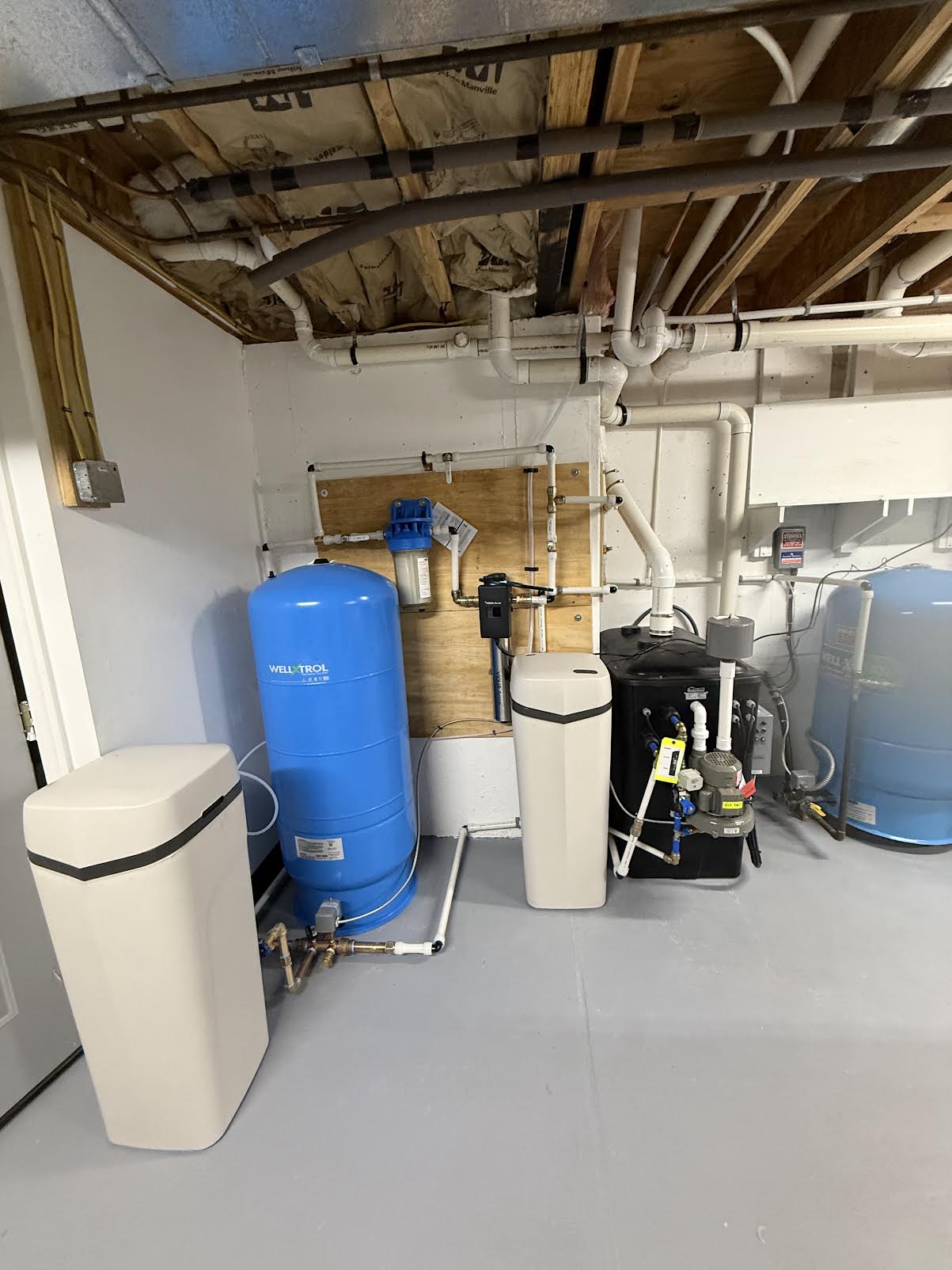
Our water treatment services cover the full range of solutions for NJ well water quality issues. Water testing provides the diagnostic foundation. Whole-house water filtration addresses iron, manganese, hydrogen sulfide, sediment, and other groundwater contaminants at the point of entry. Water purification systems including reverse osmosis and UV disinfection address health-based contaminants and biological concerns. Water softener installation and service addresses hardness. Our water problems page covers the full range of specific conditions we diagnose and treat for NJ homeowners. For radon in air, residential radon mitigation provides the complete sub-slab depressurization solution. For radon in water, waterborne radon treatment covers aeration and GAC systems for NJ well water applications.
A Note on Inherited Treatment Equipment
If your new NJ home came with water treatment equipment already installed — a softener, iron filter, UV system, reverse osmosis unit, or any combination — have it inspected and serviced before relying on it to protect your water quality. Equipment installed by previous owners may not be calibrated for your household’s water usage, may not be appropriate for your actual water chemistry as revealed by your own test results, and may not have been maintained on schedule. A water softener that hasn’t had its resin cleaned in five years, a UV system with an old bulb, or an RO unit with an expired membrane is not providing the protection you think it is. Verify before trusting.
You’re Not in This Alone
Private well ownership in New Jersey can feel like a lot of responsibility, and it is. But it’s manageable responsibility — the kind that a structured approach, comprehensive testing, and the right professional support makes entirely navigable. Thousands of NJ homeowners on private wells have established safe, clean, well-understood water supplies by following exactly the framework laid out in this series. You can too.
The articles in this series are designed to give you the knowledge to ask the right questions, understand your test results, evaluate your options, and make informed decisions about your water. They are not a substitute for professional assessment of your specific well, your specific water chemistry, and your specific household’s needs — but they give you the foundation to have that professional conversation from a position of understanding rather than uncertainty.
At Jersey Radon, we work with new homeowners across New Jersey — from Hackettstown, Chester, and Flemington in the Highlands and Piedmont to Toms River, Freehold, and Howell on the coastal plain, and everywhere in between — to test well water comprehensively, interpret results accurately, and install treatment systems that address what’s actually in the water. If you’ve just moved into a home with a private well in New Jersey and you want to start your well water ownership on the right foot, reach out to our team for a free consultation. We’re here to help you protect what matters most — the water your family drinks every day.
